
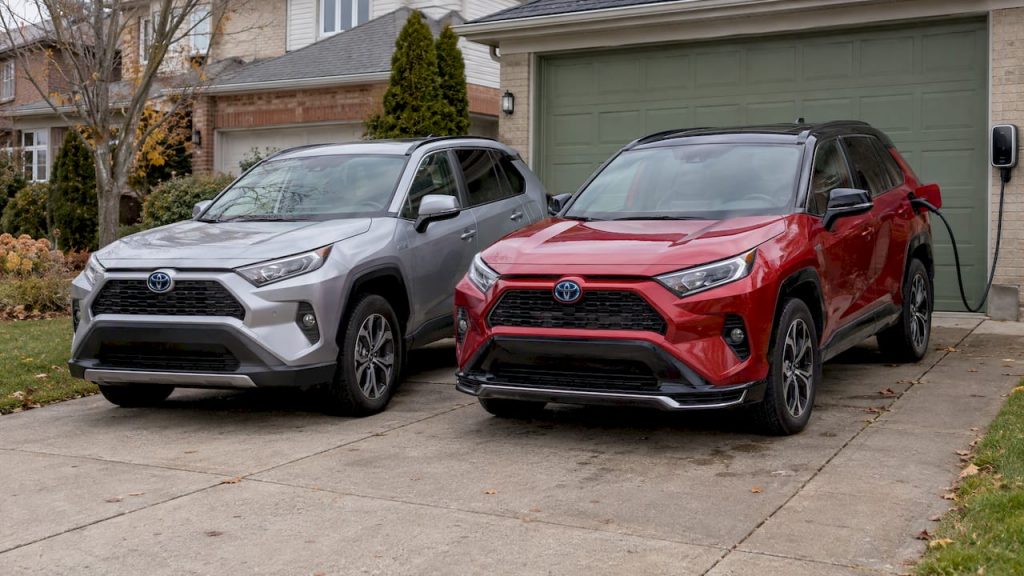
Hybrid or plug-in hybrid? Compare charging, electric range, winter performance, costs and 2026 Canadian incentives to see which one suits how you drive.
A conventional hybrid is the easy choice: it saves fuel without asking anything of you. A plug-in hybrid (PHEV) saves more, but only if you can plug it in and your daily drives are short enough to run on the battery. If you have a driveway or garage outlet and a commute under about 50 km, a plug-in hybrid can turn most of your weekday driving into electric driving. If you park on the street, or you mostly take long trips, a regular hybrid usually gives you more value with less fuss.
This guide walks through how the two differ, what charging really involves, how Canadian winters change the picture, what the numbers look like, and which incentives apply in 2026.
TL;DR
- A regular hybrid charges its own small battery while you drive and never needs a plug. A plug-in hybrid has a larger battery that you charge from an outlet, so it can drive on electricity alone for a while.
- Most plug-in hybrids cover roughly 20 to 80 km on electricity before the gas engine takes over, and that range shrinks in cold weather.
- The plug-in only pays off if you charge it regularly. A hybrid delivers its savings automatically.
- Federal incentives in 2026 are up to $2,500 for plug-in hybrids and none for regular hybrids. Provincial programs vary.
- Choose a plug-in if you can charge at home and drive short daily distances. Choose a regular hybrid if you can’t, or if you drive long distances most days.
Table of Contents
- What is the difference between a hybrid and a plug-in hybrid?
- How each one works day to day
- Charging a plug-in hybrid at home
- How far can a plug-in hybrid go on electricity?
- Winter driving in Canada
- Fuel and ownership costs
- Incentives in Canada
- Which one should you choose?
- Our perspective
- Have expertise to share?
- FAQ
- Sources
What is the difference between a hybrid and a plug-in hybrid?
Both pair a gasoline engine with an electric motor. The difference is the battery and how it gets its energy.
Natural Resources Canada (NRCan) explains in its 2026 Fuel Consumption Guide that a hybrid-electric vehicle charges its battery with electricity the vehicle generates itself and cannot be plugged in. The same guide says a typical hybrid offers fuel savings and CO2 reductions of 20 to 40% compared with gasoline-only vehicles.
A plug-in hybrid adds a bigger battery and a charging port. Toyota Canada describes the main difference as the size of the battery and how it is charged: a PHEV’s larger battery can be charged from an external power source, which lets it drive farther on electric power alone. It also notes that its own plug-in hybrids average an all-electric range of 64 to 89 km.
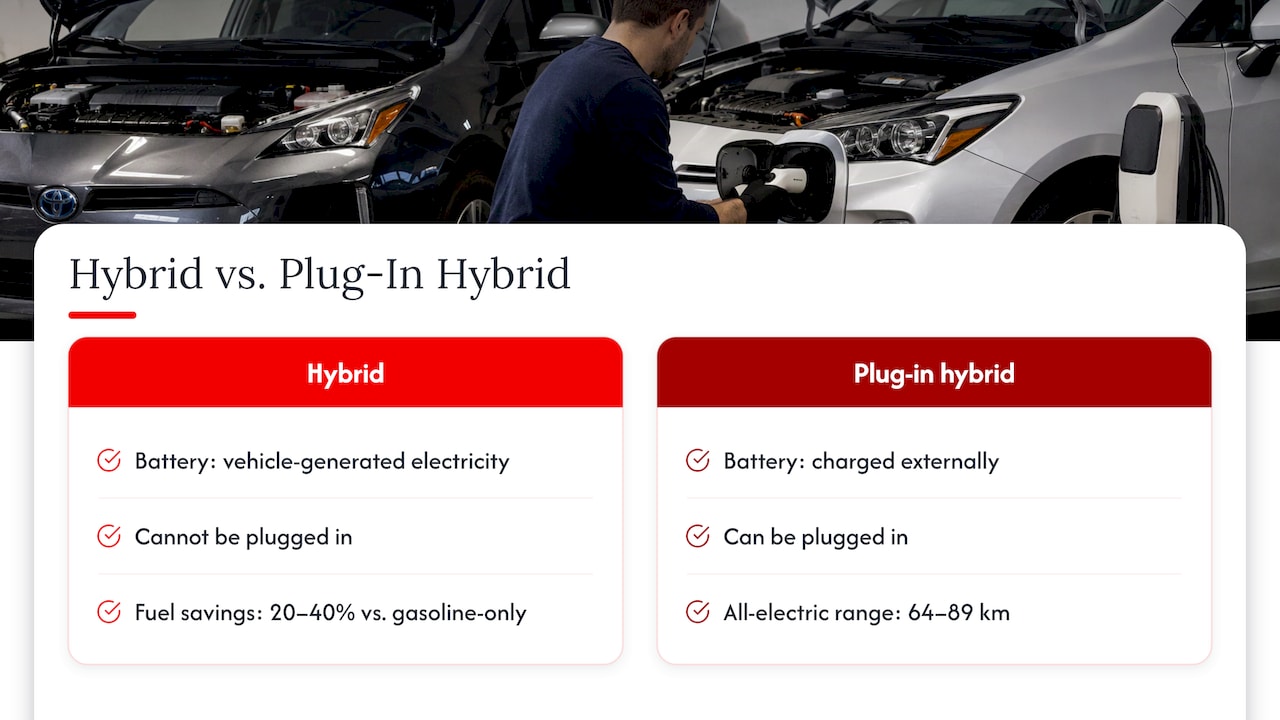
Think of it this way. A hybrid is a more efficient gas car. A plug-in hybrid is a part-time electric car with a gas engine as a backup, which is why people often call it a stepping stone toward a fully electric vehicle.
Quick comparison
| Hybrid (HEV) | Plug-in hybrid (PHEV) | |
|---|---|---|
| Plug required | No | Yes, to get the full benefit |
| Battery size | Small | Larger |
| Electric-only driving | Very short, low speed | Roughly 20 to 80 km |
| Fuel source | Gasoline only | Electricity first, then gasoline |
| Changes to your routine | None | Plug in when you park |
| Federal purchase incentive (2026) | None | Up to $2,500 |
| Best for | Anyone, especially drivers without home charging | Drivers with home or work charging and short daily trips |
How each one works day to day
With a regular hybrid, nothing changes. Toyota Canada says the powertrain works automatically, so you don’t need to change the way you drive or refuel. You fill up at the gas station, and the car recovers energy when you brake and when the engine has spare power.
A plug-in hybrid has two modes of living. When the battery has charge, it drives mostly or entirely on electricity: quiet, no tailpipe emissions in electric-only mode, as NRCan notes. When the battery is depleted, the U.S. National Highway Traffic Safety Administration says the engine assists in recharging the battery for continued driving, which mirrors how a strong hybrid operates. So an empty plug-in hybrid doesn’t strand you. It becomes a hybrid.
That last point is the one people miss. A plug-in hybrid isn’t a compromise between gas and electric. It’s both, and you decide the mix by how often you plug in.
Do plug-in hybrids charge while driving?
As described above, the engine helps keep the battery topped up once it has run down, but this is a way to keep the car running, not an efficient way to charge. The cheap electricity is the electricity from the wall. If you never plug in, you are paying to haul around a bigger battery.
Charging a plug-in hybrid at home
Charging is the part that decides whether a plug-in hybrid suits you, and it is simpler than most first-time buyers expect.
NRCan’s buying guide for electric vehicles says plug-in hybrids and battery-electric vehicles can charge from a station that uses standard 240-volt power, the kind used by stoves and clothes dryers in most homes. Most can also charge from an ordinary 110-volt outlet, though it takes significantly longer.
Here is what that looks like in hours:
- Level 1 (120 V household outlet): Mazda’s U.S. guidance puts typical PHEV charging at 5 to 6 hours. That is an overnight charge, enough for most commutes.
- Level 2 (240 V): The same source says one to two hours. RBC Royal Bank gives a similar 1 to 2 hours for a Level 2 charger.
- DC fast charging (Level 3): Most plug-in hybrids aren’t equipped for it, according to the Mazda guidance, and their small batteries don’t need it.
Because plug-in hybrid batteries are small compared with those in fully electric cars, a standard outlet is often enough. If you want to understand the levels in more depth, our guide to Level 1 vs. Level 2 charging covers how to check what your vehicle can accept.
RBC also reports that, as of March 1, 2024, Canada had over 27,000 public charging ports at more than 11,000 locations, and that many public stations are free while pay-per-use stations average around $2.50 per charge. For a plug-in hybrid, public charging is a bonus, not a necessity.
What about apartments and street parking?
If you can’t plug in where you park, a plug-in hybrid loses most of its advantage. You would be paying for the larger battery and mostly running the engine. That is the clearest situation where a regular hybrid is the better pick. A workplace charger can change this, so ask whether yours has one before you decide.
How far can a plug-in hybrid go on electricity?
Ranges vary by model, so treat any single number with care. Several Canadian sources give a range of figures:
- CAA-Quebec says PHEVs can drive 20 to 80 km in electric-only mode before switching to the combustion engine.
- RBC reports that by driving moderate distances, usually around 30 to 80 km, on battery alone, PHEVs use between 14 and 47 per cent less fuel than typical gas-powered cars and SUVs.
- Hydro-Quebec’s 2019 guide lists a 20 to 85 km range, depending on the model.
A practical way to use these numbers: compare the electric range of the model you like with your round-trip distance on a normal day. If your daily trip is 35 km and the car does 60 km in summer, you have comfortable headroom for winter too. If your daily trip is 70 km, you will be burning gas on most days.
The NRCan Fuel Consumption Guide lists official ratings for plug-in hybrids and conventional hybrids side by side, so you can compare models using the same test method.
Winter driving in Canada
Cold weather hits every vehicle, but it hits a plug-in hybrid’s electric range most visibly.
Hydro-Quebec’s guide says electric range can vary by 10% to 40% depending on weather, and that heating the cabin also draws on the battery reserve. CAA-Quebec lists limited electric range in winter among the drawbacks of plug-in hybrids.
Real-world testing shows what this looks like. In a long-term test of the 2021 Toyota RAV4 Prime, Driving.ca found that electric range changed dramatically from season to season: up to 72 km in summer, but an average of 50 km on frigid Toronto February mornings. Once the battery was depleted and the engine warm, highway economy ran around 5.0 to 6.0 L/100 km. Over 1,000 km of mixed driving, that vehicle averaged 3.2 L/100 km.
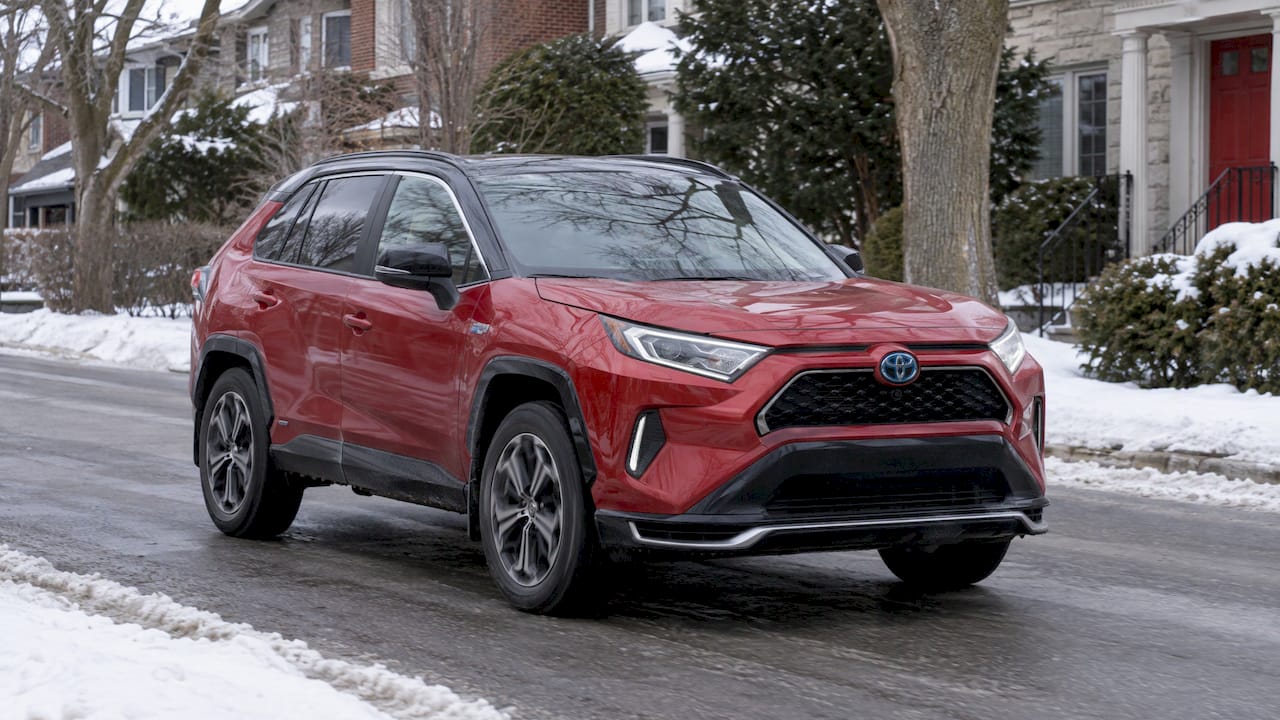
That is a useful illustration of a general point: plug-in hybrids deliver big savings when the electric range covers most of your driving, even in a Canadian winter. An older academic study of a converted Prius tested in Environment Canada’s cold chamber found fuel consumption rose sharply at sub-freezing temperatures while the engine and battery warmed up. Modern factory plug-in hybrids are built for this, but the lesson holds: short trips in deep cold use the most fuel per kilometre.
A few habits help in winter:
- Pre-heat while plugged in. Warming the cabin from the grid keeps battery energy for the road.
- Park in a garage if you can. A warmer battery gives more range.
- Plan for 10% to 40% less electric range when you estimate whether your commute works.
- Keep up with washing. Road salt is hard on any vehicle, and a guide to winter car washing frequency explains why waiting too long between washes can be a mistake.
A conventional hybrid is also affected by cold, but because it has no plug-in range to lose, there is no “drop” to notice. It simply uses a bit more fuel.
Fuel and ownership costs
The cost picture depends almost entirely on how you charge.
RBC reports that the average annual cost of electricity and fuel for a plug-in hybrid is around $700, while the average Canadian driving about 15,000 km spends around $2,000 a year on gas. Those are averages for drivers who plug in regularly, so your own total depends on your electricity rate and your mileage.
NRCan gives the per-kilometre comparison: electricity costs about 3 to 4 cents/km for a battery-electric vehicle at 15 cents/kWh, versus 11 to 12 cents/km for a typical four-cylinder gasoline vehicle at $1.50/L. A plug-in hybrid running in electric mode sits in the same low range as the electric figure, and when the engine runs it behaves like a hybrid.
A worked example
Suppose your round trip to work is 40 km, five days a week, and you have a Level 1 outlet in your driveway.
- You plug in every night. Each weekday trip runs mostly or entirely on electricity.
- On weekends you take a 250 km road trip. The first 40 to 60 km are electric, and the rest runs as a hybrid.
- Your fuel use falls well below that of a gas car, and you never worry about range.
Now suppose you park on the street and never plug in. The plug-in is now a hybrid that carries extra battery weight, and you paid a higher purchase price for the privilege. A regular hybrid would be the smarter buy for that driver.
The price premium
Plug-in hybrids typically cost more to buy than their regular hybrid siblings. One Canadian ownership analysis from RIDEZ, a car-buying platform, put the premium on a popular compact SUV pair at roughly $8,000 to $11,500. It also found that a plug-in rarely charged can cost more to run than the equivalent hybrid. Treat this as a rough illustration: the gap depends on the model, the year and any incentive. The takeaway is that the larger battery earns its keep only when you use it.
CAA-Quebec also reminds buyers that plug-in hybrids still need regular maintenance such as oil changes and air filters, since there is still an engine. A regular hybrid shares that need.
Incentives in Canada
Incentives are one of the few areas where plug-in hybrids have a clear edge, so check the rules before you buy.
Federal. The Electric Vehicle Affordability Program (EVAP) began on February 16, 2026, replacing the older iZEV program. According to Transport Canada, it offers up to $5,000 for battery-electric and fuel cell vehicles and up to $2,500 for plug-in hybrids, for transactions of $50,000 or less. The CAA EV Buyer’s Guide says the incentive window runs for eligible purchases and leases of 12 months or more through March 31, 2031, subject to funding availability. Regular hybrids don’t qualify.
Provincial. Programs differ by province and change often. The CAA guide notes that Quebec’s Roulez vert program reopened on April 1, 2025 with revised amounts and is scheduled to end on December 31, 2026, and that Manitoba offers up to $4,000 on new eligible EVs. CBC News reported in January 2025 that other provinces such as Ontario and Alberta did not offer rebates at that time. Always check your provincial government’s page for the current amounts and eligibility, since a plug-in hybrid may need a minimum electric range to qualify.
Amounts are scheduled to shrink in future years, so the incentive you see in 2026 is not guaranteed later.
If you’re weighing a fully electric car as well, our look at why electric vehicles are worth it covers the wider benefits.
Which one should you choose?
Use these questions in order.
- Can you plug in where you park overnight, or at work? If not, choose a regular hybrid.
- Is your typical daily round trip under the car’s electric range, including a winter allowance? If yes, a plug-in hybrid will do most of your driving on electricity. If no, you will mostly burn gas, and a hybrid is simpler.
- Do you take frequent long trips? Both handle them. A plug-in hybrid drives like a hybrid once the battery is empty.
- Will you actually remember to plug in? The savings depend on this habit.
- Do you qualify for an incentive? The federal amount of up to $2,500 and any provincial rebate can narrow the price gap.
| Your situation | Likely better fit |
|---|---|
| Condo or street parking, no charger | Hybrid |
| House with garage or driveway outlet, commute under 50 km | Plug-in hybrid |
| Long highway commute every day | Hybrid, or plug-in if you can charge at work |
| Want to ease into electric driving | Plug-in hybrid |
| Want zero routine changes | Hybrid |
| Quebec, B.C. or Manitoba resident with a rebate available | Plug-in hybrid worth a close look |
If you’re shopping used, browse a broad selection of hybrid vehicle listings to get a feel for the body styles and model types on offer.
Our perspective
We think the question “hybrid or plug-in” is really a question about your driveway and your habits. The technology is good either way. What decides the outcome is whether the car’s design matches the way you live.
When we research a topic like this, we start with the official numbers: the ratings from Natural Resources Canada, the incentive rules from Transport Canada, and guidance from motoring associations. Then we ask what a reader can actually do with them. A rated range is a promise made in good conditions. A Canadian winter, a cold garage and a long commute are the real test.
Our advice is to be honest about your week. If you can plug in every night, the plug-in hybrid rewards you with cheap, quiet daily driving and a gas engine for the occasional road trip. If you can’t, a regular hybrid will quietly save you fuel for years without asking for anything. Both are smart steps away from a conventional gas car, and either one beats staying put.
Alexander
Have expertise to share?
We publish guides on cars, technology, travel, home and money for Canadian readers. If you work in automotive or energy topics and want to reach them, we accept guest posts, and we offer banner placements for brands with something useful to show. See the details on our advertise with us page.
FAQ
What is the main difference between a hybrid and a plug-in hybrid?
A hybrid charges its small battery on its own and never needs a plug. A plug-in hybrid has a larger battery you charge from an outlet, so it can drive a meaningful distance on electricity alone. Once that battery is used up, a plug-in hybrid runs like a regular hybrid.
Is a plug-in hybrid better than a hybrid?
It depends on charging. If you can plug in regularly and your daily drives fit within the electric range, a plug-in hybrid can use far less fuel. If you can’t charge, a regular hybrid is simpler and usually costs less to buy.
How long does it take to charge a plug-in hybrid?
Mazda’s U.S. guidance gives about 5 to 6 hours on a standard 120-volt outlet and one to two hours on a 240-volt Level 2 charger. RBC also cites 1 to 2 hours on Level 2. Exact times depend on the vehicle’s battery size.
Do plug-in hybrids work well in Canadian winters?
They work well, but electric range drops. Hydro-Quebec says range can vary by 10% to 40% with the weather, and heating the cabin draws on the battery. Pre-heating while plugged in and parking indoors help. When the battery is empty, the engine takes over.
Can I get a rebate for a hybrid in Canada?
Federal EVAP incentives cover battery-electric, fuel cell and plug-in hybrid vehicles, not regular hybrids. Plug-in hybrids can receive up to $2,500 under the federal program. Provincial programs vary, so check your province’s official page for the current rules.
Sources
- 2026 Fuel Consumption Guide, Natural Resources Canada
- Hybrid vs Plug-In Hybrid vs Battery Electric Vehicles, Toyota Canada
- Electric and Hybrid Vehicles: Battery, Charging and Safety, NHTSA
- Buying an electric vehicle, Natural Resources Canada
- Hybrids vs. Plug-in Hybrid Vehicles, Mazda USA
- 4 Things to Know about Buying and Owning an Electric Vehicle, RBC Royal Bank
- Electric vehicles: A guide to making the right choice, CAA-Quebec
- Choose a plug-in vehicle that meets your needs, Hydro-Quebec
- Range Finder: 2021 Toyota RAV4 Prime, Driving.ca
- Effect of Cold on PHEV Fuel Consumption, EVS24
- Electric Vehicle Affordability Program (EVAP), Transport Canada
- Cost of owning an electric vehicle, CAA EV Buyer’s Guide
- EVs are now more expensive for Canadians, CBC News

















Leave a Comment
Your email address will not be published. Required fields are marked with *