
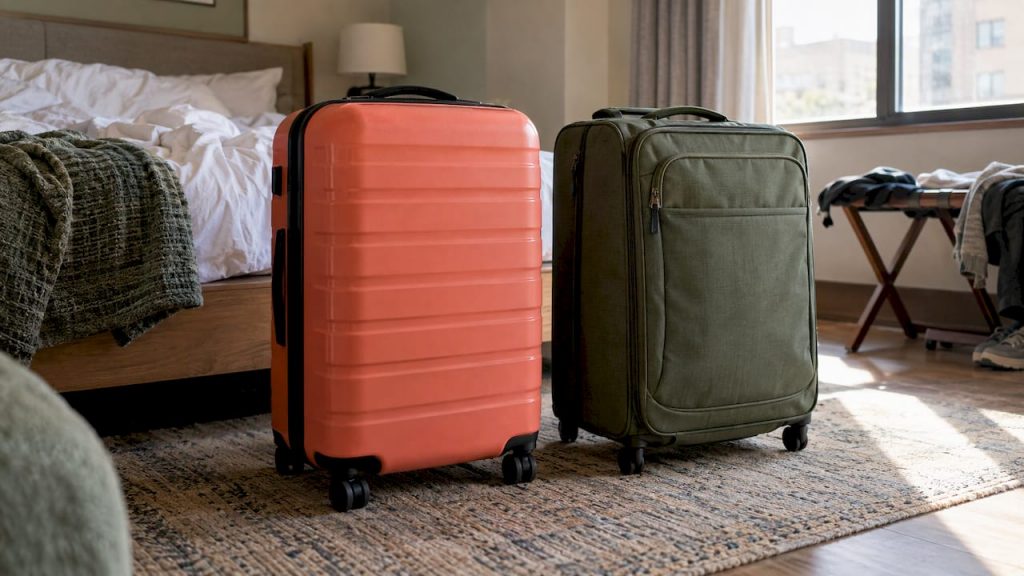
Hard vs soft luggage compared on weight, protection, packing space, rain and airline rules, so you can choose the suitcase that fits how you travel.
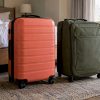
Choose hard-sided luggage if you check bags often and want rigid protection and a bag that wipes clean. Choose soft-sided luggage if you want pockets, a little stretch in the packing space and a bag that squeezes into tight overhead bins. Weight is rarely the deciding factor, because the gap between the two is usually small. Below, we compare them on the things that decide the choice: weight, protection, access, rain, security and airline rules.
TL;DR
- Hard-sided suits frequent flyers and fragile items. Its rigid shell resists crushing better than fabric, and it wipes clean after a spill or a wet curb.
- Soft-sided suits flexible packers. Exterior pockets, expansion zippers and a bag that gives a little in a tight space all add up to easier daily use.
- Weight is close. Empty weights usually differ by a few pounds, and material and brand matter more than shell type.
- Rain and zippers: neither type is fully waterproof. A hard shell sheds moderate rain, but water can still get in at the zipper.
- Carry-on fit: soft bags flex into overhead bins, while hard cabin bags are less forgiving. Always check your airline’s size limits before you buy.
Table of Contents
- The real difference between hard-sided and soft-sided luggage
- Quick comparison table
- Does hard or soft luggage weigh more?
- Durability and protection for what is inside
- Packing space, pockets and access
- Rain, spills and cleaning
- Security and locks
- Carry-on fit and overhead bins
- Choosing for international trips
- Which one should you buy?
- Our perspective
- Reaching travelers who are choosing luggage
- FAQ
- Sources
The real difference between hard-sided and soft-sided luggage
The two types differ in how they are built, and that explains almost every other difference.
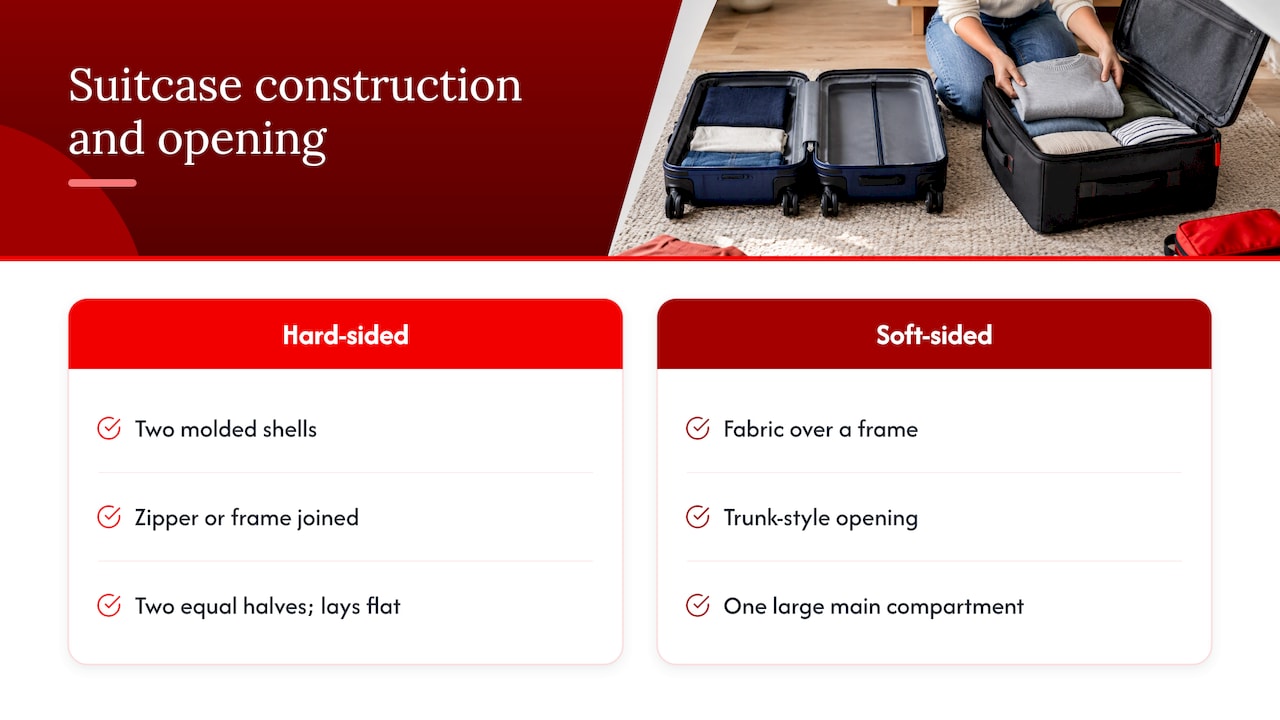
A hard-sided suitcase is a pair of molded shells joined by a zipper or a frame. Consumer Reports notes that hard-shell luggage is often made from lightweight plastics such as ABS and polycarbonate. Polycarbonate is the most popular of these because it is light and impact resistant, as CBC Life explains. Aluminum cases exist too, and they sit at the premium, heavy end of the range.
A soft-sided suitcase is built from fabric over a frame. Consumer Reports describes the fabrics as woven nylon such as Cordura, ballistic nylon or ripstop. They move and yield instead of cracking.
The opening style changes too. According to Wirecutter, a soft-sided suitcase opens like a trunk with one big main compartment. A hard-side has two equally sized halves that zip together and open like a clamshell. You have to lay it completely flat to get at your things.
One popular belief is wrong: that a hard shell is automatically tougher. A flight attendant with 16 years of experience, quoted by the Daily Mail, says passengers assume hard shells resist better, but she finds it is the opposite. She says hard cases can break under the pressure of other bags in the hold. Toughness depends on the materials and the build quality of the particular bag, not only on the category.
Quick comparison table
| Feature | Hard-sided | Soft-sided |
|---|---|---|
| Shell | Molded polycarbonate, ABS or aluminum | Woven nylon or similar fabric over a frame |
| Opening | Clamshell, needs flat floor space | Trunk-style, one main compartment |
| Exterior pockets | Rare | Common |
| Expansion | Usually none | Often 15–25% extra capacity |
| Rigid protection for fragile items | Better | Lower |
| Squeezing into tight spots | Harder | Easier |
| Cleaning | Wipes clean | Fabric can stain |
| Built-in locks | Often integrated | Zippers, often with add-on locks |
The expansion figure comes from Kit Authority, as summarized in the research on this topic, which puts the typical gain at 15 to 25 percent beyond base capacity through a zipper panel. Most hardside cases offer none. Treat it as a typical range, not a guarantee for any one bag.
Does hard or soft luggage weigh more?
It depends on the bag, and the difference is smaller than most shoppers expect.
A common assumption is that soft means light. Wirecutter says soft-sided suitcases can actually be heavier than hard-sided ones, though usually by just a few pounds. Soft bags use heavier fabrics and need framing. A hard-side is basically two lightweight polycarbonate shells zipped together.
Other comparisons point the other way. One retailer-independent comparison reported that hard-shell carry-ons typically weigh 3.0 to 4.5 kg, against 2.0 to 3.5 kg for soft ones. Both claims can be true, because brand, wheels, handles and frame all add weight.
Real-world examples show how close it gets:
- AFAR compared two popular carry-ons. The hard-shell model weighed 7.9 pounds and the soft-shell model 7.8 pounds. The hard-shell offered nearly two more liters of packing space when the soft one was not expanded.
- The Sydney Morning Herald reported that an 85-liter soft case might weigh 2.8 kilograms, and a polycarbonate case of the same size probably about half a kilo more. Metal cases were the heaviest, with one large aluminum check-in at 6.2 kilograms.
- ABC News noted that many hard cases use ultra-light, durable materials, while some soft cases use heavier vinyl. Choosing a hard shell does not automatically mean a heavy suitcase.
The practical rule: ignore the category and read the listed empty weight. If you fly on airlines with tight limits, every pound of empty bag is a pound you cannot pack. Checked bags on Air Canada in economy can weigh up to 23 kg (50 lb), according to Milesopedia’s Air Canada baggage guide, so an empty bag that weighs 5 kg leaves you 18 kg of packing room. Heavy bags also run into other airline charges. The same logic applies to bulky gear, as shown by airline bike fees in 2026, where size and weight rules decide the final bill.
If you want to keep the whole kit light, our guide to packing light shows how to pack with less so the weight of the bag matters less.
Durability and protection for what is inside
Protection and durability are two separate questions, and the best answer differs for each.
Protecting contents. The AAA Club Alliance says hard-sided luggage is best for frequent flyers and travelers wanting extra protection. Its rigid exterior is particularly useful for fragile items and resists crushing better than fabric. If you are carrying a camera, a bottle of local wine or a ceramic souvenir, the rigid shell gives the contents a better chance. Packing delicate objects well still matters, as you will see in this guide to protecting fragile items in transit, where a rigid case and careful padding keep a delicate collection intact.
Surviving the trip. Fabric can take abuse in a different way. High-denier fabrics are durable, and soft luggage has the benefit of being more pliable, which helps when you need to stuff it into tight spaces. Wirecutter’s luggage experts disagree in a useful way: one thinks soft-sided suitcases are at least as durable as their stylish hard-sided counterparts, and another who prefers hard-sided still agrees that soft is more durable and flexible. Her reason for choosing hard is the sleeker look and feel.
The checked-bag caution. The flight attendant quoted earlier advises against hard shells for the cargo hold and also against four-wheel suitcases. Her advice is specific to checked baggage. She suggests a fabric bag in a bright color so you can spot it quickly at baggage delivery. A bright color is a cheap upgrade for either type.
Put together: for a bag that rides in a cabin and a car trunk, a hard shell protects well. For a bag that gets stacked, thrown and wedged in a hold, a good fabric bag is a strong choice, and the quality of the nylon matters more than any label.
Packing space, pockets and access
This is where soft-sided luggage earns most of its fans.
Soft bags typically have exterior pockets for last-minute items and essentials. A carry-on with a front pocket is ideal for anything you may want during the journey: a passport, a charger, a light layer or a tablet. Wirecutter jokes that a front pocket is a feature a hard-sided suitcase can only dream about. Consumer Reports adds that soft pieces often have two or more interior compartments as well.

Hard-shell bags open into two shallower halves. That layout is tidy if you use packing cubes, because each half holds a neat stack. You do need floor space to open the bag fully, and a luggage rack or a narrow hotel room can make that awkward. Our piece on why packing cubes help explains how to make the most of two shallow halves.
Expansion is the other big difference. A soft bag that grows by 15 to 25 percent gives you room for souvenirs on the way home. Most hard bags cannot. If you often return with more than you left with, that expansion zipper matters. The flip side is that an expanded bag is a bigger bag. If your airline is strict about carry-on size, an expanded soft case can fail the sizer at the gate.
If you are tempted to fill every inch, read why overpacking is a problem before you decide that extra capacity is worth it.
Rain, spills and cleaning
Neither type is waterproof, but they fail in different ways.
- Soft-sided: Wirecutter says a soft suitcase left on the tarmac in a downpour could get soaked, and in rare cases the suitcase itself could get moldy. Quality soft-sided cases use water-repellent fabric that guards against less drastic rain. CBC Life says soft-shell luggage is not weather-proof, while hard shell protects belongings better.
- Hard-sided: The shell sheds water, but water can still get through the zipper of a hard-side, as Wirecutter notes. The seams of the zipper are the weak point, and in sustained heavy rain water can eventually enter.
For a Canadian traveler, this matters in practice. A wet November curb in Vancouver or a slushy Toronto winter will test both types. A hard shell is easier to wipe down, and a spilled toiletry bag will not leave a permanent stain on the shell. A soft bag needs spot cleaning and time to dry.
A sensible habit with either type: pack electronics and documents in a zip-top bag or a packing pouch, and keep clothing in cubes. That way, a damp bag does not turn into a ruined trip.
Security and locks
Consumer Reports says hard-shell luggage is more secure because it cannot be ripped open as easily, and it usually has integrated locks. Aluminum luggage can be even more secure with metal drawbolt latches instead of zippers. Soft bags rely on zippers, and a zipper can be forced, so add a small lock and keep valuables in your carry-on. No lock stops a determined thief, but it discourages a casual one.
Carry-on fit and overhead bins
This is the point most buyers overlook, and it is also where soft bags shine.
An Emirates flight attendant with nine years of experience, reported by The Economic Times, says hard-shell cabin bags are much harder to fit in the overhead locker. A soft-shell suitcase can adjust slightly when placed inside the compartment. She also notes that many hard-shell cabin bags cannot always be stored wheels-first, the preferred position in many aircraft bins.
Size limits are the second part. According to Milesopedia’s guide, Air Canada’s carry-on maximum is 55 x 40 x 23 cm (21.5 x 15.5 x 9 in), wheels and handles included. The personal item limit is 33 x 43 x 16 cm (13 x 17 x 6 in). There is no official weight limit for the carry-on, but you must be able to lift it into the bin without help. On Economy Basic fares within Canada and to or from the U.S., Mexico, Central America and the Caribbean, the guide says only a personal item is included. Airlines update rules, so confirm the numbers on your airline’s own page before you fly.
Those figures mean a typical 22-inch North American carry-on can be slightly too tall for the sizer. A soft bag that is not overstuffed can squeeze to fit. A hard shell cannot compress, so its listed dimensions must be right from the start. For ideas on what to put in such a bag, see how to pack a carry-on efficiently.
If even a small roller feels like too much, a carry-on backpack is the most flexible option of all, since it has no wheels or handle to count against the limit.
Choosing for international trips
International travel adds a few questions that domestic trips do not.
- Check the airline’s allowance for your route. Allowances vary between carriers and fare classes. Economy checked bags on Air Canada are limited to 158 cm (62 in) in total dimensions and 23 kg (50 lb), according to Milesopedia. Other carriers set their own figures, and some long-haul or regional airlines apply strict cabin weight limits. ABC News notes that most airlines have a 7-kilogram limit for carry-on suitcases, which is common in Europe and Australia but not the rule on every airline.
- Think about the surfaces you will roll on. Cobblestones, stairs and uneven pavement in older city centers punish small wheels and thin shells. A durable fabric bag with sturdy wheels tends to cope well. If you will mostly move between airports, taxis and hotels, a hard shell is fine.
- Plan for souvenirs. A soft bag that expands has headroom. With a hard shell, leave a quarter of the case empty on the way out.
- Choose a color you can find. Bright shades make your bag easy to spot at the belt, and they help in busy hubs where many black bags look identical.
- Match the bag to the style of trip. A multi-stop trip with trains and short flights suits a compact soft bag. A single-base beach vacation with fragile gifts to bring home suits a hard shell. On a boat or small plane, soft is often easier to stow, a point explored in this guide to packing light for a yacht escape, where compact, flexible bags win over rigid ones.
- Think about tech. Some luggage includes tracking features and battery packs, and airlines have rules about batteries. Read our guide to smart luggage before you buy a model with built-in power.
Which one should you buy?
Use this short decision guide.
Pick hard-sided if:
- You check bags often and carry breakable items.
- You want a clean, easy-to-wipe surface.
- You prefer a sleek look.
- You always have flat floor space to open the bag.
Pick soft-sided if:
- You want quick access through exterior pockets.
- You like extra room from an expansion zipper.
- You often squeeze bags into tight overhead bins or car trunks.
- You travel on trains, boats and small planes.
If you are undecided, consider a hybrid approach: a soft carry-on for the cabin and a hard-shell check-in for the hold if you must check a bag at all. That said, the flight attendant advice above suggests a durable fabric bag may actually be the better pick for the hold, so base your choice on the materials listed for each model, not on the category.
Whatever you pick, pay attention to four specs in the product listing: empty weight, outside dimensions including wheels, the quality of the zipper and the fabric or shell material. Those four figures tell you more than the words hard or soft.
Our perspective
We have written about luggage, packing and travel gear for a long time, and one pattern comes back in every guide. Readers ask whether hard or soft is better, when the more useful question is what they are carrying and how they move.
Our view is simple. Match the bag to the trip. Hard-sided luggage rewards travelers who check bags and carry breakables. Soft-sided luggage rewards travelers who value pockets, flexibility and quick access. Neither category beats the other on weight or toughness in every case, so read the specifications.
We also think the best bag is the one you pack well. A smaller bag, a few packing cubes and a clear list will help more than any shell material. That is why we pair luggage advice with our guides on packing light and carry-on organization.
Alexander
Reaching travelers who are choosing luggage
If you make or sell luggage, travel accessories or packing gear, our readers are the ones comparing options like these. You can reach them through Banner Ads or a Guest Post on our travel pages.
FAQ
Does hard or soft luggage weigh more?
It varies by model. Wirecutter says soft-sided suitcases can be heavier, usually by just a few pounds, because of heavier fabrics and framing. Other measurements show hard carry-ons a little heavier, so compare the listed empty weight of the exact bag.
What suitcase do flight attendants say not to use?
One flight attendant with 16 years of experience advises against hard shells for the cargo hold and against four-wheel suitcases, and recommends a bright fabric bag. An Emirates flight attendant says hard-shell cabin bags are harder to fit in the overhead locker.
What kind of luggage is best for international travel?
The best choice is the one that meets your airline’s size and weight limits and suits your route. A durable fabric bag with room to expand works well for multi-stop trips, and a hard shell suits fragile cargo. Check your carrier’s current allowances first.
Are suitcases waterproof?
No suitcase is fully waterproof. A hard shell sheds moderate rain, but water can enter at the zipper in a downpour. Soft fabric is often water-repellent, but it can soak through in heavy rain, so pack electronics and documents in sealed pouches.
Sources
- Soft-sided vs. hard-sided suitcases (Wirecutter)
- Choosing between hard-shell and soft-sided luggage (Consumer Reports)
- A guide to buying luggage (CBC Life)
- Hard vs. soft luggage (AFAR)
- Hard or soft shell luggage (The Sydney Morning Herald)
- Pros and cons of soft-sided and hard-shell suitcases (ABC News)
- Hard-sided vs. soft-sided luggage (AAA Club Alliance)
- Flight attendant packing hacks (Daily Mail)
- Flight attendant baggage warning (The Economic Times)
- Air Canada baggage size guide (Milesopedia)















Leave a Comment
Your email address will not be published. Required fields are marked with *