
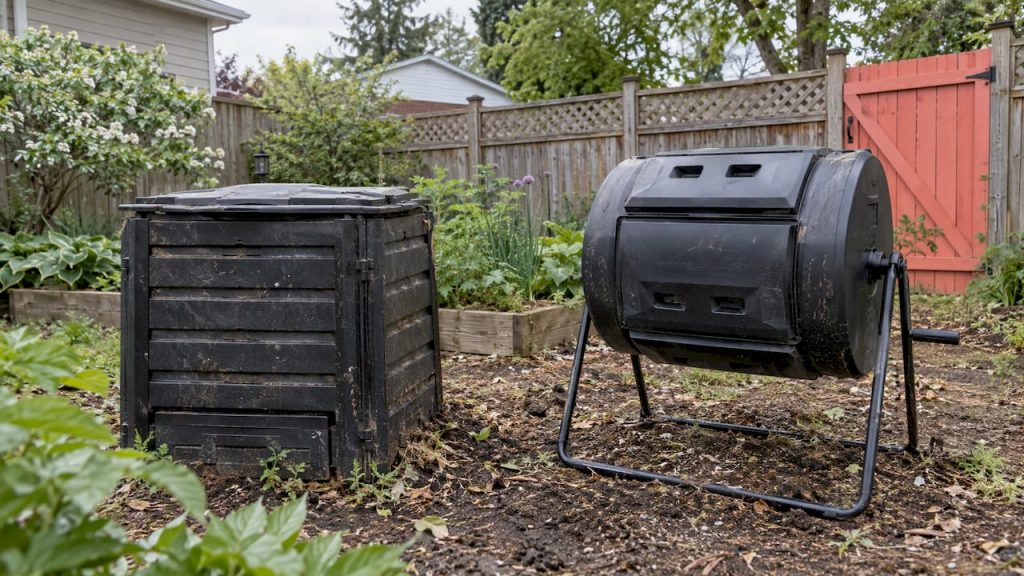
Compost bin or tumbler? Compare cost, capacity, speed, pests and Canadian winters, plus hot vs cold composting, so you can pick the right setup.
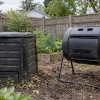
Pick a tumbler if you have a small yard, a balcony or a patio, want a tidy, pest-resistant unit and are happy to turn it every few days. Pick a stationary bin if you have a bit of ground, a steady stream of kitchen scraps and yard waste, and would rather spend less money and less effort. Both make good compost. They differ in price, capacity, upkeep and how they handle a Canadian winter, and those four things decide which one you will still be using a year from now.
We pulled together guidance from Canadian municipalities and universities so you can see the trade-offs in plain numbers, then match them to your own home.
TL;DR
- A bin is a static container, usually open to the ground. A tumbler is a sealed drum on a stand that you rotate by hand to mix and aerate the contents.
- Tumblers run from about $100 to $1,000 or more, hold less, and are more pest-resistant. Bins hold more and suit slow, low-effort composting.
- Finished compost needs at least 6 weeks to mature, whatever the box says. Be wary of units promising results in under 4 weeks.
- Winter is the weak spot for tumblers in colder parts of Canada: contents freeze and lids can freeze shut.
- Meat, dairy and oil usually belong in a municipal green bin, not your backyard unit.
Table of Contents
- What the two actually are
- Side-by-side comparison
- Cost: what you really pay
- Capacity and space
- Effort and speed
- Pests and odours
- Canadian winters change the answer
- Hot vs. cold composting: what changes with bin type
- What goes in, and what stays out
- How to use a tumbler step by step
- How to get the most from a stationary bin
- Which one should you choose?
- Our perspective
- Want your gardening brand in front of our readers?
- FAQ
- Sources
What the two actually are
A compost bin is a container that sits on the soil. Material goes in at the top, worms and soil microbes move in from below, and you finish with compost at the bottom. Most municipal composting guides treat the bin as the default home setup. Edmonton’s guide notes that a bin keeps the pile neat, protects it from weather and keeps animals out.
A tumbler is a closed barrel mounted on a frame or stand. The Regional District of Central Kootenay (RDCK) describes tumblers as working like backyard composters, through aerobic decomposition, which simply means microbes that need air break the material down. The difference is that the rotating mechanism mixes air in, so the process can finish faster than passive composting in an open pile.
That single design difference, ground contact versus a sealed drum, explains almost everything else in this comparison.
Side-by-side comparison
| Stationary bin | Tumbler | |
|---|---|---|
| Typical price | Lower | About $100 for small models, $1,000 or more for large or wildlife-resistant ones |
| Capacity | Larger, good for a steady supply | Smaller; 7.5 cubic foot models generally suit a family of four with no yard |
| Effort | Low; turning with a fork at least once a month helps | Regular turning, 1 to 4 times a week |
| Speed | Slow; from a few weeks to a few years depending on the composter | Faster when managed well, but at least 6 weeks to mature |
| Pests | Open to the ground, so more exposure | More pest- and wildlife-resistant than ground composters |
| Soil contact | Yes | None, which limits the exchange of beneficial microorganisms |
| Winter | Keeps working slowly | Contents can freeze and the lid may freeze shut |
Cost: what you really pay
The RDCK puts tumblers at roughly $100 for small, cheaper models and $1,000 or more for larger or wildlife-resistant ones. A University of Saskatchewan write-up of a 2014 bin study found tumbling bins considerably more expensive than stationary ones. The extra money pays for moving parts, a stand and a sealed body.
Plain bins cost less, and many Canadian municipalities sell or subsidize them for residents. Check your city or regional district website before you buy, since programs and prices vary by place and change from year to year.
A useful way to judge value: divide the price by how long you expect to use the unit. A mid-priced tumbler that you turn faithfully for years beats a cheap one that cracks or a pricey one that sits full and unturned.
Capacity and space
Size relative to what you produce is the first thing USask’s bin checklist asks you to weigh, alongside ease of use, assembly, aeration, moisture and animal protection. Their guidance is a good template for any purchase.
Tumblers are compact, which is their big selling point for townhouses, small lots and patios. The trade-off is volume. If you cut the lawn weekly and rake a large yard in fall, a single tumbler fills quickly. Edmonton’s guide suggests that about one cubic metre, roughly the size of a dishwasher, is a good starting bin size for beginners. That is far more than most tumblers hold.
If you want both, the answer is two units. Washington State University’s extension notes that two tumblers let you alternate: fill one while the other finishes. St. Albert makes the same point about multi-compartment bins, which work like a dual-compartment tumbler but need more space.
Effort and speed
Here is where manufacturer claims and reality part ways. Tumblers can speed things up because turning adds oxygen. St. Albert says tumblers are easy to use and can produce a finished product quickly, and it recommends 5 to 6 turns, 3 to 4 times a week. The RDCK suggests 1 to 4 turns a week. Either way, a tumbler rewards a routine.
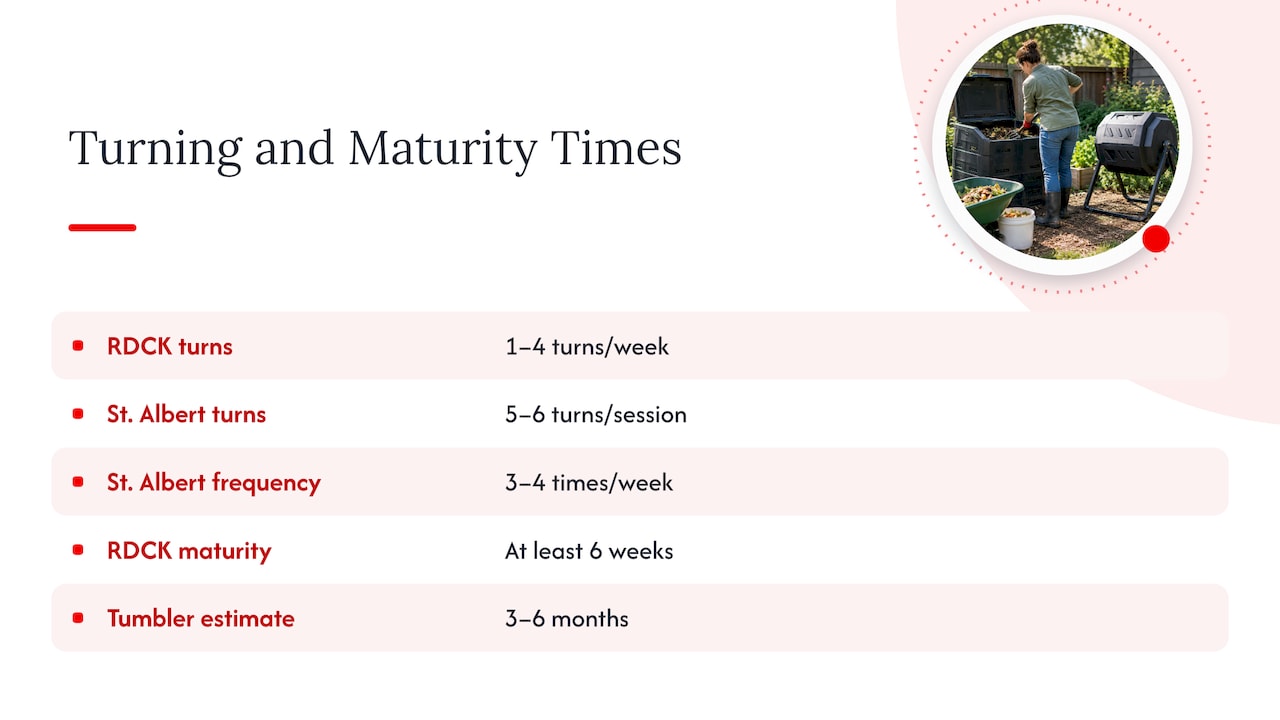
On timing, the RDCK is direct: compost needs at least 6 weeks to mature before it is stable and fit for use, so avoid units claiming finished compost in under 4 weeks. USask adds that some tumbler compost may be finished after 3 to 6 months, depending on particle size and materials.
There is one more wrinkle. Because a single-chamber tumbler mixes new scraps with older material, it is hard to end up with a clean, fully finished batch unless the unit has two compartments or you stop adding and let a full load cure. That is why many people run a tumbler in batches: fill it, then leave it alone.
A stationary bin asks less of you. St. Albert says single-compartment bins are the best choice for a slow, low-maintenance approach. Edmonton’s guide says that with regular fluffing and moisture, finished compost arrives in four to six months.
Pests and odours
If raccoons, rodents or bears visit your neighbourhood, this section may decide it for you. The RDCK notes that tumblers are more pest- and wildlife-resistant than ground composters. USask’s summary of the 2014 study agrees that tumblers were more rodent-proof than stationary bins.
With an open-bottom bin, you reduce problems through good habits: bury fresh kitchen scraps under browns, keep the lid on and keep the right moisture. Where bears are a concern, a sealed, wildlife-resistant model is the safer match, and that is the case where a higher price makes sense.
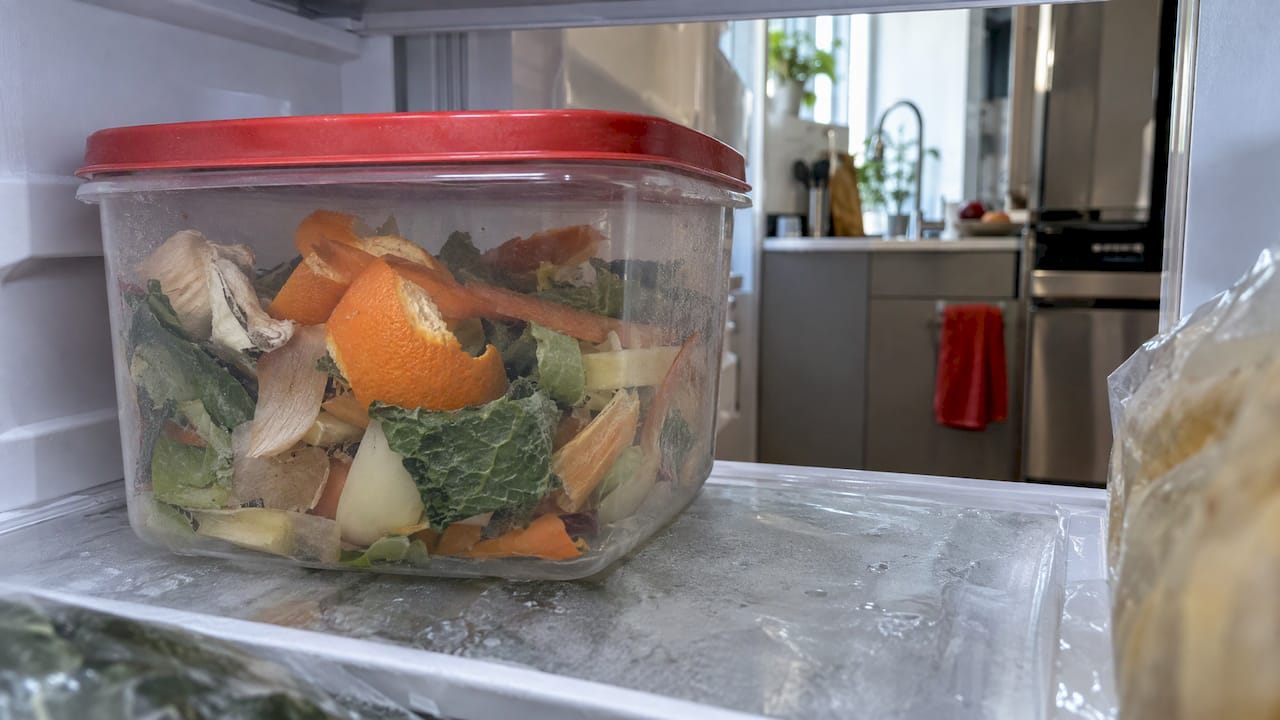
A small trick for the kitchen side: Toronto’s guide suggests freezing or refrigerating organic waste and washing the kitchen container with dish soap often, which keeps odours and flies down before the scraps ever reach your composter.
Canadian winters change the answer
This is the part most generic comparisons skip. USask says that in winter, tumbler contents freeze, which prevents tumbling, and the lid may freeze shut. Its 2014 study summary adds that tumblers’ small capacity couldn’t hold much frozen waste.
You have workable options:
- Pause and store. Keep kitchen waste in paper bags or newspaper, frozen outside until spring, then add it when things thaw. USask and Edmonton both describe this.
- Choose a sunny spot. Edmonton advises a black plastic bin in a sunny, wind-sheltered area for best winter performance.
- Go indoors for the cold months. USask lists bokashi, vermicomposting or compost tubs as indoor methods.
If you want to prep the rest of the house for the same cold snap, our guide to preparing your home for winter fits neatly alongside this.
Hot vs. cold composting: what changes with bin type
Hot composting means building a pile that heats up as microbes work. Cold composting means adding material as you have it and waiting. Neither is better in every case. They suit different habits.
Cold composting is what most stationary bins do. You add scraps and yard waste over time, turn rarely, and wait. It is forgiving, works year-round for steady inputs and needs little attention. The price is time, and cooler piles may not kill weed seeds or plant diseases.
Hot composting asks for more: enough volume, a balanced mix, enough moisture and regular turning. A tumbler seems made for this, since the sealed drum holds heat and turning is built in. There is a catch, though. Washington State University’s extension notes that even though some tumblers promise compost in a few weeks, the smaller volume doesn’t retain enough heat to safely compost weeds gone to seed or diseased plants. So keep seeded weeds and diseased plants out of a typical home tumbler.
The practical rule: a tumbler gets you faster, tidier compost from kitchen scraps and garden trimmings. A bigger bin or pile is the better place for bulky yard waste, because volume is what carries heat.
What goes in, and what stays out
Both setups run on the same recipe. USask recommends a mix of about 40% green and 60% brown material, with moisture, oxygen and a small amount of soil or finished compost to introduce microbes. The RDCK suggests equal parts greens and browns by volume, which is a simpler starting point if you do not want to measure. Greens are wet, nitrogen-rich items like fruit and vegetable scraps and grass clippings. Browns are dry, carbon-rich items like dry leaves, shredded paper and straw.
What about meat and dairy? Backyard units are not the place for them. The good news is that many Canadian cities take them curbside. Toronto’s guide confirms that meat, poultry, fish, dairy, eggs and bones go in the Green Bin and are processed in industrial digesters. Saint John’s guide lists meat, bones, fish, cheese and dairy as accepted in its municipal program. Check your own municipality’s list, since rules differ by city.
How to use a tumbler step by step
This routine draws on the RDCK and USask guides.
- Place it well. Choose a level, accessible spot. Sunshine speeds things up, according to Edmonton’s guide.
- Start with a balance. Add greens and browns in roughly equal volumes, or closer to 40% green and 60% brown. Add a shovelful of soil or finished compost to seed the microbes.
- Chop small. St. Albert notes that shredding yard waste and cutting food scraps small gives microorganisms more surface area.
- Check moisture. The RDCK says the contents should feel like a wrung-out sponge. Too dry and the process stalls. Too wet and it smells.
- Turn on a schedule. Aim for 1 to 4 times a week. Weekly maintenance is expected.
- Do not overfill. If it gets too heavy to turn, the RDCK suggests filling only two-thirds.
- Let a full load rest. Wait about 6 to 8 weeks until the material is dark brown, soil-like and sweet-smelling.
- Sift and reuse. Sift out larger pieces and return them to a fresh round.
When your first batch is ready, the fun part begins: putting it to work. Compost suits new beds, containers and borders, and sustainable planting design helps you match plants to light, water and site conditions so the compost goes where it will do the most. If you are building new beds to receive it, our guide to building raised garden beds is a good companion, and the step-by-step gardening guide for beginners covers the basics.
How to get the most from a stationary bin
The routine is simpler.
- Size it for your yard. Around one cubic metre is a good beginner size per Edmonton.
- Layer greens and browns. Keep a pile of dry leaves nearby to cover each load of kitchen scraps.
- Aerate monthly or more. St. Albert says turning with a shovel or pitchfork at least once a month improves air circulation, and more frequent aeration produces compost quicker.
- Keep it damp, not soggy. Same wrung-out sponge test.
- Harvest when it looks right. Finished compost is dark, crumbly and smells like earth, as Edmonton and St. Albert both describe.
If your garden is still taking shape, our garden improvement ideas can help you decide where a bin should live.
Which one should you choose?
Use your own situation, not the product page, as the guide.
Choose a tumbler if:
- You have a small yard, patio or balcony. The RDCK says tumblers take up less space and suit small or no yards.
- Pests or wildlife are a real concern where you live.
- You like a routine and want tidy, faster results.
- You produce a modest amount of kitchen and garden waste.
Choose a stationary bin if:
- You have ground to spare and a steady flow of yard waste.
- You want low effort and are fine with a slower timeline.
- You want worms and soil life to reach the compost naturally.
- You want to keep the budget small.
Consider both if: you have a bigger garden and want a tumbler for kitchen scraps near the house and a bin for leaves and clippings farther out.
Our perspective
We write about gardens, homes and everyday upgrades, and compost questions land in our inbox more than almost any other. The pattern is always the same: people buy the fastest-sounding option, then stop using it when winter arrives or the drum gets heavy.
Our advice is to begin with your habits, not the product. Look at how much waste you make, how much space you have and how often you will honestly turn a drum. Then use the numbers from your own municipality and university extension programs, which publish Canadian guidance for Canadian weather.
Good composting is a small, steady habit that pays you back every spring. Whether you pick a bin, a tumbler or both, the best choice is the one that fits your week.
Alexander
Want your gardening brand in front of our readers?
If you run a home, garden or sustainability brand and want to reach readers who are planning projects like this one, we offer Banner Ads and Guest Post placements. You can find the details on our advertise with us page.
FAQ
Is a compost tumbler better than a bin?
Neither wins everywhere. A tumbler is tidier, more pest-resistant and suits small spaces, but it costs more, holds less and can freeze in winter. A bin is cheaper and holds more, but works slowly. Match the choice to your yard size and how much effort you want to give.
How long does compost take in a tumbler?
Plan on at least 6 weeks for compost to mature, and often longer. The RDCK says a full tumbler needs about 6 to 8 weeks to become soil-like, while USask says some tumbler compost may be finished in 3 to 6 months depending on the materials. Be cautious of any unit that promises finished compost in under 4 weeks.
Can I use a tumbler in winter in Canada?
In colder regions, contents can freeze and the lid may freeze shut, which stops you from turning it. Many gardeners store scraps frozen in paper bags until spring, or move to indoor methods such as bokashi or worm composting for the winter months.
Can I compost meat and dairy in my backyard?
It is best to keep them out of a backyard bin or tumbler. Many Canadian cities, including Toronto and Saint John, accept meat, bones and dairy in their curbside organics programs. Check your local list for what is accepted.
What is the difference between hot and cold composting?
Hot composting uses a well-balanced, regularly turned pile that heats up and breaks down faster. Cold composting is add-and-wait and takes much longer but needs little work. Most home bins run cold, while a tumbler can speed things up but is too small to reliably kill weed seeds.
Sources
- RDCK Tumbler Composters guide (2026)
- City of St. Albert, Home Composting
- University of Saskatchewan, Choosing a compost bin
- University of Saskatchewan, Tumbling compost bins
- City of Edmonton, A down to earth guide to composting
- City of Toronto, What goes in the Green Bin organics
- City of Saint John, Waste and compost dos and don’ts
- Washington State University Extension, Composting Methods
















Leave a Comment
Your email address will not be published. Required fields are marked with *