

Discover effective strategies to save for travel, including setting up a dedicated account and budgeting tips for your dream trip.
Open a dedicated travel savings account right now, name it after your destination, and schedule an automatic transfer for the day after your next payday. That single move puts your trip on a financial track before you spend a dollar on anything else. Three quick follow-ups you can do in the next ten minutes:
- Set your target amount and date. Pick a rough trip cost and a departure month so you have a finish line.
- Calculate your monthly transfer. Divide the total cost by the number of months until you leave.
- Cut one discretionary item today. Cancel a streaming service or skip one takeout order and redirect that exact dollar amount to the new account.
Name the account something vivid, like “Bali Fund” or “Paris Fund,” so every time you log in, the goal feels real. Set the transfer to run automatically. Then walk away and let the system do the work.
Key Takeaways
The fastest way to save for travel is to open a dedicated account today, automate a fixed monthly transfer, and protect that money from both impulse spending and emergency fund confusion.
| Point | Details |
|---|---|
| Start with one action | Open a named travel savings account and schedule an auto-transfer for the day after payday. |
| Use the monthly formula | Divide total trip cost by months until departure; round up to the nearest $25 for a built-in cushion. |
| Free up cash with two cuts | Pausing subscriptions and reducing dining out often cover the monthly target for short trips. |
| Use the right savings vehicle | Choose an FDIC-insured high-yield savings account for trips under 6 months; money-market for 6–18 months. |
| Route windfalls immediately | Deposit tax refunds and bonuses into the travel fund the same week they arrive, before they blend into daily spending. |
Table of Contents
- How to estimate the real cost of your trip
- How to compute your monthly savings target
- Where to keep your travel money and which tools make it easy
- How automation keeps your savings on track without daily effort
- Practical spending cuts that free up real cash every month
- How to accelerate your fund with extra income and windfalls
- Booking and on-trip tactics that make your savings go further
- A sample savings plan you can copy right now
- Financial safety checks and mistakes to avoid
- Our team’s take: budget around what matters most
- Sources
How to estimate the real cost of your trip
Most people underestimate their trip budget because they price flights and hotels and stop there. A complete budget covers six core categories: flights, accommodation (including taxes and resort fees), food, activities, local transportation, and pre-trip costs such as visas and travel insurance. Travo’s trip cost estimator recommends adding a 10–15% contingency buffer on top of those six categories to catch hidden fees.
Here is a starting framework you can adapt to your trip style:
If your budget must shrink, cut activities and food first. Flights and accommodation are harder to reduce once booked. The non-obvious cost most travelers miss? Tourist taxes and dynamic currency conversion fees. Many European cities charge a nightly tourist tax of €1–€5 per person, and using a card without foreign-transaction protection can add 2–3% to every purchase. Factor both in before you finalize your total.
Pro Tip: Check your destination’s official tourism site for tourist tax rates before you build your budget. Some cities collect it at checkout; others require payment at the airport. Knowing in advance prevents a nasty surprise on your last morning.
How to compute your monthly savings target
The formula is simple: total trip cost ÷ months until departure = monthly transfer amount. Round up to the nearest $25 so you build a small cushion automatically.
Pack Lightly’s savings plan guide illustrates this well: a $1,100 Southeast Asia trip works out to roughly $185 per month over six months, or about $92 per month over twelve. Choosing your timeline is the single most powerful decision you make.
Three worked examples to help you calibrate:
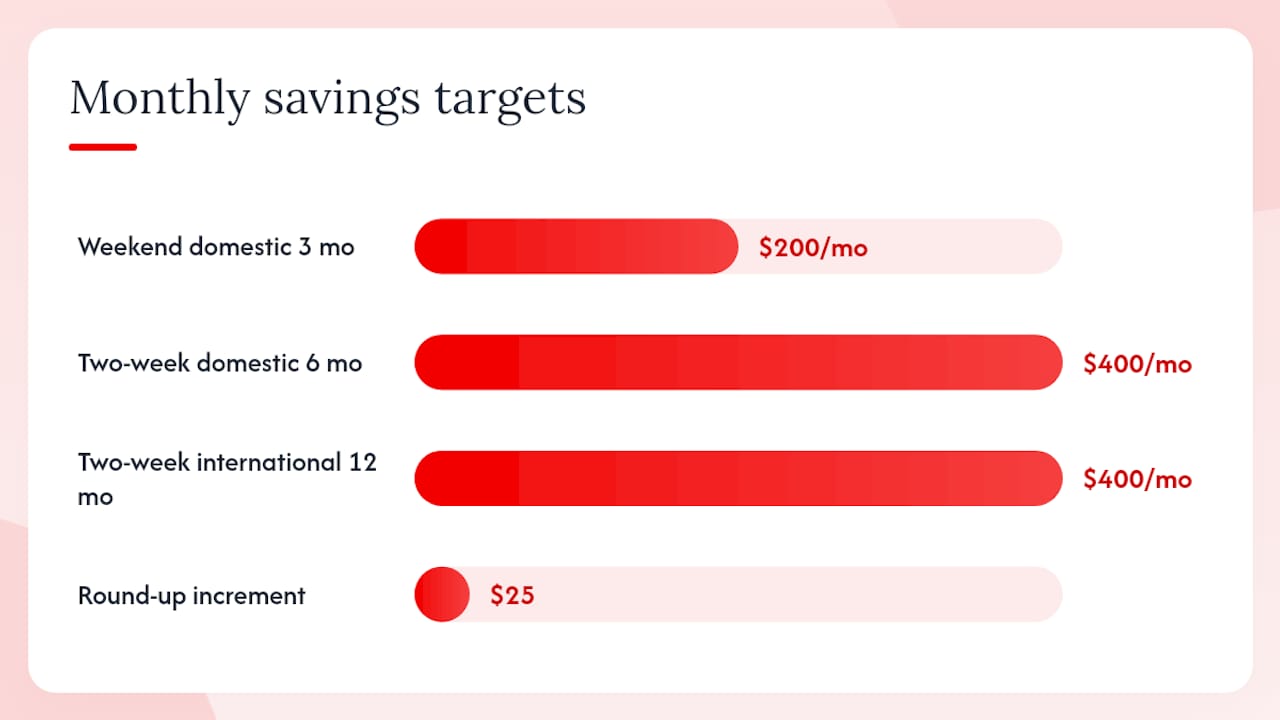
- Weekend domestic trip ($600 total, 3-month timeline). Monthly transfer: $200. This is a realistic target for most people who pause one or two subscriptions and reduce dining out for a quarter.
- Two-week domestic road trip ($2,400 total, 6-month timeline). Monthly transfer: $400. NewDayBudgeting’s vacation savings guide notes that $200–$600 per month covers most domestic trips when you start 6–12 months ahead.
- Two-week international trip ($4,800 total, 12-month timeline). Monthly transfer: $400. Spread over a year, this feels manageable. Add windfalls (tax refund, bonus), and you may finish two months early.
Mini decision guide: If the monthly number feels too high, you have three levers. Postpone the departure date to spread the cost further. Trim trip scope (fewer nights, one fewer activity category). Or add a side income stream to cover the gap. Avoid the fourth option, financing the trip on a credit card, because interest charges can erase weeks of careful saving.
Where to keep your travel money and which tools make it easy
A dedicated savings vehicle does two things: it keeps travel money physically separate from spending money, and it earns interest while you wait. Fidelity’s vacation savings guide recommends moving the money into a separate account and automating transfers as the foundation of any savings plan.
Here is how to choose the right vehicle by time horizon:
- Under 6 months: An FDIC-insured high-yield savings account (HYSA) is the right fit. Online banks frequently offer rates well above the national average, and the money stays liquid. Open one, name it after your destination, and link it to your checking account for the auto-transfer.
- 6–18 months: A conservative money-market account or a high-yield savings account at a reputable online bank still works well. The goal is safety and access, not growth.
- Tracking and planning tools: YNAB (You Need A Budget) uses an envelope-style system that assigns every dollar a job. Create a “Travel” envelope, fund it each payday, and watch the balance grow toward your target. It also flags when you are overspending in other categories that could feed the fund. For a more flexible, visual approach, Airtable lets you build a custom budgeting template with color-coded progress bars, linked tables for each trip category, and automatic calculations. Fidelity’s budgeting tools let you link external accounts and view all balances in one dashboard, which is useful if your travel fund lives at a different bank. Our team at Lizard’s Lunch also recommends reading through our budgeting apps overview for a broader look at how these tools compare in practice.
How automation keeps your savings on track without daily effort
Willpower is a limited resource. Automation removes the decision entirely. FNBO’s vacation savings tips confirm that setting up a dedicated vacation savings account with automatic transfers is one of the most reliable ways to build a fund consistently.
Four automation tactics worth setting up today:
- Direct deposit split. Many employers let you split your paycheck between two accounts. Send a fixed dollar amount straight to the travel fund before it ever touches your checking account.
- Auto-transfer the day after payday. If a deposit split is not available, schedule a recurring bank transfer for the morning after each payday. The money moves before you have a chance to spend it.
- Round-up apps. Some banking apps round every purchase to the nearest dollar and sweep the difference into savings. Small amounts accumulate faster than you expect over six months.
- Paycheck allocation rules in YNAB. Set a rule that funds the Travel envelope first every time income arrives. The app enforces the priority automatically.
The single most effective friction trick is removing the debit card from your travel savings account. When accessing the money requires a deliberate bank transfer that takes one to two business days, impulse withdrawals disappear. Name the account after your destination to reinforce the goal every time you log in. Fidelity’s research supports this: named, separate accounts increase saving consistency because the goal stays visible.
On high-income months, manually top up the difference. This prevents overdrafts while keeping the habit intact.*
Practical spending cuts that free up real cash every month
Pausing subscriptions and reducing dining out are the two highest-impact levers most people have, and Pack Lightly’s savings guide notes these two moves alone often cover the monthly target for short trips. Here is a ranked list of cuts with realistic monthly savings ranges:
- Pause unused subscriptions ($15–$80/month). Run a subscription audit using an app like Rocket Money or Trim. Cancel anything you have not used in the past 30 days. Streaming services, gym memberships, and app subscriptions are the usual culprits.
- Reduce dining out ($100–$300/month). Packing lunch three days a week and cooking dinner at home four nights instead of two can free up a significant amount. Set a weekly dining-out cap and stick to it.
- One-month money diet ($50–$200/month). For 30 days, buy nothing that is not food, transportation, or a bill. Everything else goes to the travel fund.
- Downgrade phone or internet plan ($20–$60/month). Many carriers offer lower-tier plans that cover everyday needs. A quick call or online chat often unlocks a retention discount without changing your number.
- Sell unused items (one-time $50–$500+). Old electronics, clothes, sports gear, and furniture sell quickly on Facebook Marketplace and eBay. Treat every sale as a windfall deposit.
- Cash envelopes for variable spending. Withdraw a fixed weekly cash amount for groceries and entertainment. When the envelope is empty, spending stops. The physical constraint is surprisingly effective.
How to accelerate your fund with extra income and windfalls
Windfalls are the fastest way to close a gap between your monthly savings rate and your departure date. Capital One’s trip budgeting guide recommends routing tax refunds, work bonuses, and gift money directly to the travel fund and treating reward points strategically rather than letting them sit unused.
- Tax refund. The average federal tax refund in the U.S. runs in the hundreds to low thousands of dollars. Deposit it into the travel fund the same week it arrives, before it blends into everyday spending.
- Work bonus. Commit a fixed percentage (50% is a reasonable starting point) to the travel fund before you mentally spend the rest.
- Gift money. Birthday and holiday cash gifts are easy to redirect. Tell family members about the trip goal; many will happily contribute to the fund instead of buying a physical gift.
- Sell unused gear. Camera equipment, bicycles, musical instruments, and collectibles often fetch more than people expect. List three items this week.
- Gig and freelance work. Rideshare driving, food delivery, freelance writing, tutoring, or selling handmade goods on Etsy can generate $200–$800 per month depending on hours invested. Even a single weekend shift per month adds meaningful momentum.
- One important caution: Keep your emergency fund intact. A general rule is three to six months of living expenses in a separate, untouched account. Never raid it for travel, and never put a trip on a high-interest credit card with no plan to pay it off immediately.
Booking and on-trip tactics that make your savings go further
Saving the money is only half the equation. Spending it wisely on the other side determines how far it stretches. Lonely Planet’s travel budgeting guide recommends tracking spending daily against category totals and favoring local food and transit options to reduce on-the-ground costs.
- Book flights at the right window. For domestic flights, the sweet spot is generally 1–3 months out. International flights tend to reward booking 3–6 months ahead. Flexibility on departure day (Tuesday or Wednesday departures are often cheaper) can reduce airfare noticeably.
- Travel in shoulder season. Visiting a destination just before or just after peak season often cuts accommodation and activity costs by 20–40% while keeping the experience largely the same. Our full guide on why off-peak travel saves more walks through the best timing by region.
- Use points without carrying a balance. Rewards credit cards are powerful when paid in full every month. Carrying a balance at 20%+ APR erases the value of any points earned. Use the card for planned purchases, pay it off on the due date, and let the points fund a flight or hotel night.
- Mix budget and splurge nights. Two nights in a well-reviewed budget guesthouse fund one night in a memorable boutique hotel. Short-term rentals with a kitchen also cut food costs by letting you prepare breakfast and lunch.
Pro Tip: Pick two “must-have” experiences for your trip, budget generously for those, and go lean on everything else. Thrivent’s vacation budgeting advice supports this approach: tailoring the budget to the experiences that matter most produces more satisfaction than chasing the lowest price on everything.
- Set a daily spending limit on the ground. Decide your daily budget before you land and track it each evening. Capital One’s budgeting guide recommends a category-based daily cap to prevent the “I’m on vacation” overspend spiral.
- Favor local markets and public transit. Street food and local markets cost a fraction of tourist-area restaurants. A metro or bus pass beats taxis for most city travel.
A sample savings plan you can copy right now
Here is a ready-made three-column template. Pick the row that matches your timeline, copy the monthly transfer, and set it up today. Pack Lightly’s concrete monthly examples inspired this framework.
| Timeline | Monthly Transfer | Payday Actions |
|---|---|---|
| 3 months | $200/month | Transfer day after payday; audit subscriptions week 1; sell one item week 2 |
| 6 months | $185–$400/month | Auto-transfer day after payday; pack lunch 3x/week; redirect one windfall |
| 12 months | $92–$400/month | Auto-transfer day after payday; quarterly spending audit; route tax refund to fund |
Track progress as a percentage: if your goal is $2,400 and you have saved $600, you are 25% of the way there. Milestone rewards keep motivation alive. Visual trackers in Airtable, or a simple Google Sheet with a progress bar, make the number feel real every time you open it.
Our team at Lizard’s Lunch also recommends keeping a short motivational checklist pinned somewhere visible: your trip goal, your departure date, your current balance, and one photo of the destination. Reviewing it weekly takes 30 seconds and keeps the goal from fading into the background.
Pro Tip: A downloadable Airtable or Google Sheets template with pre-built category rows and a progress bar can cut setup time to under five minutes. Search “travel budget template” in Airtable’s template gallery or Google Sheets template library to find one you can duplicate instantly.
Financial safety checks and mistakes to avoid
Excitement about a trip can lead to shortcuts that cost more in the long run. FNBO’s savings tips are clear: never finance a vacation on high-interest revolving credit card debt, and always keep your emergency fund separate from your travel fund.
Common pitfalls and quick fixes:
- Underbudgeting for taxes and fees. Resort fees, city taxes, and airline baggage fees are rarely included in the headline price. Add them to your budget estimate before you finalize the total, and revisit Travo’s trip cost categories to make sure nothing is missing.
- Ignoring exchange rate and foreign-transaction fees. A card with no foreign-transaction fee (Charles Schwab’s debit card and some travel credit cards offer this) saves 2–3% on every international purchase.
- Hoarding points without a redemption plan. Points lose value over time as programs devalue their currencies. Know your redemption target before you start accumulating.
- Raiding the travel fund for non-travel expenses. Keep the account at a separate bank from your checking account to add friction. If accessing it requires a two-day transfer, you will think twice.
- Skipping travel insurance. A medical emergency abroad or a canceled flight can cost far more than the trip itself. Our travel insurance basics guide covers what to look for before you book.
- Quick corrective rule: Add a 10–15% buffer to every trip estimate, verify all currency and baggage fees before booking, and commit to paying off any travel-related card charge within the same billing cycle.
Our team’s take: budget around what matters most
Our team at Lizard’s Lunch has built travel budgets for trips ranging from a three-day road trip to a multi-week international adventure, and the pattern is always the same. The travelers who feel best about their trips are not the ones who spent the least. They are the ones who spent deliberately, choosing two or three experiences they genuinely wanted and trimming everywhere else without guilt.

The math in this guide works. The formula, the automation, the spending cuts, they all add up. But the mindset underneath the math matters just as much. Pick the two things you most want to do on this trip, budget generously for them, and let the rest be flexible. That approach, supported by Thrivent’s experience-first budgeting philosophy, produces trips people talk about for years rather than trips they barely remember.
For readers who want to go deeper on the financial side, our budgeting finance hub covers saving strategies across every life category, not just travel. And if you are rethinking how you travel altogether, our guide to slow travel shows how a slower pace often costs less per day while delivering more of what makes travel meaningful.
Sources
These are the primary resources our team used to build this guide. Each one is worth bookmarking.
- How to save for a vacation | Fidelity
- How to Save Money for Travel: A Real Savings Plan – 2026 Pack Lightly
- Trip Cost Estimator: How to Budget Any Trip in 2026 | Travo
- How to Budget for Saving for Vacation: A Complete Guide
- How to Budget for Travel: A Complete Guide (Lonely Planet)
- Budget your trip | Capital One
This article is general information, not a substitute for advice from a qualified financial advisor. Consult a qualified financial professional about your own circumstances before acting on anything here.


















Leave a Comment
Your email address will not be published. Required fields are marked with *