

Discover the internet of things definition and learn how it impacts your life. Understand the technology behind everyday devices today!
The Internet of Things is defined as a network of physical objects embedded with sensors, software, and processing capabilities that autonomously collect, share, and act on data through wireless or wired networks. You interact with this technology every day, often without realizing it. Your thermostat that adjusts itself, your fitness tracker that logs your steps, and the traffic light system that responds to congestion are all part of the same connected fabric. Understanding what IoT actually is, and how it works beneath the surface, gives you a real advantage as connected technology becomes woven into nearly every part of daily life.
What is the Internet of Things definition, exactly?
The Internet of Things concept describes a system where physical devices communicate data autonomously, without requiring a human to press a button or type a command. The key word is “autonomously.” These devices sense their environment, process what they find, and transmit that information to other devices or systems on their own.
Kevin Ashton coined the term “Internet of Things” in 1999, though he personally preferred “Internet for things” to clarify that the network centers on objects, not people. That distinction matters. Traditional internet use puts humans at the keyboard. IoT flips that model and puts the device in charge of initiating communication.

The earliest example of a connected device predates Ashton’s phrase entirely. A vending machine connected to ARPANET in 1970 could report its inventory remotely. That single machine contained the same core idea driving billions of devices today: objects reporting their own status without human prompting.
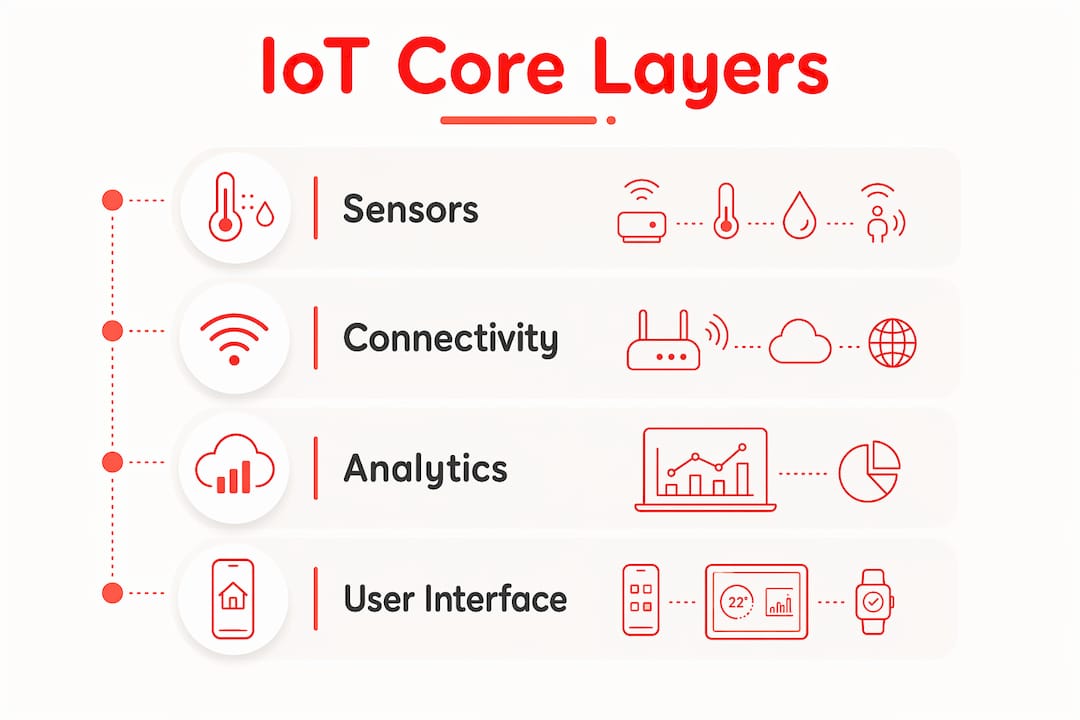
Every IoT ecosystem relies on four core functional elements: sensors and devices, connectivity, data analytics engines, and user interfaces. Remove any one of these, and the system breaks down. A sensor with no connectivity is just a meter. Connectivity with no analytics is just noise. The magic happens when all four work together.
What are the key components and technology behind IoT?
IoT systems run on a layered architecture, and each layer has a specific job. Understanding these layers helps you see why IoT is more than just “things connected to Wi-Fi.”
Sensors and devices
Sensors are the starting point. They detect physical conditions like temperature, motion, light, pressure, or heart rate and convert those readings into digital data. A single smart home might contain dozens of sensors: door contacts, motion detectors, air quality monitors, and water leak sensors. Each one feeds data into the larger system.
Connectivity methods
The data those sensors collect needs a path to travel. IoT uses several different connectivity protocols depending on the use case:
- Wi-Fi: High bandwidth, short range, ideal for home devices like smart speakers and cameras
- Bluetooth: Very short range, low power, common in wearables and personal health devices
- Cellular (5G): Long range, high speed, used in connected vehicles and remote industrial sensors
- Zigbee: Low power, mesh networking, popular in smart home automation systems
- LoRaWAN: Very long range, extremely low power, used in agricultural and infrastructure monitoring
No single protocol wins every situation. A soil moisture sensor in a remote field needs LoRaWAN. A smartwatch needs Bluetooth. Choosing the right connectivity method is one of the first real engineering decisions in any IoT deployment.
Data analytics and edge computing
Raw sensor data is rarely useful on its own. It needs to be processed, filtered, and interpreted. Edge computing handles this by processing data locally on the device or a nearby gateway, rather than sending everything to a distant cloud server. This reduces latency and cuts bandwidth costs significantly. For real-time applications like industrial automation or autonomous vehicles, edge computing is not optional. It is the only approach fast enough to work.
Pro Tip: If you are building or buying an IoT system, ask whether it uses edge processing. A system that sends all data to the cloud first will always be slower and more expensive to run than one that filters data at the source.
User interfaces and dashboards
The final layer is where humans interact with the system. Dashboards, mobile apps, and voice interfaces translate processed data into something you can read, respond to, or act on. A well-designed user interface turns thousands of data points into a single, clear recommendation: “Your HVAC filter needs replacing in 14 days.”
How are IoT devices categorized and what are common examples?
IoT devices fall into two broad categories, and the distinction shapes how they are designed, deployed, and secured.
Digital-first devices are built with connectivity as a core feature from the start. These include smartphones, streaming media players, smart speakers, and tablets. Connectivity is not an add-on for these products. It is their primary reason for existing.
Physical-first devices are traditional objects that have been enhanced with IoT technology. These include vehicles, medical devices, industrial machines, and home appliances. A refrigerator is fundamentally a cooling box. Add sensors, a network connection, and software, and it becomes an IoT device that can track expiration dates and order groceries automatically.
IoT devices cover a broad range of categories, and the commonality across all of them is autonomous data exchange. Here is a breakdown of the major device types:
- Consumer devices: Smartwatches, fitness trackers, smart thermostats, connected door locks, robot vacuums, smart lighting systems
- Connected vehicles: Cars with GPS tracking, remote diagnostics, over-the-air software updates, and collision avoidance systems
- Medical devices: Remote patient monitors, insulin pumps with wireless reporting, hospital bed sensors, and connected imaging equipment
- Industrial machines: Predictive maintenance sensors on factory equipment, connected conveyor systems, and automated quality control cameras
- Infrastructure: Smart traffic lights, water utility monitors, electrical grid sensors, and environmental monitoring stations
The consumer gadget category gets most of the attention in mainstream media. The real scale of IoT, though, lives in industrial and infrastructure applications. A single smart factory can contain thousands of connected sensors, each feeding data into systems that keep production running without interruption. The role of gadgets in daily life is visible and tangible. The role of industrial IoT is quieter but far more economically significant.
What are the practical applications and benefits of IoT in everyday life and industry?
IoT’s value shows up differently depending on the context, but the underlying benefit is always the same: better decisions made faster, with less human effort.
Smart home and consumer applications
Smart home automation is the most visible consumer application of IoT. A connected home can adjust lighting based on occupancy, lock doors remotely, monitor energy use in real time, and alert you to a water leak before it becomes a flood. The benefits of home automation extend beyond convenience. They include measurable reductions in energy bills and improved home security. Wearable technology adds another layer, tracking health metrics continuously and sharing that data with healthcare providers when needed.
Industrial and infrastructure applications
Industrial IoT applications can reduce operational costs by over 20% through predictive maintenance and real-time data analysis. That number represents a fundamental shift in how manufacturing and logistics operate. Instead of scheduling maintenance on a fixed calendar, machines report their own wear and trigger service requests only when actually needed. Smart traffic systems use IoT sensors to adjust signal timing based on live vehicle counts, reducing congestion without adding new roads. Energy management systems track consumption across entire buildings and automatically shift loads to off-peak hours.
The table below shows how IoT benefits vary across sectors:
| Sector | Primary IoT application | Key benefit |
|---|---|---|
| Consumer / home | Smart thermostats, lighting, security | Energy savings, convenience, remote control |
| Healthcare | Remote patient monitoring, connected devices | Faster response, continuous data, reduced hospital visits |
| Manufacturing | Predictive maintenance, quality control sensors | Lower downtime, reduced repair costs |
| Transportation | Fleet tracking, connected vehicles | Route efficiency, safety improvements |
| Infrastructure | Smart grids, water monitoring | Resource optimization, early fault detection |
Business benefits of IoT center on greater visibility into operations and enhanced responsiveness. The most significant value, according to research from Britannica and McKinsey, comes from improving internal business processes rather than consumer-facing features. That insight reframes how you should think about IoT investment. The flashy consumer applications are the tip of the iceberg. The real returns sit in the operational layer beneath.
For readers curious about how connected technology fits into broader Industry 4.0 trends, the convergence of IoT with artificial intelligence and automation is creating entirely new production models.
What are common challenges and security considerations in IoT?
IoT’s greatest strength, the fact that devices operate autonomously, is also its greatest security risk. A device that communicates on its own can be compromised without anyone noticing.
Many IoT devices cannot run traditional security software, which makes them inherently harder to protect. A standard laptop can run antivirus software, a firewall, and encryption tools simultaneously. A small sensor monitoring a water pipe has neither the processing power nor the memory to do the same. This gap requires a different security approach entirely.
The most common IoT security risks include:
- Default credentials: Many devices ship with factory usernames and passwords that users never change, making them trivially easy to access
- Unencrypted data transmission: Some devices send data in plain text, exposing it to interception on the network
- Lack of update mechanisms: Devices without automatic firmware updates stay vulnerable to known exploits indefinitely
- Network exposure: Devices placed on the same network as computers and phones create a path for attackers to move laterally between systems
- Physical access risks: Devices in public or industrial spaces can be physically tampered with to extract credentials or inject false data
Network segmentation is the most practical defense available to most users. Placing IoT devices on a separate network, isolated from your primary computers and phones, limits the damage any single compromised device can cause. Most modern routers support a guest network that works perfectly for this purpose.
Pro Tip: Put all your smart home devices on a dedicated guest network. If a connected camera or thermostat is ever compromised, the attacker cannot reach your laptop or phone from there.
One important clarification: most IoT devices do not need public internet access to function. They need network access to communicate with a local gateway or edge device. Restricting outbound internet access for IoT devices reduces their attack surface without breaking their core functionality.
The role of tech in home security is growing fast, and understanding these risks helps you make smarter choices about which devices you bring into your home and how you configure them.
Key Takeaways
The Internet of Things is a four-layer system of sensors, connectivity, analytics, and interfaces that enables physical objects to exchange data autonomously, with its greatest value found in industrial efficiency and real-time operational insight.
| Point | Details |
|---|---|
| IoT core definition | Physical devices with sensors and software that collect and share data without human input. |
| Four functional layers | Every IoT system needs sensors, connectivity, data analytics, and a user interface to work. |
| Two device categories | Digital-first devices are built for connectivity; physical-first devices are traditional objects enhanced with IoT tech. |
| Industrial impact | Predictive maintenance and real-time analysis can cut operational costs by over 20% in industrial settings. |
| Security priority | Place IoT devices on a separate network and change default credentials to reduce exposure. |
Our team’s perspective on IoT: more than just smart gadgets
Our team at Lizard’s Lunch has spent a lot of time covering connected technology, and the single biggest misconception we keep running into is that IoT is primarily a consumer story. People think of voice assistants and smart light bulbs. Those are real, and they are genuinely useful. But they represent a fraction of what IoT actually does in the world.
The more you look at industrial and infrastructure applications, the more you realize that IoT is quietly running systems most people never think about. The water coming out of your tap, the traffic flow on your commute, the electricity staying on during peak demand hours. These outcomes increasingly depend on sensor networks and automated responses that fit the IoT definition exactly.
We also think the security conversation is underserved in most introductory IoT content. Most articles spend 90% of their space on applications and benefits, then add a brief caution at the end. The reality is that security decisions made at the device selection and network configuration stage matter enormously. A poorly secured IoT device is not just a personal risk. It can become part of a botnet used to attack other systems entirely.
The future of IoT is genuinely exciting. The convergence of 5G, edge computing, and artificial intelligence is creating systems that can respond to physical conditions in milliseconds. But the readers who will benefit most from that future are the ones who understand the technology clearly enough to adopt it thoughtfully, not just enthusiastically.
— Our team at Lizard’s Lunch
Ready to put connected technology to work at home?
Understanding IoT is the first step. Putting that knowledge to work in your own space is where the real payoff begins. Smart home technology, connected security systems, and automated appliances all build on the same IoT principles covered here. If you are thinking about upgrading your home with connected devices, pairing that with broader home improvement planning makes the investment go further. Our guide on home improvement tips covers practical upgrades that maximize return, including where smart technology fits into a renovation plan. For a deeper look at the benefits of smart gadgets in everyday life, Lizardslunch has you covered with guides built for real readers, not tech insiders.
FAQ
What is the simplest Internet of Things definition?
The Internet of Things is a network of physical devices embedded with sensors and software that collect and share data automatically, without human input. The key feature is autonomous communication between objects.
How does IoT work in everyday life?
IoT devices use connectivity protocols like Wi-Fi, Bluetooth, or cellular networks to send sensor data to analytics systems, which then trigger automated responses or display information on a user interface. Your smart thermostat adjusting the temperature based on occupancy is a direct example.
What are the four core components of an IoT system?
Every IoT system relies on sensors and devices, connectivity, data analytics engines, and user interfaces. All four layers must function together for the system to deliver value.
Are IoT devices a security risk?
IoT devices carry real security risks because many cannot run traditional security software, making them vulnerable to network attacks. Placing them on a separate network and changing default passwords significantly reduces that risk.
Does IoT require a public internet connection?
Most IoT devices do not require public internet access. They need network connectivity to communicate with a local gateway or edge device, and restricting their outbound internet access often improves security without affecting performance.
















Leave a Comment
Your email address will not be published. Required fields are marked with *