
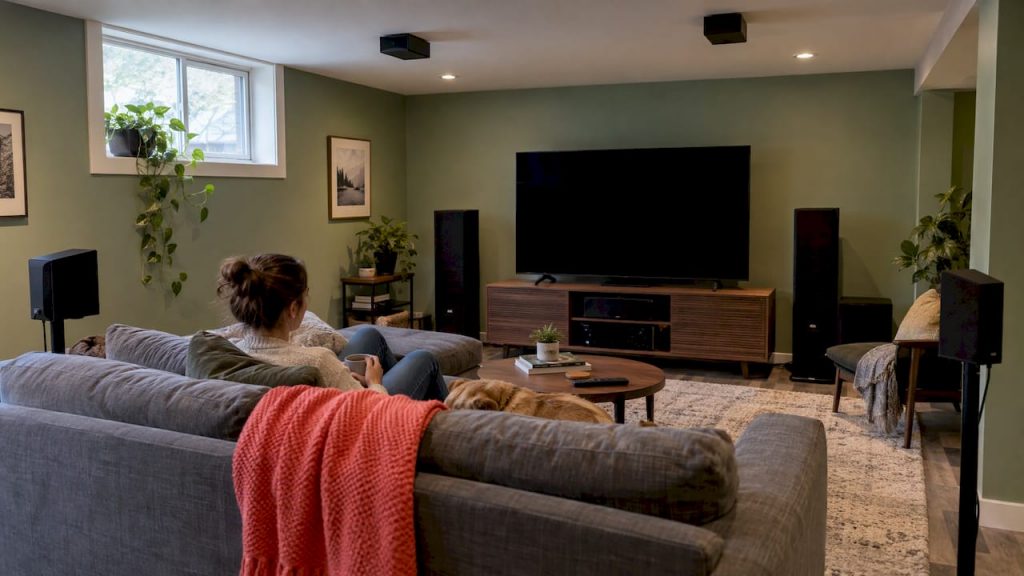
Dolby Atmos vs DTS:X explained in plain English: how each works, where you can find them in Canada, what gear you need and how to choose for movies, music and games.
For most households, Dolby Atmos is the safer pick because far more streaming apps, soundbars and game consoles are built around it. DTS:X is a strong match if you collect Blu-ray discs and own a receiver with speakers placed around the room. With the same speakers in the same room, the two formats sound very close, so the real decision is about what you watch, what you own and what you plan to buy.
This guide walks you through how each format works, where you will actually meet it, what equipment and settings you need, and a simple way to decide. No jargon without a plain explanation first.
TL;DR
- Both Dolby Atmos and DTS:X are “object-based” formats: sounds are placed in a 3D space instead of being locked to one speaker channel.
- Atmos is the easier choice for streaming, soundbars and TVs. DTS:X is mostly found on discs and on receivers.
- Your speaker layout and room shape the sound more than the logo on the box.
- Check your HDMI path: for the best quality from either format, use HDMI eARC or a direct HDMI input, not optical.
- If you own a receiver, you will often get both formats at once, so the choice matters most when buying a soundbar or TV.
Table of Contents
- What Dolby Atmos and DTS:X actually do
- Dolby Atmos vs DTS:X at a glance
- How each format reaches your speakers
- Movies and streaming in Canada
- Music: where Atmos has a head start
- Gaming: what to look at besides the format
- What you need to hear either format
- Should DTS processing be on or off?
- Troubleshooting: when you expected Atmos or DTS:X and do not get it
- A simple way to decide
- Our perspective
- Reach readers who care about home audio
- FAQ
- Sources
What Dolby Atmos and DTS:X actually do
Traditional surround sound works in channels. A 5.1 mix has five speakers and a subwoofer, and each sound is assigned to one or more of those channels. A sound can pan around you, but it stays on the flat plane where the speakers sit.
Object-based audio adds a second idea. Instead of only assigning a sound to a channel, the mix stores that sound as an “object” with position information, such as “a helicopter, above and behind the listener.” Your receiver or soundbar reads that information and works out which of your speakers should play it, and how loudly. That is why one soundtrack can play on a small soundbar, a 5.2.2 home theater or a pair of headphones.
Dolby describes Atmos as a mix of channel-based beds (the ambient foundation) plus movable audio objects, whose position data is rendered by the receiver to the speakers you have. DTS:X follows the same core idea. One manufacturer explainer notes that DTS:X adapts to different speaker arrangements without an official fixed speaker count or location requirement.
In plain terms: both formats aim to put sounds where the filmmaker or sound designer intended, including overhead, and both adapt that to the room you have.
What the numbers mean (5.1.2 and friends)
You will see setups written as three numbers. The first is the number of ear-level speakers, the second is the number of subwoofers, and the third is the number of overhead or height speakers. A 5.1.2 system has five regular speakers, one subwoofer and two height speakers. One receiver maker lists 7.2-channel or 5.2.2-channel layouts for a model that supports both formats, which is a good example of how a single box can be set up for height or for more ear-level speakers.
Dolby Atmos vs DTS:X at a glance
| Question | Dolby Atmos | DTS:X |
|---|---|---|
| Basic idea | Channel beds plus movable audio objects | Object-based audio that adapts to the speaker layout |
| Streaming | Commonly delivered over Dolby Digital Plus | Little used by major streamers, according to a January 2025 comparison |
| Discs | Dolby TrueHD for lossless disc soundtracks | Profile 1 is commonly found on Blu-ray and UHD Blu-ray |
| Soundbars and TVs | Very widely supported | Supported on some models, so check the spec sheet |
| Music | Early platforms for Atmos music releases exist | Music adoption is emerging and limited |
| Speaker flexibility | Maps to the layout you set up | Designed to adapt to many layouts |
| Sound with the same speakers | Very close | Very close |
The last row is worth repeating. One professional review concluded that both formats use the same speaker layout in a system, and it is doubtful one would sound different from the other. Arguments about which one “sounds better” usually come down to how a specific disc was mixed, how the speakers were placed and how the receiver was calibrated.
How each format reaches your speakers
This is where the two formats feel different in daily life. The format is the container, and the container depends on where your content comes from.
Atmos: lossless on discs, efficient for streaming
Dolby’s own home-theater guide says Atmos can travel over Dolby TrueHD for lossless disc soundtracks and Dolby Digital Plus for streaming and broadcast. “Lossless” means no audio detail is thrown away in compression, as with a FLAC file compared with an MP3. “Lossy” streaming versions are compressed to fit a normal internet connection, but they still carry the object positions that create the overhead effect.
DTS:X: two profiles for two jobs
One explainer reports that DTS:X Profile 1 is commonly found on Blu-ray and UHD Blu-ray and can use lossless encoding, while Profile 2 is intended for streaming and uses lossy encoding. So DTS:X was designed for both worlds, but in practice the disc version is the one most owners will meet.
What this means for you
If you mostly open an app on a TV, you will almost always be receiving Atmos when a title says “immersive audio.” If you mostly slide a disc into a player, you may meet either, and a receiver that handles both removes the question.
Movies and streaming in Canada
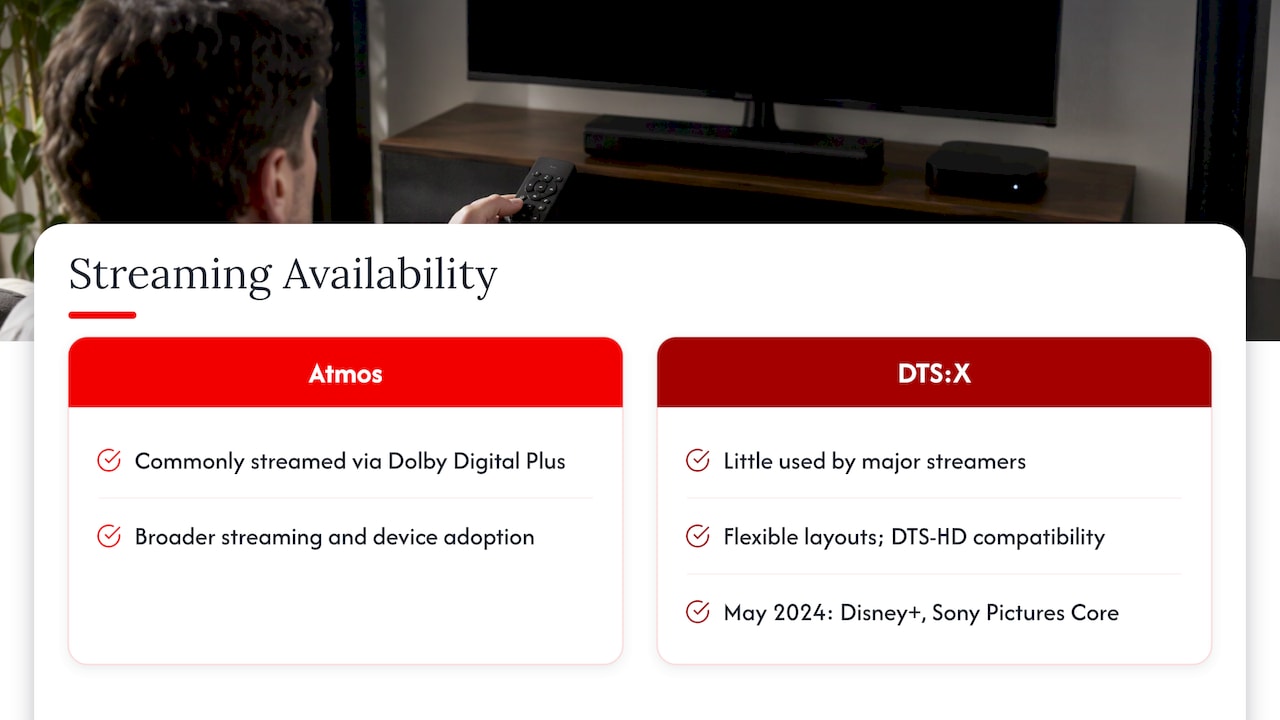
For streaming, Atmos has the clear advantage. An independent comparison published in January 2025 found that streaming services commonly deliver Atmos using Dolby Digital Plus, while DTS:X was little used by major streamers at the time. A separate comparison from May 2025 likewise reports broader Atmos adoption across streaming and home devices, while DTS:X is more associated with layout flexibility and compatibility with DTS-HD discs.
There are exceptions. As of May 2024, Disney+ and Sony Pictures Core offered DTS:X for streaming. Streaming catalogs change often, so before you buy hardware for one specific service, open that service’s help page and confirm what it currently offers on your device and plan. Many apps also reserve their immersive audio for a higher subscription tier.
Discs are where DTS:X shines
If you own a shelf of Blu-rays and UHD Blu-rays, DTS:X is likely to appear on some of them. A receiver that decodes both formats means you never have to check the back of the case. This is the single best argument for a receiver over a soundbar for disc lovers.
A quick tip for disc players
Dolby warns that a Blu-ray player’s secondary-audio mixing mode can output ordinary Dolby Digital instead of the original Atmos bitstream, and it recommends turning that mode off to get the full Atmos signal decoded. If a disc that should be Atmos only shows a plain surround label on your receiver, this setting is the first place to look.
Music: where Atmos has a head start
Immersive music is newer than immersive movies. A May 2025 comparison identifies Apple Music and Tidal as early platforms for Atmos music releases and describes DTS:X music adoption as emerging and limited. For a music lover, that points to Atmos for now.
A good immersive music mix does not fling instruments around for show. It gives voices, reverb and instruments more room, so a live recording feels like a space instead of a line between two speakers. Headphones can reproduce this with virtual rendering, which is a clever way of simulating height and distance with only two drivers. It will not match a ceiling-speaker setup, but it is the easiest way to try immersive audio.
Spoken-word listeners also hear the difference between formats and production styles. If you enjoy stories on audio, see how audiobooks and audio dramas differ, since dramas with layered sound effects are the kind of production where spatial mixing feels most natural.
Gaming: what to look at besides the format
Gaming forums love to argue about this one, and most of the arguments are about opinion. Atmos is widely supported on consoles and PC through software, while DTS:X support depends on the device and the game. Whichever format you pick, check the spec sheet of your console, PC or headset for the exact format it outputs.
For gamers, the video side of your home theater matters just as much as the audio. A Canadian retailer’s AV receiver guide advises gamers to look at VRR, ALLM and QFT, features that help reduce screen tearing, stuttering and lag. If your receiver or soundbar does not pass those signals through, you could end up with better sound and a worse picture.
A practical rule: choose the receiver or soundbar that supports the connections your console needs, then enable the format your games offer. Positional cues such as footsteps overhead or a vehicle passing behind you come from the object placement, and they work the same way in either format when the game supports it.
What you need to hear either format
The format only matters if every link in the chain supports it. Think of it as a relay race: the source, the cable, the TV, the receiver or soundbar and the speakers all have to pass the baton.
1. A source that carries the format
A streaming app, a disc player or a game console must offer an Atmos or DTS:X track, and your account or disc must include it. Pick the immersive audio option in the title’s audio menu if it is not automatic.
2. The right HDMI path
Dolby says an HDMI 1.4-or-later connection supports Atmos audio, and a compatible Blu-ray player should send the bitstream to an Atmos-capable receiver. If you use apps built into your TV, you need to send the sound back to the receiver or soundbar. One receiver maker states that HDMI ARC or eARC can carry TV audio to the receiver. eARC is the newer version, with more room for high-quality audio.
Optical cables are the common trap. A receiver manual for one model says its DTS:X support works via HDMI eARC or an HDMI input, not optical, and that it requires a compatible TV or passthrough and a bitstream, RAW or no-encoding output setting. Treat that as a good general habit: use HDMI, set the player or TV to pass audio through untouched, and let the receiver decode it.
3. A receiver or soundbar that decodes it
A receiver is the box that decodes the audio and powers your speakers. Many current models support both formats, and one Canadian listing, for example, describes a model supporting both Dolby Atmos and DTS:X. Soundbars are different: Atmos is almost standard on the ones that advertise immersive sound, while DTS:X appears on some and not on others. Always look for the exact words “DTS:X” on the product page.
4. Height speakers, or a good simulation
Overhead sound comes from speakers in the ceiling or from upward-firing speakers that bounce sound off it. A professional guide says ceiling or upward-firing height channels help create the overhead sound field, and upward-firing results depend on your room and ceiling. In plain terms: low, flat ceilings work best for bounce speakers, while very high, vaulted or sloped ceilings can weaken the effect.
5. Room calibration
Most receivers include a microphone and an automatic setup routine. The Canadian listing mentioned above describes room calibration using the supplied microphone. Run it with the room as you normally use it, with the couch in place and the microphone at ear height in your seat. It takes a few minutes and tunes levels and distances so that overhead effects do not overpower dialogue.
6. A room that helps the sound
Big, bare rooms add echo that blurs positioning. Rugs, curtains and bookshelves help, and so does controlling outside noise. Our guides on setting up an immersive entertainment space and on soundproofing a room as a homeowner or renter cover the practical side of seating, layout and keeping the sound where you want it.
Should DTS processing be on or off?
This is one of the most common questions people ask, and it has a simple answer: leave processing on automatic unless something sounds wrong.
TCL’s Canadian support page for its Google TV models lists the audio processing choices as Auto, Dolby Atmos, DTS Virtual:X and Off, and explains that Auto selects the appropriate processing for you. Virtual processing like this is meant for TV speakers and headphones, where it simulates height and width with software.
A good way to think about it:
- Using the TV’s built-in speakers: Auto is a sensible start. Try a virtual mode and compare it with Off while playing a familiar scene.
- Sending audio to a receiver or soundbar: set the TV to pass the audio through unchanged, so the receiver does the decoding. Extra processing on the TV can interfere.
- Dialogue sounds thin or echoey: switch off virtual processing and see whether the problem goes away.
There is no right answer for every room. Pick the setting that makes dialogue clear and effects believable at the volume you normally watch.
Troubleshooting: when you expected Atmos or DTS:X and do not get it
When the receiver display says plain Dolby Digital or PCM rather than the format you expected, work through this list from the source outward:
- Check the title’s audio menu. Not every episode or disc track includes the immersive version.
- Check the app’s plan and device support. Some apps only offer immersive audio on certain plans or devices.
- Check the player’s audio output setting. It should be set to bitstream, RAW or no encoding, as the manual above describes, not to PCM or a downmix.
- Turn off secondary-audio mixing on disc players if you see a plain surround format, as Dolby advises.
- Use HDMI, not optical. Switch to eARC or a direct HDMI input.
- Update firmware on your TV, player and receiver, since support for formats is often added or fixed this way.
A simple way to decide
Ask yourself three questions.
What do you watch and play most? If the answer is streaming apps and consoles, choose Atmos. If it is discs, look for a receiver that handles both.
What are you buying? A soundbar or TV: Atmos is nearly always the safest feature to prioritize, with DTS:X as a bonus if listed. A receiver: look for both formats, then focus on the number of speaker channels, HDMI connections and calibration.
What does your room allow? If you cannot add height speakers, a good soundbar with upward-firing drivers or a headphone mode is a fine way to get a sense of overhead sound. If you can mount ceiling speakers, either format will use them well.
Three example households
- The streaming-first apartment. One TV, one soundbar, mostly apps. Pick an Atmos soundbar with eARC and enable the immersive option in each app.
- The disc-collector basement. A projector, a stack of UHD Blu-rays and room for speakers. Pick a receiver that decodes both formats, wire everything with HDMI and run calibration.
- The console gamer in a small room. A console, a gaming monitor or TV and a headset. Choose the setup that passes your console’s video features through and use the headset’s Atmos option if offered.
One thing to avoid is buying on the logo alone. A well-placed, well-calibrated system with either format beats a poorly placed one with both.
Our perspective
We read a lot of spec sheets, and the same pattern keeps showing up: shoppers get stuck comparing two logos when the choice is really about the content they play and the room they sit in. Atmos and DTS:X both do the same remarkable thing, which is to put sound in three dimensions, and either one can make a Friday movie night feel bigger than the screen.
Our approach at Lizard’s Lunch is to give you the practical picture: what to watch for in a spec sheet, how to wire things up, and how to set up the room so the sound lands. We cover home improvement, tech, music and entertainment in one place because a great audio setup touches all of them: the gear, the space, the neighbours and the playlist.
Start with what you already own and watch, pick the format that fits it, then enjoy tuning the room. That is where the magic happens.
Alexander
Reach readers who care about home audio
If you run a brand, shop or service in home entertainment, audio gear or lifestyle, our team at Lizard’s Lunch offers banner ads and guest posts for readers who come to us for guides like this one. Visit the page to see how to get in touch.
FAQ
Is Atmos better than DTS:X?
Not in any way you can reliably hear. With the same speaker layout, the sound is very close, and one professional review found it doubtful that one would sound different from the other. Atmos is better supported on streaming services and soundbars, which makes it the easier default.
Is it worth getting a soundbar with Dolby Atmos?
If you stream a lot, yes, since Atmos is the format most streaming apps use for immersive sound. Look for HDMI eARC on the soundbar, and check how it creates height, either with upward-firing drivers or with processing. A low, flat ceiling helps upward-firing models perform as designed.
What is the difference between Dolby Atmos and regular surround sound?
Regular surround assigns sound to fixed channels around you at ear level. Atmos stores sounds as objects with position data, so a receiver or soundbar can place them in 3D, including overhead, based on the speakers you have. It also scales from a soundbar to a full home theater.
Can one system play both formats?
Many current receivers decode both Dolby Atmos and DTS:X, so you can enjoy streaming and discs without choosing. Soundbars vary more, so check the product page for the exact format names before you buy.
Sources
- Dolby Atmos for the Home Theater (Dolby)
- What is DTS X or Dolby Atmos Audio Format? (Sony USA)
- Dolby Atmos vs DTS:X: The leading object-based audio formats (Expert Reviews)
- The Differences Between Dolby Atmos and DTS:X (HomeTheaterHiFi)
- DTS:X explained (ecoustics)
- AVR-X2800H 7.2 Ch. 8K AV Receiver (Denon Canada)
- AX5125H manual
- TCL Google TV Audio Settings (TCL Canada)
- Best AV receivers (Best Buy Canada blog)
- Audiobook vs audio drama


















Leave a Comment
Your email address will not be published. Required fields are marked with *