

Discover the role of technology in fashion by 2026. Explore how AI and digital innovation are transforming design, production, and shopping.
The role of technology in fashion is to reshape every stage of the industry, from the first sketch on a design screen to the moment a garment reaches your hands. Digital innovation in fashion now touches trend forecasting, factory production, sustainable sourcing, and the way you shop online or in store. AI has moved from a priority to a necessity, dominating industry priorities by pushing workflows toward leaner, faster, and more resource-efficient models. Whether you follow luxury couture or fast fashion, the technology reshaping those worlds is more fascinating, and more consequential, than most people realize.
How is artificial intelligence reshaping fashion design and production?
AI is the single most powerful force changing how fashion brands design, forecast, and manufacture clothing in 2026. The impact shows up in hard numbers and on factory floors in equal measure.
Trend forecasting at machine speed
Trend analysis used to mean teams of buyers traveling to trade shows and flipping through mood boards. Today, AI processes visual data at a scale no human team can match. Zara analyzes over 3 million social media images daily to align 85% of its production with in-season demand. That single capability eliminates enormous amounts of static inventory and avoids millions of tons of fabric waste each year. The speed of that feedback loop, from street style image to production decision, is genuinely new in the history of fashion.
Demand forecasting and operational efficiency
Demand forecasting is where AI delivers its clearest financial return. When a brand predicts what shoppers will buy before the season opens, it orders less, wastes less, and marks down less. Sales per employee surpassed $222,000 in the fashion industry, with a 0.5% annual growth rate since 2021 driven largely by AI efficiency gains. Industry analysts project EBIT margins to increase by 50 basis points in 2026 as a direct result. That margin improvement is not abstract. It funds better materials, better wages, and more investment in sustainable production.
Physical AI on the factory floor
The most surprising development in production technology is what researchers call “physical AI.” Physical AI on garment factory floors follows a sense, think, act, learn workflow, meaning machines adapt in real time to variations in fabric texture, weight, and stretch. Traditional factory robots follow pre-programmed instructions and fail when materials deviate from spec. Physical AI systems adjust on the fly, the way a skilled tailor does. This adaptive automation represents a genuinely new paradigm for garment manufacturing.
Here is how AI is restructuring the core production workflow:
- Image analysis scans social media and runway data to identify emerging trends before they peak.
- Demand modeling predicts category-level sales volumes weeks or months ahead of production deadlines.
- Physical AI sensing monitors fabric behavior on the production line and adjusts machine parameters in real time.
- Inventory alignment matches finished goods to regional demand signals, reducing overstock at the distribution level.
- Returns analysis feeds post-sale data back into the design cycle to improve fit and reduce return rates.
Pro Tip: When evaluating how a brand uses AI, look for evidence of demand alignment, not just trend prediction. Brands that connect forecasting directly to production orders reduce waste far more effectively than those using AI only for marketing.
What technologies are enabling personalization and immersive consumer experiences?
Personalization is the most visible face of digital innovation in fashion for everyday shoppers. The technology behind it is more complex, and more contested, than the polished shopping apps suggest.
Virtual try-ons and clienteling
AI-powered virtual try-ons with 360-degree previews are changing the relationship between online browsing and physical retail. Rather than replacing in-store visits, the best implementations actually increase them by giving shoppers confidence before they arrive. A customer who has virtually tried on three jacket silhouettes walks into a store knowing exactly what she wants to feel on her body. That confidence shortens the sales conversation and deepens the relationship between shopper and brand advisor. Retailers that integrate virtual try-ons as a clienteling tool, rather than a pure e-commerce feature, see stronger engagement on both channels.

The trust problem in AI personalization
Personalization technology carries a real risk that brands often underestimate. Excessive AI-driven personalization creates trust deficits and perceived complexity, which reduce purchase intention among shoppers. A survey of 375 fashion shoppers confirmed that when recommendations feel opaque or intrusive, shoppers disengage rather than convert. The fix is not less personalization. The fix is transparency and control.
- Give shoppers a visible way to adjust or override AI recommendations.
- Explain why a product is being suggested, even in a single sentence.
- Avoid surfacing recommendations based on data points shoppers did not knowingly share.
- Let shoppers build their own style profiles rather than inferring everything from behavior.
- Test personalization intensity by segment, since high-engagement shoppers tolerate more algorithmic curation than casual browsers.
Successful AI personalization requires balancing consumer agency and trust by providing transparency and options to steer recommendations. Brands that treat personalization as a conversation rather than a prediction engine build longer-term loyalty.
Digital prototyping and made-to-order fashion
The most exciting application of personalization technology is not on the shopping app. It is in the design studio. Made-to-order fashion scales with 3D pattern making and digital prototyping to balance individual customization with genuine sustainability. The Just Fashion EU Project piloted this approach with Bastet Noir, proving that a small brand can offer true made-to-measure garments without the traditional cost and waste of sample production. Digital prototyping eliminates physical samples, which means no fabric cut until a real order exists. That shift alone can reduce a brand’s pre-production waste by a significant margin. You can see how fashion trends in 2026 are being shaped by exactly this kind of technology-driven customization.
Pro Tip: If you want to experience made-to-order fashion without a luxury price tag, look for brands using digital prototyping platforms. They can offer genuine fit customization at near-ready-to-wear prices because they have eliminated the cost of physical sampling.
How does technology drive sustainability in the fashion industry?
Sustainability is where the impact of technology on fashion becomes most consequential. The fashion industry is one of the world’s largest polluters, and digital tools are the most credible path toward changing that.
Reducing waste through demand alignment
The core sustainability problem in fashion is overproduction. Brands make more than they sell, then discount, destroy, or landfill the excess. AI-driven demand forecasting attacks this problem directly. When production aligns with real demand, less fabric gets cut, fewer garments get made, and less ends up in landfill. Zara’s use of social media image analysis to align 85% of production with in-season demand is the clearest large-scale proof point available. The environmental math is straightforward: fewer unsold units means fewer tons of textile waste.
Digital tools for circular and local production
Beyond demand forecasting, digital tools support circular business models in two specific ways. First, 3D knitting technology produces garments with near-zero cutting waste because the fabric is formed to shape rather than cut from a flat panel. Second, digital prototyping enables local manufacturing by removing the need to ship physical samples across continents for approval. Both approaches reduce the carbon footprint of production before a single garment ships to a consumer.
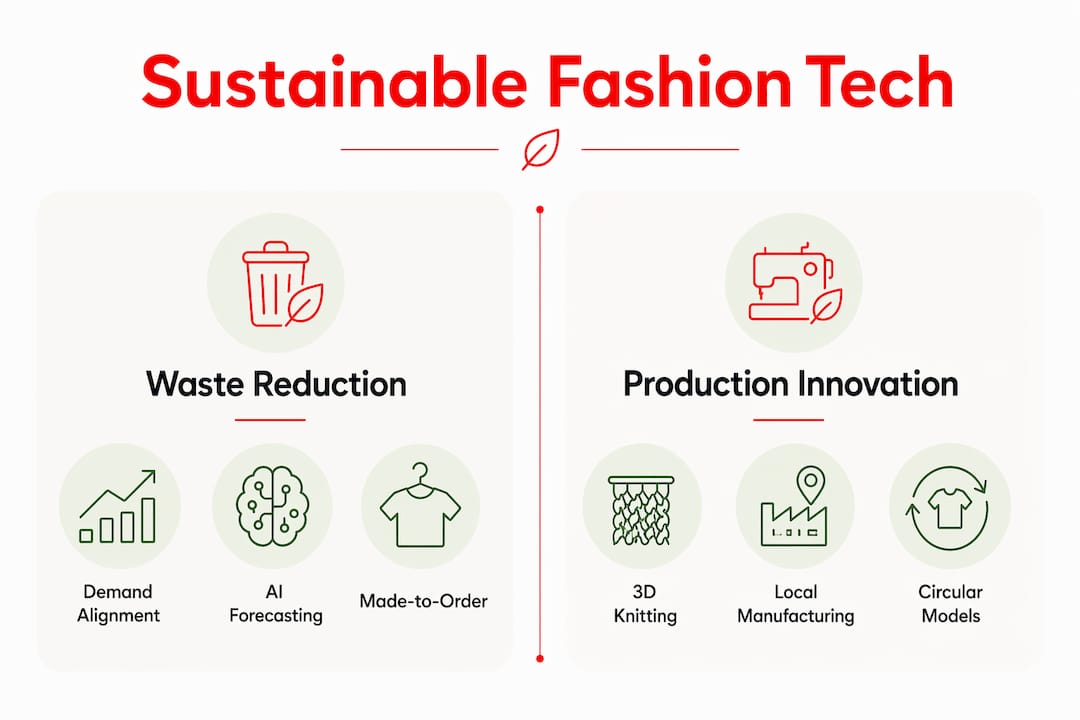
| Practice | Traditional approach | Tech-enabled approach |
|---|---|---|
| Trend forecasting | Buyer travel, trade shows, intuition | AI image analysis of millions of social posts |
| Sample production | Physical fabric samples, international shipping | 3D digital prototypes, no physical waste |
| Demand planning | Historical sales data, seasonal estimates | Real-time AI demand modeling |
| Garment construction | Cut-and-sew from flat fabric panels | 3D knitting, near-zero cutting waste |
| Inventory management | Seasonal bulk orders, markdown cycles | Dynamic ordering aligned to live demand signals |
Sustainability as a driver for digital adoption
Smaller brands adopt digital tools for sustainability reasons as often as for efficiency reasons. Digital innovation in fashion often arises from constraint, such as a small brand needing to offer personalization without the waste of traditional sampling. For independent designers and small-to-medium enterprises, digital prototyping is not a luxury. It is the only way to compete on customization while keeping environmental impact low. You can read more about how eco-friendly business practices connect to these digital tools across industries.
What is the nuanced impact of technology in luxury fashion versus mass retail?
The most misunderstood dimension of technology trends in clothing is how differently luxury and mass retail use the same tools. The technology is often identical. The philosophy behind its use is completely opposite.
Luxury fashion: AI in the background
Luxury brands do not want their customers to feel like they are interacting with an algorithm. Luxury fashion uses AI agents behind the scenes to empower sales advisors with live customer segmentation, product information, and storytelling capabilities, while keeping AI invisible to the consumer. A sales advisor at a luxury house knows your purchase history, your size preferences, and the narrative behind every piece in the new collection, all delivered by AI in real time through a discreet interface. The customer experiences a deeply personal conversation. The technology stays out of sight.
Luxury brands also make a deliberate choice to preserve human imperfection. Luxury brands deliberately preserve “friction” and human imperfections enabled by AI to maintain exclusivity in a commoditized market. A hand-stitched buttonhole that takes a craftsperson twenty minutes is not inefficient. It is the point. AI handles the logistics, the inventory, and the client data so that the craftsperson can focus entirely on the hand work that justifies the price.
Mass retail: full automation as the goal
Mass retail takes the opposite approach. The goal is frictionless automation at every stage, from trend detection to checkout. AI agents handle customer service, product recommendations, size guidance, and post-purchase follow-up with minimal human involvement. Physical AI on production lines reduces labor costs and increases throughput. The consumer experience is designed to be fast, convenient, and personalized at scale.
“AI should be a background tool enabling, not replacing, human storytelling and consumer connection. The brands that will win are those that use technology to free their people to do what only humans can do.”
Andrea Steiner, as cited in Vogue’s expert analysis on AI in fashion
The contrast between these two models reveals something important about how technology changes fashion. The tool is neutral. The brand’s values determine whether technology serves human creativity or replaces it. AI disrupting marketing and media follows the same pattern across industries: the brands with the clearest sense of identity use AI to amplify what makes them distinctive, while brands without that clarity risk becoming interchangeable.
- Luxury model: AI empowers advisors, preserves artisanal craft, keeps technology invisible to the consumer.
- Mass retail model: AI automates customer touchpoints, production lines, and inventory management end to end.
- Shared foundation: Both models rely on demand forecasting, data analysis, and physical AI in manufacturing.
- Key differentiator: The human role. Luxury expands it. Mass retail reduces it.
The wearable tech space sits interestingly between these two worlds. Wearable tech in travel shows how technology can enhance personal experience without replacing the human element, a balance luxury fashion is actively trying to replicate.
Key Takeaways
Technology in fashion is most powerful when it amplifies human creativity, reduces waste, and gives consumers genuine control over their experience.
| Point | Details |
|---|---|
| AI drives measurable efficiency | Sales per employee surpassed $222,000, with EBIT margins projected to rise 50 basis points in 2026. |
| Demand forecasting cuts waste | Aligning production to real demand, as Zara does with 85% in-season alignment, reduces fabric waste at scale. |
| Personalization requires trust | Giving shoppers control over AI recommendations reduces trust deficits and increases purchase intention. |
| Luxury and mass retail diverge | Luxury keeps AI invisible to preserve human connection; mass retail automates consumer touchpoints end to end. |
| Digital prototyping enables sustainability | 3D pattern making and made-to-order production eliminate physical samples and reduce pre-production waste significantly. |
Where technology and humanity meet in fashion
Our team at Lizard’s Lunch has spent considerable time tracking how technology reshapes creative industries, and fashion is the most revealing case study available right now. The numbers are compelling. The efficiency gains are real. But the most interesting story is not about the technology itself.
The brands getting this right are the ones that started with a clear answer to one question: what do we want technology to free our people to do? Luxury houses answer that question with craft and storytelling. Mass retailers answer it with speed and scale. Both answers are legitimate. The brands that struggle are the ones that adopt AI because competitors are doing it, without a clear sense of what human value they are trying to protect or amplify.
The personalization trust problem is the clearest warning sign in the current moment. A survey of 375 fashion shoppers confirmed that opaque, intrusive AI recommendations actively reduce purchase intention. That finding should be uncomfortable for any brand that has deployed personalization without giving shoppers meaningful control. Technology that erodes trust is not a competitive advantage. It is a liability dressed up as progress.
The future of fashion technology belongs to brands that treat AI as infrastructure, not identity. The infrastructure handles forecasting, logistics, and data. The identity comes from designers, craftspeople, and the stories brands tell about why their work matters. That balance is not a philosophical position. It is a business strategy with a growing body of evidence behind it.
— Our team at Lizard’s Lunch
What Lizard’s Lunch covers on technology and modern living
Lizard’s Lunch covers the full spectrum of how technology shapes the way we live, dress, and experience the world around us. If this look at digital innovation in fashion sparked your curiosity, there is a lot more to explore across the site. From the role of gadgets in daily life to the broader tradeoffs that come with living in a tech-forward world, Lizard’s Lunch brings the same depth and specificity you found here. The site covers lifestyle, home, travel, and technology with the same commitment to real insight over generic advice. Readers who want to understand how technology fits into a well-lived life will find plenty of material worth their time.
FAQ
What is the role of technology in fashion today?
Technology reshapes fashion across design, production, sustainability, and consumer experience. AI drives trend forecasting, demand alignment, and personalized shopping, while digital prototyping reduces waste in manufacturing.
How does AI reduce waste in fashion production?
AI demand forecasting aligns production to real consumer demand before garments are manufactured. Zara uses this approach to align 85% of production with in-season demand, significantly reducing unsold inventory and fabric waste.
What is physical AI in garment manufacturing?
Physical AI refers to factory systems that sense, think, act, and learn in real time, adapting to variations in fabric texture and weight. This goes beyond traditional pre-programmed robotics by adjusting machine behavior on the fly.
How does luxury fashion use technology differently than mass retail?
Luxury brands keep AI invisible, using it to empower sales advisors with live customer data while preserving human craft and storytelling. Mass retail uses AI to automate customer touchpoints and production lines end to end.
Why does AI personalization sometimes reduce purchase intention?
Opaque or intrusive AI recommendations create trust deficits among shoppers. A study of 375 fashion shoppers found that giving consumers control over AI curation and explaining why products are recommended restores trust and improves conversion.
















Leave a Comment
Your email address will not be published. Required fields are marked with *