

Discover why sleep hygiene is important for better health. Improve your sleep quality and boost your well-being with simple daily habits.
Sleep hygiene is the set of daily habits and environmental conditions that directly shape your ability to get restorative, consistent sleep. Most people treat sleep as something that just happens, but the quality of your sleep is largely determined by choices you make throughout the day. Over 33% of Americans face chronic sleep quality issues, making poor sleep one of the most widespread health problems in the country. That number reflects not just tired mornings but a measurable drag on immune function, mental clarity, and long-term disease risk. Understanding why sleep hygiene is important is the first step toward changing how you sleep and, by extension, how you feel every day.
Why sleep hygiene is important for your body and mind
Sleep hygiene directly affects how well your body repairs itself each night. Every major system in your body, including your immune, metabolic, and cardiovascular systems, depends on consistent, quality sleep to function properly. Poor sleep over time raises the risk of heart disease, type 2 diabetes, depression, and anxiety. These are not distant possibilities. They are documented outcomes of years of fragmented or shortened sleep.
Your brain is especially active during sleep, even though it feels like the opposite. Sleep is an active period of neurological maintenance, including memory consolidation, emotional regulation, and metabolic waste clearance through the brain’s glymphatic system. That glymphatic system flushes out harmful proteins that, when they accumulate, are associated with cognitive decline. Think of it as a nightly cleaning cycle your brain cannot run while you are awake.
The effects of poor sleep hygiene show up faster than most people expect. Mood instability, reduced concentration, and weakened immune response can appear after just a few nights of disrupted sleep. Sleeping fewer than six hours regularly increases the clinical risk for hypertension, obesity, and type 2 diabetes. That six-hour threshold is not a guideline. It is a measurable boundary where health outcomes begin to shift.
The mental health connection is equally striking. Sleep and emotional regulation are deeply linked. When you sleep poorly, your brain’s threat-detection center, the amygdala, becomes overactive. You react more intensely to stress, feel more anxious, and recover more slowly from difficult emotions. Consistent, quality sleep is one of the most powerful tools for mental health and well-being you have access to right now.
Key physical and mental effects of poor sleep hygiene:
- Increased risk of hypertension and cardiovascular disease
- Higher likelihood of developing type 2 diabetes and obesity
- Weakened immune response and slower recovery from illness
- Impaired memory consolidation and reduced learning ability
- Heightened anxiety, mood swings, and emotional instability
- Accelerated cognitive decline over the long term
Pro Tip: If you wake up feeling unrefreshed even after seven or eight hours, the issue is likely sleep quality, not duration. Track how often you wake during the night, since fragmented sleep disrupts the glymphatic cycle even when total hours look adequate.
What sleep hygiene practices does science actually support?
The science of sleep hygiene has grown sharply over the past two decades, and not every popular tip holds up under scrutiny. The practices with the strongest evidence share one thing in common: they work by anchoring your body’s internal clock, known as the circadian rhythm.
Consistent wake times
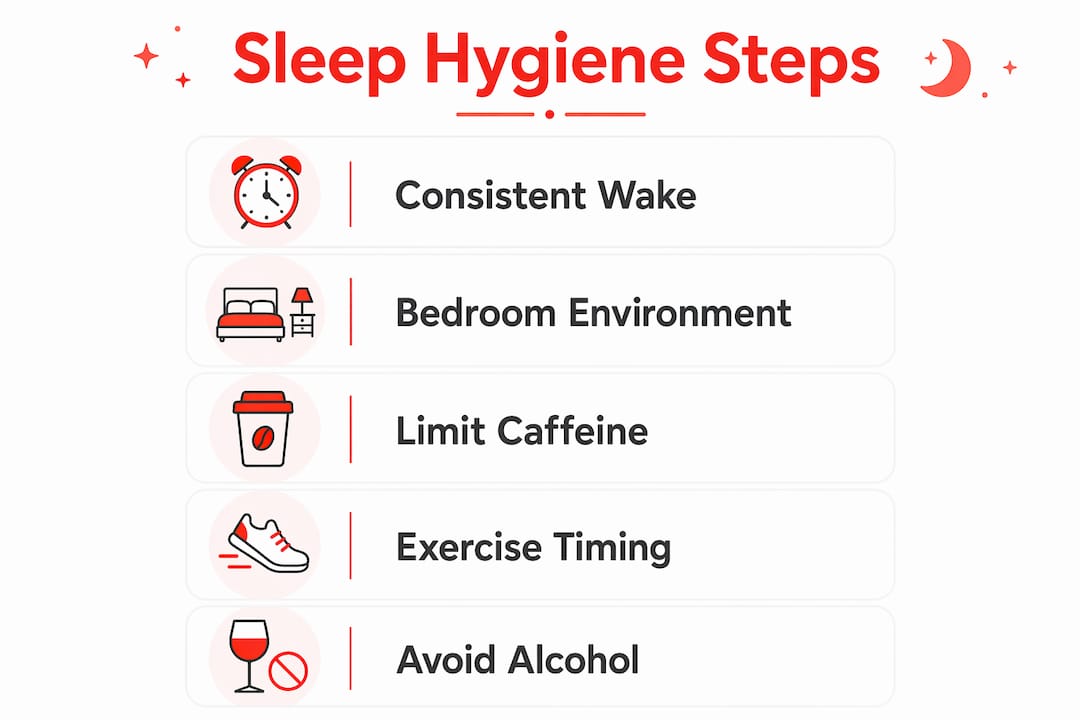
Maintaining a consistent wake time every day, including weekends, is one of the most impactful habits you can build. Your circadian rhythm is a biological clock that regulates sleepiness and alertness on a roughly 24-hour cycle. When your wake time shifts by two or more hours on weekends, you create what researchers call “social jet lag,” which disrupts that rhythm in the same way crossing time zones does. A fixed wake time, even after a bad night, is the single fastest way to reset your sleep drive.
Environment controls
Your bedroom environment sends powerful signals to your brain about whether it is time to sleep. The three variables with the most evidence behind them are temperature, light, and noise. A cooler room, typically around 65–68°F, supports the natural drop in core body temperature that triggers sleep onset. Blackout curtains or a sleep mask block light that suppresses melatonin production. White noise or earplugs reduce the chance that environmental sounds fragment your sleep cycles. The color of your bedroom can also influence how quickly you relax, with cooler, muted tones generally supporting a calmer pre-sleep state.
Stimulant and alcohol timing
Caffeine and alcohol are the two most commonly misunderstood sleep disruptors. Caffeine blocks adenosine receptors, the chemical signal that builds sleep pressure throughout the day. Its half-life is approximately 5–7 hours, which means a 3:00 PM coffee still has half its caffeine active at 8:00 PM or 9:00 PM. Afternoon caffeine intake reduces slow-wave sleep even when you do not feel alert at bedtime. Alcohol is equally deceptive. It may help you fall asleep faster, but it fragments the second half of your sleep cycle and suppresses REM sleep, the stage most critical for emotional processing.
Exercise timing
Regular exercise improves sleep quality, and the evidence for this is strong. The nuance is timing. Intense workouts within one to two hours of bedtime can delay sleep onset for some people by raising core body temperature and elevating adrenaline. For most people, morning or afternoon exercise delivers the full benefit without the trade-off. If evening is your only option, moderate intensity activities like walking or yoga are far less disruptive than high-intensity interval training.
Pro Tip: Cut off caffeine by 1:00 PM if you want to protect your deep sleep. Even if you feel fine after an afternoon coffee, your slow-wave sleep, the most physically restorative stage, is likely being shortened without you noticing.
Evidence-based sleep hygiene practices ranked by impact:
| Practice | Evidence Strength | Key Mechanism |
|---|---|---|
| Consistent wake time (7 days) | Very strong | Anchors circadian rhythm |
| Cool, dark, quiet bedroom | Strong | Supports sleep onset and continuity |
| Caffeine cutoff before 1:00 PM | Strong | Preserves slow-wave sleep |
| Limiting alcohol before bed | Moderate to strong | Protects REM sleep |
| Regular daytime exercise | Strong | Increases sleep drive and depth |
| Pre-sleep wind-down routine | Moderate | Reduces cortisol and arousal |
Common misconceptions about sleep hygiene
Sleep hygiene is widely discussed but frequently misunderstood. The biggest misconception is that it is a cure for all sleep problems. It is not. Sleep hygiene is foundational, meaning it creates the conditions for good sleep, but it cannot resolve every sleep disorder on its own.
Sleep hygiene education alone rarely resolves chronic insomnia. Multiple studies find that sleep hygiene as a standalone intervention produces only modest improvements for people with persistent insomnia. The reason is that chronic insomnia is often maintained by psychological factors, specifically conditioned arousal, where the bed itself becomes associated with wakefulness and anxiety rather than sleep.
“Worrying about sleep or lying awake in bed can actually worsen insomnia over time. The brain learns to associate the bedroom with alertness, creating a cycle that good sleep habits alone cannot break. Cognitive behavioral therapy for insomnia, known as CBT-I, directly targets these conditioned patterns through stimulus control, sleep restriction, and cognitive restructuring. CBT-I is the first-line recommended treatment for chronic insomnia, not sleep hygiene education.”
Other myths worth addressing:
- “Screens before bed are always harmful.” Blue light from screens does suppress melatonin, but the effect is modest compared to the mental stimulation of engaging content. The content matters as much as the light.
- “You need exactly eight hours.” The 8-hour sleep target is overly simplistic. True sleep health includes regularity, efficiency, timing, duration, and subjective satisfaction. Some adults function well on seven hours. Others need nine.
- “Exercise before bed always ruins sleep.” For most people, moderate evening exercise does not significantly disrupt sleep. The concern applies mainly to high-intensity training within one to two hours of bedtime.
- “Catching up on weekends fixes sleep debt.” Weekend recovery sleep partially restores alertness but does not fully reverse the metabolic and cognitive effects of a sleep-deprived week.
How to apply sleep hygiene for better rest
Building better sleep habits works best as a gradual process, not an overnight overhaul. Trying to change everything at once creates stress, which is itself a sleep disruptor. A phased approach, starting with the highest-impact habits, delivers results without the friction.
A practical step-by-step approach:
- Set a fixed wake time. Choose a time you can maintain every day, including weekends. This is your anchor. Everything else builds from here.
- Audit your bedroom environment. Check temperature, light, and noise. Make one adjustment at a time so you can identify what helps.
- Map your caffeine intake. Write down every caffeinated drink and its timing for three days. Move your last caffeine intake earlier by 30 minutes each week until you reach 1:00 PM or earlier.
- Create a 30-minute wind-down routine. This signals your nervous system that sleep is coming. Options include reading physical books, gentle stretching, or a warm shower. A warm shower works partly because the subsequent drop in skin temperature mimics the body’s natural sleep-onset cooling process.
- Reserve your bed for sleep only. Avoid working, scrolling, or watching content in bed. This rebuilds the mental association between your bed and sleep rather than wakefulness.
- Track your sleep satisfaction, not just duration. Rate how rested you feel each morning on a simple 1–5 scale. Patterns will emerge within two weeks.
Pro Tip: A therapeutic sleeping pillow that supports your neck’s natural curve can reduce nighttime repositioning, which fragments sleep cycles more than most people realize.
Small, persistent sleep problems can evolve into chronic sleep disorders if left unaddressed. Early consultation with a healthcare provider leads to faster relief and better outcomes. If you have applied consistent sleep hygiene practices for four to six weeks without improvement, that is a clear signal to seek professional evaluation.
Quick-reference sleep hygiene checklist:
| Sleep Hygiene Step | Why It Works |
|---|---|
| Fixed wake time daily | Stabilizes circadian rhythm across the week |
| Bedroom at 65–68°F | Triggers core body temperature drop for sleep onset |
| Caffeine cutoff at 1:00 PM | Protects slow-wave deep sleep stages |
| 30-minute wind-down routine | Lowers cortisol and reduces cognitive arousal |
| Bed reserved for sleep only | Prevents conditioned wakefulness in the bedroom |
| Daytime exercise (not late evening) | Builds sleep drive and improves sleep depth |
For people managing irregular schedules, such as shift workers or frequent travelers, the priority shifts to protecting the wake time anchor as much as possible and using light exposure strategically. Morning light exposure within 30 minutes of waking is one of the fastest ways to reset a disrupted circadian rhythm. Pair that with avoiding bright light in the two hours before your target bedtime, and you give your body a clear signal about when day ends and night begins. Exploring sleep improvement products designed for irregular schedules can also provide practical support when your environment is not fully in your control.
Key Takeaways
Good sleep hygiene is the most accessible and evidence-backed foundation for physical health, mental clarity, and long-term disease prevention available to you right now.
| Point | Details |
|---|---|
| Sleep hygiene shapes health outcomes | Poor sleep raises the risk of heart disease, diabetes, and depression over time. |
| Consistent wake time is the top habit | Fixing your wake time every day anchors your circadian rhythm and prevents social jet lag. |
| Caffeine timing matters more than you think | Caffeine consumed after 1:00 PM reduces deep sleep even when you feel fine at bedtime. |
| Sleep hygiene alone does not cure insomnia | Chronic insomnia requires CBT-I, which targets conditioned arousal that habits cannot fix. |
| Early action prevents chronic disorders | Addressing sleep problems within weeks leads to faster recovery and better long-term outcomes. |
What our team at Lizard’s Lunch has learned about sleep hygiene
Our team at Lizard’s Lunch has spent a lot of time covering health and lifestyle topics, and sleep hygiene consistently stands out as the area where the gap between what people know and what they actually do is widest. Almost everyone understands that sleep matters. Very few people treat it with the same discipline they apply to diet or exercise.
The most common barrier we observe is not lack of information. People know caffeine affects sleep. They know screens are stimulating. The real barrier is the belief that these habits only matter if you have a serious sleep problem. That thinking is exactly backwards. Sleep hygiene is most powerful as a preventive practice, not a rescue strategy. By the time sleep problems feel serious, conditioned patterns have often already formed and simple habit changes are no longer enough.
One insight that genuinely surprised us: the wind-down routine matters more than the bedtime itself. People obsess over what time they go to bed, but the 30 minutes before that moment are what actually determine how quickly and deeply you fall asleep. A consistent pre-sleep ritual, even a simple one, signals your nervous system to shift gears. That transition is where sleep hygiene does its most important work.
The other thing worth saying plainly: sleep hygiene is not a wellness trend. It sits alongside diet and exercise as a genuine pillar of healthy living. Treating it as optional is like treating hydration as optional. You can get away with it for a while, but the costs accumulate quietly and show up later in ways that are much harder to reverse.
— Our team at Lizard’s Lunch
Sleep well, live better: more resources from Lizard’s Lunch
Better sleep is one piece of a much larger picture. At Lizard’s Lunch, we cover the full range of habits and choices that add up to a genuinely healthy life. If this article sparked your interest in building better daily routines, our complete healthy lifestyle guide covers nutrition, movement, mental well-being, and sleep as an integrated system rather than separate goals. You will find practical, research-grounded advice written for real people with real schedules. Good sleep is the foundation. What you build on top of it is where life gets interesting.
FAQ
What is sleep hygiene and why does it matter?
Sleep hygiene is the collection of daily habits and environmental conditions that influence sleep quality. It matters because consistent, restorative sleep directly supports immune function, metabolic health, emotional regulation, and long-term disease prevention.
How many hours of sleep do adults actually need?
Most adults need seven to nine hours, but duration alone does not define sleep health. Regularity, sleep efficiency, timing, and how rested you feel in the morning are equally important measures of whether your sleep is truly restorative.
Can sleep hygiene fix chronic insomnia?
Sleep hygiene alone rarely resolves chronic insomnia. Persistent insomnia is best treated with cognitive behavioral therapy for insomnia, known as CBT-I, which targets the conditioned arousal patterns that habits cannot address on their own.
What is the single most impactful sleep hygiene habit?
Maintaining a consistent wake time every day, including weekends, has the strongest evidence behind it. A fixed wake time anchors your circadian rhythm and reduces the social jet lag that disrupts sleep quality across the week.
Does caffeine really affect sleep if you drink it in the afternoon?
Yes. Caffeine’s half-life of approximately 5–7 hours means an afternoon coffee is still partially active at bedtime. It measurably reduces slow-wave deep sleep even when you do not feel alert, leaving you less physically restored by morning.

















Leave a Comment
Your email address will not be published. Required fields are marked with *