
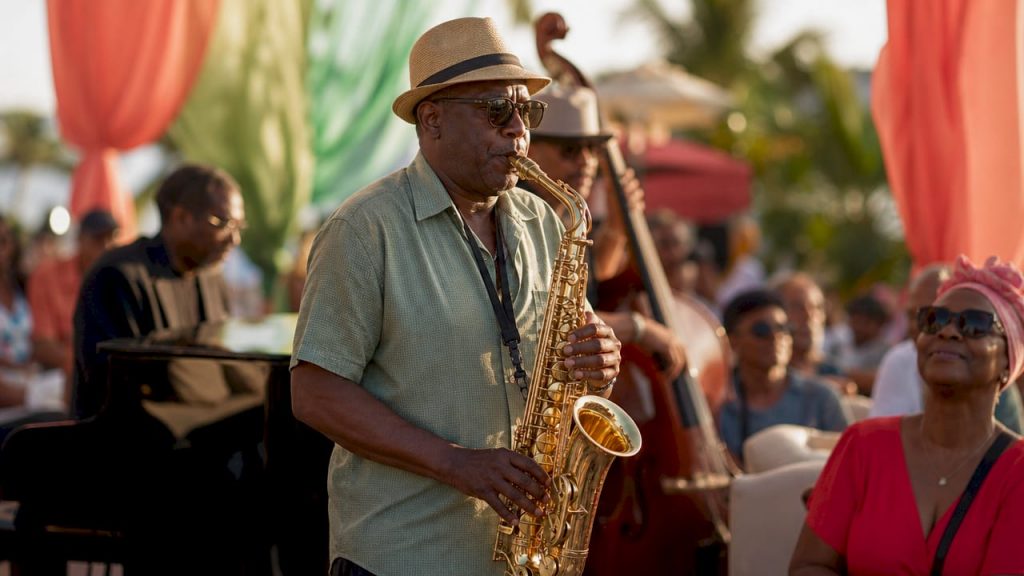
Explore the definition of jazz music in this complete guide. Discover its rich history, core traits, and cultural significance today.
Jazz music is defined as a distinctly American art form built on improvisation, syncopated rhythms, and complex harmonies, born from African American communities in New Orleans during the late 19th century. The term “jazz” covers a broad family of styles, but every branch shares those three core traits. Understanding the definition of jazz music means understanding a living conversation between musicians, not a fixed set of notes on a page. From its roots in blues and ragtime to the global stages it commands today, jazz remains one of the most expressive and culturally rich genres in musical history. This guide walks you through everything you need to know.
What is the definition of jazz music?
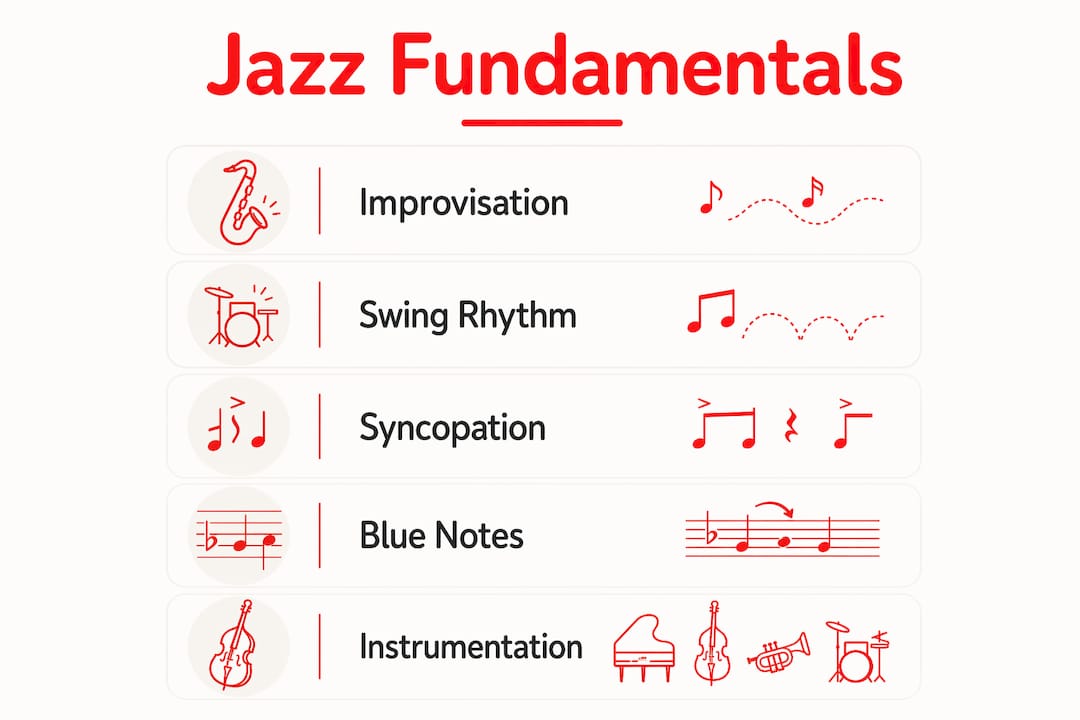
Jazz is defined by improvisation, syncopated rhythms, swing feel, and harmonic complexity that set it apart from classical and popular music. Those four traits work together to create something no other genre quite replicates. A jazz performance is never identical twice, because the musicians are composing in real time, responding to each other like speakers in a conversation.
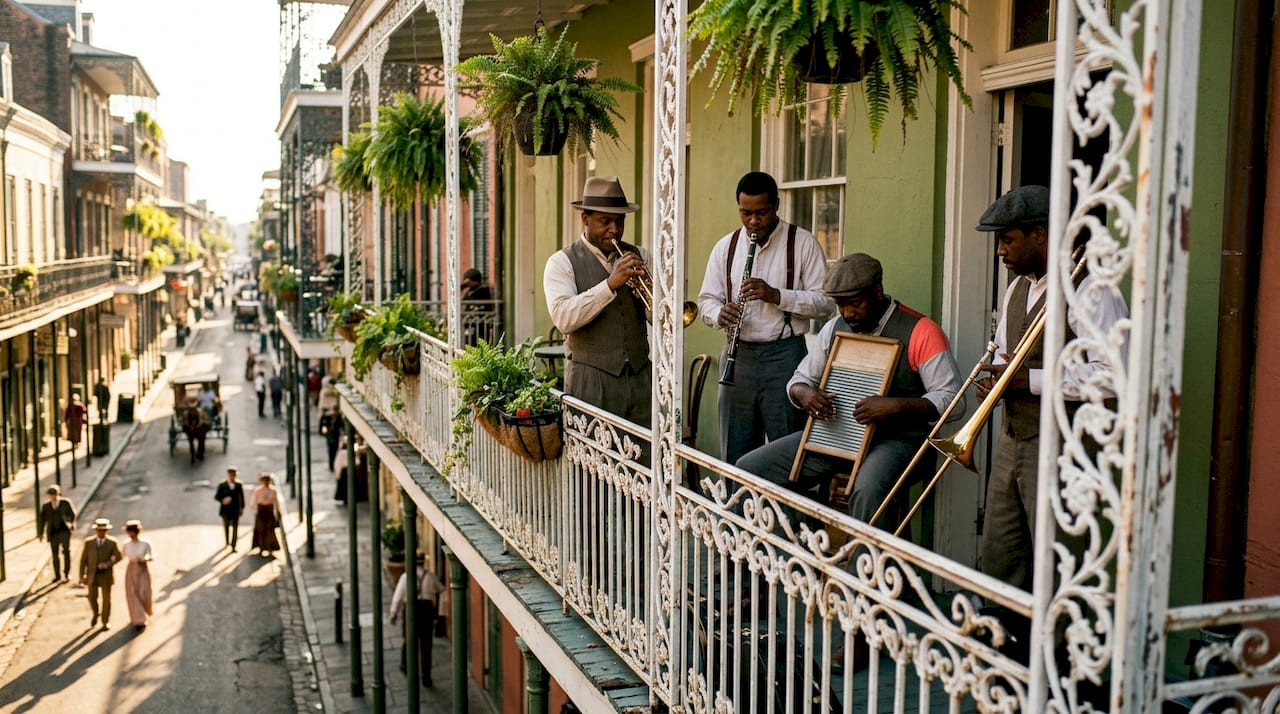
The music originated in African American communities in New Orleans during the late 1800s and early 1900s, blending African rhythmic traditions with European harmonic structures. That blend produced something entirely new. African polyrhythms gave jazz its pulse, while European chord progressions gave it its harmonic vocabulary.
Jazz also carries a formal academic classification. The Smithsonian Institution recognizes jazz as a foundational American art form, and it is taught in conservatories worldwide alongside classical music. That institutional recognition reflects how seriously the genre is taken as both a musical discipline and a cultural document.
One nuance worth knowing: many legendary musicians resisted the label entirely. John Coltrane and others viewed “jazz” as a commercial term that flattened the music’s deep roots in Black American culture. That tension between label and legacy is itself part of what makes jazz so fascinating to study.
How did jazz music originate and evolve?
Jazz did not appear overnight. Its development unfolded across several decades and passed through distinct stylistic eras, each one building on the last.
The New Orleans roots
Jazz emerged from New Orleans in the late 19th and early 20th centuries, where African rhythms, spirituals, blues, and ragtime collided in a single city. New Orleans was uniquely positioned for this fusion. It was a port city with a diverse population, and its culture encouraged musical mixing across racial and ethnic lines. The result was Dixieland jazz, the earliest recognizable form of the genre, featuring collective improvisation over a driving two-beat rhythm.
The swing era and big bands
By the 1930s, jazz had moved north to cities like Chicago and New York. Big bands led by Duke Ellington and Count Basie brought jazz to mainstream American audiences through radio broadcasts and dance halls. Swing became the popular music of its era. The arrangements were more structured than early Dixieland, but improvised solos still sat at the heart of every performance.
Bebop and the modern turn
The 1940s brought bebop, a deliberate reaction against the commercialization of swing. Musicians like Charlie Parker and Dizzy Gillespie pushed tempos faster, chord changes more complex, and melodies more angular. Bebop was music for listening, not dancing. It repositioned jazz as an art music and set the stage for every experimental style that followed.
Cool jazz, modal jazz, and free jazz
Miles Davis introduced cool jazz in the late 1940s with a softer tone and more relaxed tempos. By the late 1950s, he shifted again toward modal jazz, which replaced rapid chord changes with open scales that gave soloists more room to explore. Free jazz, pioneered by Ornette Coleman in the 1960s, abandoned chord structures almost entirely. Each era expanded what jazz could be.
- Dixieland (early 1900s): Collective improvisation, brass-heavy, two-beat feel
- Swing (1930s–1940s): Big band arrangements, four-beat rhythm, accessible and danceable
- Bebop (1940s): Fast tempos, complex harmonics, small ensembles, art-music intent
- Cool jazz (late 1940s–1950s): Relaxed tone, lyrical phrasing, chamber-music influence
- Modal jazz (late 1950s–1960s): Scale-based improvisation, open harmonic space
- Free jazz (1960s): Structural freedom, avant-garde experimentation
Pro Tip: Start your jazz listening journey with Miles Davis’s “Kind of Blue” (1959). It is the best-selling jazz album of all time and uses modal scales that make it unusually accessible for new listeners.
What are the core characteristics of jazz music?
Jazz has several defining musical traits. Each one contributes to the genre’s unmistakable sound, and together they explain why jazz feels so different from other styles.
1. Improvisation
Jazz improvisation is a structured musical conversation, not random playing. Musicians follow an agreed chord progression and take turns soloing within that framework. To a listener, it sounds spontaneous and free. To the musician, it requires deep knowledge of harmony, scales, and the ability to respond to what other players are doing in real time. Think of it as a debate with musical instruments: each player makes a point, responds to others, and builds toward a shared conclusion.
2. Swing rhythm
Swing feel cannot be fully captured by written notation. It is a rhythmic momentum that makes listeners want to tap their feet or move. Technically, swing involves playing pairs of eighth notes unevenly, with the first note slightly longer than the second. That subtle delay creates the forward-leaning pulse that defines jazz rhythm. You learn it by listening, not by reading a textbook.
3. Syncopation
Syncopation means placing accents on the “off” beats rather than the strong beats of a measure. Classical music typically emphasizes beats one and three. Jazz emphasizes beats two and four, and often accents unexpected subdivisions within the bar. That rhythmic unpredictability is part of what gives jazz its energy and tension.
4. Blue notes and modal scales
Blue notes are slightly flattened pitches, typically the third, fifth, or seventh degree of a major scale, borrowed from African American blues traditions. They give jazz its characteristic emotional color, somewhere between major brightness and minor sadness. Modal scales, popularized by Miles Davis and John Coltrane, gave musicians even more tonal freedom by organizing improvisation around modes rather than chord changes.
5. Instrumentation
Primary jazz instruments include piano, trumpet, saxophone, clarinet, double bass, drums, and guitar. The rhythm section (piano, bass, and drums) provides the harmonic and rhythmic foundation. Horn players (trumpet, saxophone, clarinet) carry the melody and take solos. The interplay between these roles creates the layered texture that makes jazz so rich to listen to.
| Element | Description | Example |
|---|---|---|
| Improvisation | Real-time melodic invention over chord changes | Charlie Parker’s alto saxophone solos |
| Swing rhythm | Uneven eighth notes creating forward momentum | Count Basie’s big band recordings |
| Syncopation | Accents on off-beats for rhythmic tension | Duke Ellington’s piano comping |
| Blue notes | Flattened pitches adding emotional depth | Blues-inflected trumpet by Louis Armstrong |
| Modal scales | Scale-based improvisation replacing chord changes | Miles Davis’s “So What” from Kind of Blue |
Who are the most influential jazz musicians?
Jazz’s evolution was driven by a relatively small group of visionary musicians. Their contributions did not just change the genre. They changed what music could do.
Early legends
Louis Armstrong is the first name in jazz history for good reason. He transformed jazz from a collective art into a vehicle for individual expression, establishing the improvised solo as the genre’s central event. His trumpet playing and vocal style influenced virtually every musician who followed. Duke Ellington built on that foundation by composing extended works for big band that treated jazz as a serious compositional form, not just a vehicle for improvisation.
- Louis Armstrong: Defined the jazz solo; bridged New Orleans jazz and swing
- Duke Ellington: Elevated jazz composition; led one of the most celebrated big bands for five decades
- Bessie Smith: Brought blues emotion into jazz vocals; shaped the expressive range of the genre
Bebop innovators
Charlie Parker and Dizzy Gillespie co-created bebop in the 1940s. Parker’s alto saxophone work introduced a level of harmonic sophistication and speed that redefined what was technically possible. Gillespie matched him on trumpet and added Afro-Cuban rhythmic elements that broadened jazz’s global reach. Together, they made jazz intellectually demanding and permanently separated it from commercial pop.
Modal and avant-garde pioneers
Miles Davis and John Coltrane pioneered styles including bebop, cool jazz, and modal jazz, reshaping the genre across multiple decades. Davis released landmark albums in nearly every decade from the 1940s through the 1980s, each one pointing jazz in a new direction. Coltrane’s “A Love Supreme” (1965) is widely regarded as the most spiritually and musically ambitious jazz recording ever made. Ornette Coleman took the next step with free jazz, removing harmonic structure entirely and opening the door to pure sonic exploration.
Pro Tip: Listen to artists in chronological order when learning jazz history. Start with Louis Armstrong, move to Duke Ellington, then Charlie Parker, then Miles Davis. You will hear each generation responding directly to the one before it.
Why does jazz music matter culturally?
Jazz is not just a musical genre. It is a historical document and a cultural statement.
Jazz embodies American values like risk-taking, individuality, freedom, and collaboration, acting as a cultural bridge across communities. That combination of individual expression within a collective framework mirrors the ideals at the heart of American democracy. No other art form captures that tension as directly as jazz does.
The music’s origins are inseparable from the African American experience. Jazz is fundamentally Black American music, born from African rhythms, spirituals, and the blues, as both a celebration of survival and a response to systemic oppression. Understanding jazz means understanding that history. The music carries the weight of that experience in every blue note and every improvised phrase.
Jazz also served as a vehicle for social change. During the Civil Rights Movement, musicians like Charles Mingus and Max Roach wrote explicitly political compositions. Jazz clubs in cities like New York and Chicago were among the first racially integrated public spaces in America. The music created common ground where the broader culture had not yet managed to do so.
“Jazz is the music of the people, by the people, and for the people.” This sentiment, echoed by musicians and scholars alike, captures why jazz preservation efforts at institutions like the Smithsonian and the Library of Congress treat the genre as a national treasure rather than simply an entertainment category.
Today, jazz continues to evolve. Contemporary musicians like Kamasi Washington and Esperanza Spalding draw on the full history of the genre while pushing it into new territory. Jazz education programs at universities and conservatories worldwide train the next generation of improvisers. The music remains alive precisely because its core principle, that every performance is a new creation, never goes out of style.
Key Takeaways
Jazz music is defined by improvisation, swing rhythm, and harmonic complexity rooted in African American culture, and every major style from Dixieland to free jazz builds on those three foundations.
| Point | Details |
|---|---|
| Core definition | Jazz is built on improvisation, swing feel, syncopation, and complex harmonies. |
| Historical roots | Jazz originated in New Orleans in the late 1800s, blending African rhythms with European harmony. |
| Key musical elements | Blue notes, modal scales, and structured improvisation distinguish jazz from other genres. |
| Influential musicians | Louis Armstrong, Duke Ellington, Charlie Parker, and Miles Davis each redirected the genre’s evolution. |
| Cultural significance | Jazz reflects African American history and American values of freedom, individuality, and collaboration. |
Our team’s take on why jazz still matters
Our team at Lizard’s Lunch has spent a lot of time with jazz, and one thing stands out every time: new listeners almost always approach it the wrong way. They expect a melody to follow. Jazz rarely gives you that. What it gives you instead is a conversation, and once you start hearing it that way, the music opens up completely.
The biggest mistake is treating jazz as background music for its first few listens. Put on a pair of headphones, pick one instrument, and follow only that player through a track. Do that with Miles Davis’s “So What” and you will hear something most people miss entirely: the bassist Paul Chambers is essentially leading the whole performance from the bottom of the mix.
We also think the genre’s diversity is underappreciated. Most people know swing and maybe bebop. But jazz styles and techniques range from the gentle lyricism of cool jazz to the near-chaos of free jazz, and every point between those poles has something worth hearing. The genre rewards curiosity more than almost any other musical tradition.
The cultural weight of jazz is something we find genuinely moving. This music was created under conditions of profound injustice and became one of America’s greatest contributions to world culture. That story deserves to be known, not just by music students, but by anyone who cares about where American culture actually comes from.
— Our Team at Lizard’s Lunch
What to read next on Lizardslunch
Jazz is one of the richest musical traditions you can explore, and the deeper you go, the more rewarding it gets. At Lizardslunch, we cover jazz artists and styles across every era, from the swing pioneers to today’s contemporary voices. You will also find broader music hobby guides packed with tips for building your listening practice and discovering new genres. And if you are thinking about creating the perfect space to enjoy music at home, our guide to home renovation ideas covers everything from acoustics-friendly room layouts to character-building design touches that make any listening room feel special.
FAQ
What is the simplest definition of jazz music?
Jazz is a music genre defined by improvisation, swing rhythm, and complex harmonies, originating in African American communities in New Orleans in the late 19th century.
What makes jazz different from other music genres?
Jazz centers on real-time improvisation within a harmonic framework, meaning no two performances are identical. That spontaneity, combined with swing rhythm and blue notes, sets it apart from classical, pop, and rock music.
Who invented jazz music?
No single person invented jazz. It emerged collectively from African American musicians in New Orleans, with early figures like Louis Armstrong and Jelly Roll Morton among the first to shape its distinct sound.
What are the main types of jazz genres?
The main jazz styles include Dixieland, swing, bebop, cool jazz, modal jazz, and free jazz. Each style evolved from the one before it, with musicians like Duke Ellington, Charlie Parker, and Miles Davis leading each transition.
Why is improvisation so central to jazz?
Improvisation is the defining act of jazz performance. Musicians invent melodies in real time over agreed chord progressions, creating a musical conversation that makes every performance unique and unrepeatable.


















Leave a Comment
Your email address will not be published. Required fields are marked with *