
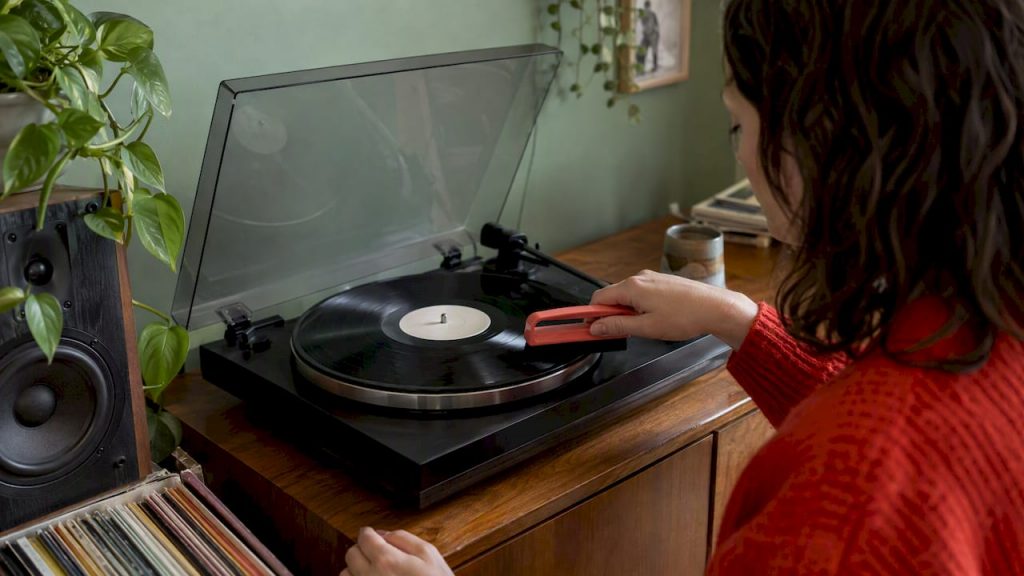
Learn how to clean vinyl records safely, tame static with a carbon fiber brush, pick a cleaning kit and store your collection in Canadian homes.
Good vinyl record care comes down to four habits: brush a record before and after each play, deep clean it only with record-safe fluid and distilled water, keep the stylus clean, and store records upright in a cool, dry room. Do those, and a record can sound great for decades. Skip them, and dust gets ground into the grooves every time the needle drops.
We put this guide together for anyone in Canada who has just inherited a crate of records, picked up a first turntable, or finally wants to look after a growing collection. It covers what to use, what to avoid, and how to cope with a Canadian winter, when indoor air turns bone dry.
TL;DR
- Brush with a carbon fiber or anti-static brush before and after every play, and handle records only by the edges and label.
- For a deep clean, use a record-specific solution and distilled water, then let the record air-dry completely. Skip isopropyl alcohol, household cleaners and tap water.
- Never put liquid on a dry anti-static brush, and never use alcohol or detergents on the turntable itself.
- Store records upright, lightly supported at both ends of the row, in the coolest, driest room you have: below 23°C and 50% relative humidity.
- Remove shrink wrap and use anti-static inner sleeves for the records you play most.
Table of Contents
- Why records need care in the first place
- Handle records the right way
- Daily dusting: the anti-static brush routine
- How to reduce static on your records
- Deep cleaning: when a brush is not enough
- What not to use on vinyl
- Choosing a record cleaning kit
- Take care of the turntable and stylus too
- Storing vinyl records
- Our perspective
- Want to reach record lovers and home audio fans?
- A simple care schedule
- FAQ
- Sources
Why records need care in the first place
A vinyl record stores music as a continuous groove, and the stylus rides inside it. Dust, skin oils and static-charged debris sit in that groove, and the needle presses them into the surface. That is where most of the pops and clicks come from.
Not every crackle is dirt, though. Audio-Technica points out that much crackle comes from microscopic surface scratches rather than static, and that careless cleaning can add new scratches. Gentle handling and the right tools matter more than any one product.
Think of record care as a short routine, not a restoration project. A few seconds before each play, a proper clean when you buy a used record, and sensible storage between plays. That is all it takes.
Handle records the right way
Before anything touches the record, think about your hands. Skin oils attract grime, so handle records by the edges and the label only. It feels fussy for the first week and automatic after that.
A few small habits help:
- Slide the record out of its inner sleeve with the sleeve’s opening facing up, and hold the disc between your palms.
- Set it on the platter right away. Records left on a table pick up dust and get stepped on, sat on and warped.
- Return it to its sleeve after playing, not after the party ends.
- Keep food and drinks away from the listening area. Sticky fingers and open mugs are the real enemies of a collection.
The same careful handling applies to the sleeves. Bent corners and split seams let dust in, and a damaged outer cover is hard to fix once the record has slipped out and scratched.
Daily dusting: the anti-static brush routine
The brush is the cheapest, most useful thing you can own. VinylSonar recommends brushing records before and after each play with a carbon fiber brush to lift surface dust and reduce static.
Here is the method Audio-Technica describes for its own brush, which works as a good template for similar ones:
- Start the record spinning.
- Hold the brush firmly and perpendicular to the surface.
- Gently lower it so the fibres sweep the grooves.
- Touch the brush to the center spindle to discharge static.
- Clean the brush by pivoting it across its protector.
These steps come from Audio-Technica’s guide to using its record cleaning products. The same page says the brush is meant for light, dry cleaning and that you should not put liquid on it. The manufacturer describes it as ideal for light cleaning on newer vinyl, so a used record with ground-in grime needs a wet clean instead.
If you use a microfiber cloth for quick wipes of sleeves or the turntable lid, keep it dry and lint-free. Our guide on cleaning a laptop screen safely covers how to choose and care for those cloths, and the same ideas apply here.
How to reduce static on your records
Static is what makes a freshly cleaned record grab every speck of dust in the room. Audio-Technica explains that static can come from production, packaging, removing a record from its inner sleeve and cleaning. A charged record attracts dust and dirt, and that produces pops and clicks.
Their suggested fix is to combine anti-static inner sleeves with an anti-static carbon brush or an anti-static cleaning solution. An ionizing anti-static gun is another option if you have a large collection and a stubborn problem.
Canadian winters make this worse. Fluance notes that static is especially common in dry environments and colder months, so keeping room humidity at a more suitable level helps. It also suggests using an anti-static brush before playback and not wiping an acrylic platter with a dry fabric, which can build up charge.
A practical winter routine:
- Brush each record just before it goes on the platter.
- Replace crinkled paper inner sleeves with anti-static poly-lined ones for your favorites.
- Keep the listening room from becoming desert-dry. A basic humidity reading from a small hygrometer tells you where you stand.
- Let records settle after coming in from the cold before you play them.
Deep cleaning: when a brush is not enough
Used records, thrift-store finds and anything that looks cloudy or sounds gritty need a wet clean. VinylSonar’s summary of the process: brush lightly over the spinning record, then use a purpose-made solution or distilled water with a suitable surfactant, wipe gently along the grooves, rinse, and let the record air-dry fully.

Rolling Stone makes the same split between everyday and deep cleaning: carbon fiber brushes for regular dusting, and a system with distilled water and cleaning fluid for used records.
A simple hand-cleaning routine
You need a record-cleaning solution, distilled water, two clean microfiber cloths and a rack or towel for drying.
- Lay the record on a soft, lint-free surface, or hold it by the edge and label.
- Brush off loose dust first, so you do not smear it into a wet film.
- Apply the solution lightly, mixed with distilled water if the product says so.
- Wipe gently along the direction of the grooves, not across them, and not in circles.
- Rinse with distilled water, and wipe with the second cloth.
- Stand the record on its edge in a rack and let it dry fully before sleeving it. A damp record in a sleeve traps moisture and dirt.
- Keep the label dry. Water can lift or stain it.
Do the other side the same way. Use fresh sleeves for cleaned records. Putting a pristine disc back into the dusty old sleeve undoes the work, and an anti-static poly-lined inner sleeve is a cheap upgrade.
Manual machines and basin systems
Basin-style washers hold the record in rollers while it turns through a bath of cleaning fluid, with brushes working both sides at once. Canada HiFi Magazine’s review of one popular design calls it an effective, manually operated kit that cleans both sides simultaneously with specialized brushes and cleaning solution. That review dates from 2012, so check current models and fluid before you buy. Ecoustics, in its roundup of affordable options, calls that type of system effective for the money, and describes surface-cleaning products as suitable for everyday use.
Vacuum-style cleaning machines also exist and cost far more. They make sense for someone cleaning hundreds of records, but a manual system or the hand method above handles most home collections well.
What not to use on vinyl
This is where most damage happens, and the people searching for answers often ask exactly this: can you use rubbing alcohol, or WD-40, or a damp paper towel?
The short answer is no to all of them.
- Isopropyl alcohol. Making Vinyl warns that alcohol can dissolve plasticizers, especially at concentrations of 60% or more. Records contain lubricants and plasticizers, and strong solvents can pull them out.
- Household cleaners and tap water. The Spruce states that isopropyl alcohol, household cleaning products and tap water should never be used on records, since they can strip protective coatings, leave residue or introduce mineral deposits. This is why the routine above calls for distilled water.
- Lubricants such as WD-40. These are not made for records, and the oily film they leave is the opposite of what you want in a groove. We found no manufacturer guidance supporting them, so leave them in the garage.
- Paper towels and rough cloths. Their fibres are abrasive. Use microfiber or the brush.
- Wiping in circles. Circular motion drives particles across the grooves. Follow the groove direction.
If a record still crackles after a careful clean, remember that the noise may come from physical wear. Audio-Technica notes the crackle is not always static, and no fluid removes a scratch.
Choosing a record cleaning kit
A good kit is simple. Look for these pieces:
| Item | What it does | What to check |
|---|---|---|
| Carbon fiber or anti-static brush | Daily dry dusting and static discharge | Dense, fine fibres and a protective cover |
| Record-safe cleaning solution | Loosens fingerprints and grime | Made for vinyl, free of harsh solvents |
| Microfiber cloths | Wiping and drying | Lint-free and kept only for records |
| Distilled water | Rinsing without minerals | Sold at most Canadian pharmacies and grocery stores |
| Anti-static inner sleeves | Keep cleaned records clean | Poly-lined and the right size for 12-inch records |
| Stylus brush | Cleans the needle | Soft and made for your cartridge |
Before you buy, ask three questions. Does it say it is safe for vinyl, and does it avoid alcohol-heavy formulas? Does it include a brush for daily use as well as fluid for deep cleaning? Is the fluid refillable, so you are not buying a whole new kit when it runs out?
Many all-in-one kits bundle these items at a modest price. The kits aimed at beginners are fine for one collection, while heavy collectors tend to build their own set piece by piece. Look at how many records a bottle of fluid cleans, not only the sticker price.
Take care of the turntable and stylus too
A clean record played with a dirty stylus will be dirty again within a few spins. The stylus gathers dust from every groove, so clean it regularly. Audio-Technica’s manual for its AT-LP7X advises cleaning the stylus tip from rear to front with a specialized brush, never side to side, which can bend the cantilever. Always check your own model’s manual, as the cartridge design affects the method.
The same manual also warns against using alcohol, detergents or chemical cleaners on the turntable itself, because they can crack or discolor plastic parts. Wipe the plinth and dust cover with a dry or barely damp microfiber cloth.
Two more points for Canadian listeners:
- Cold-to-warm shifts. If a turntable has been in a cold car or an unheated garage, let it adjust. Technics specifies that, for its SL-1200G, any condensation from rapid temperature changes means turning the unit off and leaving it 2 to 3 hours before use. That is wise advice for any player moved in January.
- Placement. The same manual says to install the turntable well away from walls or other devices so heat can radiate. A shelf crowded against an amplifier is not ideal.
Keep the dust cover down while you play and when you do not. Dust that settles on the platter transfers directly to the record.
Storing vinyl records
Storage is where collections are won or lost, because damage here is slow and silent.
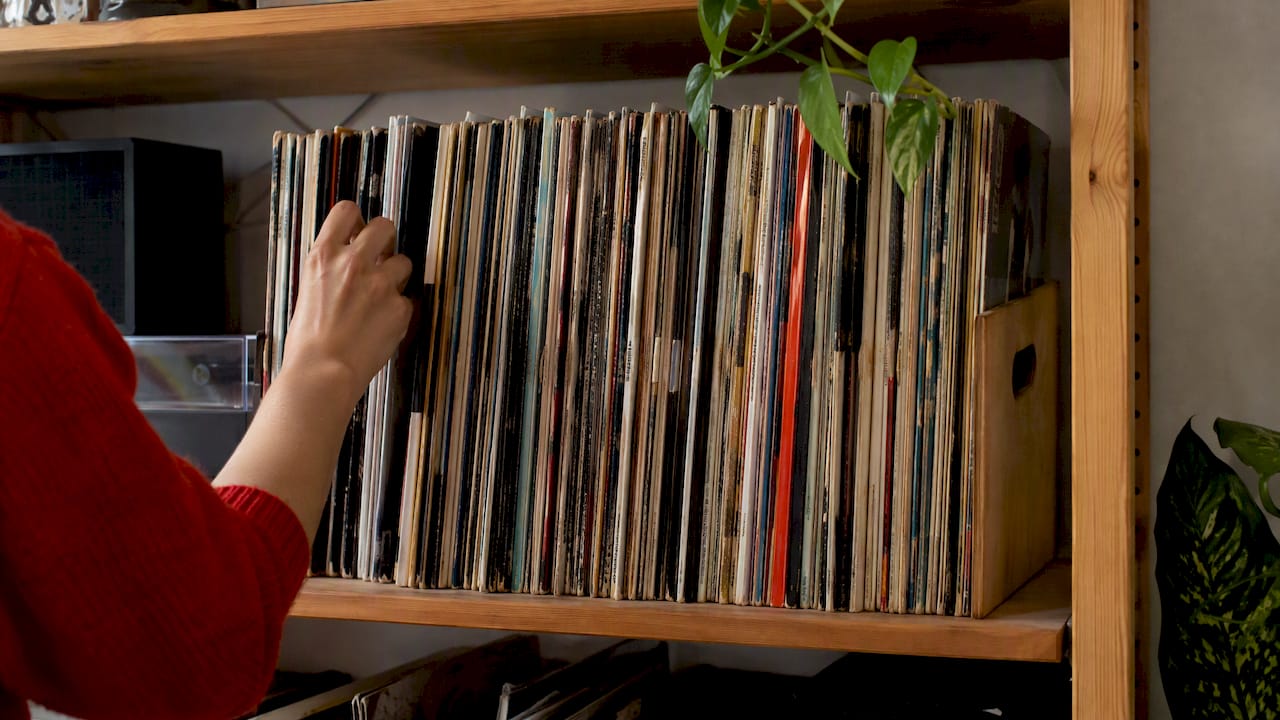
The Canadian Conservation Institute gives the clearest guidance. It says records should be stored upright, close together but not tightly packed, and fully supported at both ends of the row, in a cool, dry room below 23°C and 50% relative humidity. It also says to remove shrink wrap, which can warp records.
Upright, never stacked
VinylSonar says records should be stored vertically rather than stacked flat, to prevent warping, away from direct sunlight and protected by anti-static poly-lined inner sleeves. Use bookends or shelf dividers as tall as the records, so the row never leans. A leaning row is a warped row waiting to happen.
Temperature and humidity
Different organizations give slightly different ranges. Gaylord Archival advises keeping relative humidity under 50%, with temperature and humidity changing by no more than ±10° or ±10% in any 24-hour period. An academic preservation guide suggests a band of 13°C to 21°C and 30% to 55% relative humidity. The shared message is steady, cool and not damp.
In a Canadian home, that points to a few choices:
- Best rooms: an interior living room or bedroom with stable temperature.
- Worse rooms: the attic, an uninsulated garage or a sunny window wall, where swings and heat are the biggest risk.
- Basements: fine if you control humidity. Damp basements lead to mold on sleeves and labels, so watch the reading on a hygrometer, and run a dehumidifier in humid summers.
- Heat sources: keep shelves away from radiators, baseboard heaters and vents.
The principles are the same as those used for other valuable musical items. This guide to stable storage conditions for collections explains how steady humidity and temperature protect delicate items, and it is a good companion for anyone who also keeps instruments at home.
Sleeves and jackets
Anti-static, poly-lined inner sleeves protect the surface, while the outer jacket protects the cover art. A clear outer sleeve keeps shelf wear and ring wear off the jacket. Remove the shrink wrap from sealed records, as the Institute recommends, once you have decided to play them. Collectors who want to keep a record sealed should keep it in the coolest and most stable spot.
Our perspective
We think record care should feel like part of the fun, not a chore. The people we hear from are usually excited about a new turntable or a box of records from a relative, and they worry they will ruin something.
Our team at Lizard’s Lunch looks for the habits that matter most and the ones that are only hype. A dry brush, a record-safe solution, distilled water and a good shelf will take you most of the way. You do not need a pricey machine on day one, and you do not need to spend hours a week on upkeep.
What we do suggest is that you pick up the routine early. Brush before and after you play. Deep clean the used finds. Keep the stylus tidy. Store records upright and cool. When your collection grows, you can add tools to match, and by then you will know what you actually need.
Alexander
Want to reach record lovers and home audio fans?
If you run a brand or a blog for music, home audio or collecting, our team can put it in front of readers who enjoy guides like this one. See our banner ads and guest post options to get started.
A simple care schedule
A routine you can follow beats a perfect one you never do. Use this as a starting point:
| When | What to do |
|---|---|
| Before each play | Brush the record, check the stylus for visible dust |
| After each play | Brush again, return it to a clean inner sleeve and jacket |
| New-to-you used record | Wet clean by hand or with a basin system, dry fully, use a fresh sleeve |
| Regularly | Clean the stylus, wipe the dust cover and plinth, check room humidity |
| Each season | Look over storage for leaning rows, damp spots and sun exposure |
The frequency of the wet clean depends on how much you play and how the record sounds. A record that sounds quiet and clean after a brush does not need a bath every month.
FAQ
Can I clean vinyl records with rubbing alcohol?
It is best to avoid it. Making Vinyl warns that alcohol can dissolve plasticizers in records, especially at 60% concentration or more, and The Spruce advises against isopropyl alcohol on vinyl altogether. Use a solution made for records and distilled water instead.
Does WD-40 clean vinyl?
No. It is not made for records, and none of the manufacturer or preservation guidance we reviewed supports using it on vinyl. An oily residue in the grooves attracts dust and can affect playback. Stick to a dry brush, or a record-safe solution with distilled water.
How often should I clean my records?
Brush before and after each play. Give a deep clean to any used record when you first get it, and again if it looks cloudy or sounds noisy. Records you play a lot may need a wet clean now and then, but a brushed record that sounds clear does not need a bath.
How should I store records in a Canadian home?
Store them upright, close together but not packed, with supports at each end of the row. The Canadian Conservation Institute recommends a cool, dry room below 23°C and 50% relative humidity. Keep them out of sun, away from heat sources and out of damp garages or basements.
Can an anti-static brush get wet?
No. Audio-Technica says not to put liquid on its anti-static brush, which is made for light, dry cleaning. Use it on a dry record, and use a record-safe solution and cloths when you need a wet clean.
Sources
- Audio-Technica: How do I use record cleaning products
- Audio-Technica: Vinyl static and crackle
- Audio-Technica: AT-LP7X user manual
- VinylSonar: How to clean and store vinyl
- Fluance: Reducing static on your turntable and records
- Rolling Stone: How to clean vinyl records
- Ecoustics: Affordable record cleaning solutions
- Canada HiFi Magazine: Spin-Clean Record Washer MK II review
- Making Vinyl: Composition of vinyl records
- The Spruce: How to clean vinyl records without damaging them
- Technics SL-1200G owner’s manual
- Canadian Conservation Institute: Video and audio recordings FAQ
- Gaylord Archival: Best practices for vinyl records
- LIS Academy: Preserving plastic-based media
- Vintage Guitar World: Instrument storage guide

















Leave a Comment
Your email address will not be published. Required fields are marked with *