

Discover why eco-friendly materials matter for your health. They reduce toxins, save money, and benefit the environment. Learn more!
Eco-friendly materials are designed to minimize harm to human health and the environment while delivering real economic and social value. The case for choosing them is clear: they reduce toxic exposures, shrink carbon footprints, and often cost less over time than conventional alternatives. Here is what you need to know right away:
- Health: Green materials cut indoor air pollutants, reducing respiratory risks and chemical exposures in your home or workplace.
- Environment: They conserve natural resources, lower greenhouse gas emissions, and reduce waste sent to landfills.
- Economy: Durability and reduced maintenance translate into long-term savings, while government incentives and certifications add further financial appeal.
- Trust signals: Organizations like the US Environmental Protection Agency, the Global Organic Textile Standard (GOTS), and the Forest Stewardship Council (FSC) set the benchmarks that separate genuinely sustainable materials from greenwashed marketing claims.
Choosing sustainable materials is not a niche lifestyle preference. It is one of the most direct ways you can protect your health, support the planet, and make smarter financial decisions.
Table of Contents
- Why eco-friendly materials protect your health and the environment
- The economic and social benefits of going green with your materials
- How to identify and choose genuinely eco-friendly materials
- Why holistic thinking and local sourcing make sustainability real
- What the future of eco-friendly materials looks like
- Key Takeaways
Why eco-friendly materials protect your health and the environment
The air inside your home can be more polluted than the air outside, and traditional building and consumer materials are a major reason why. Conventional paints, adhesives, flooring, and synthetic textiles emit volatile organic compounds (VOCs), which irritate airways, trigger headaches, and contribute to long-term respiratory conditions. Replacing these with biocomposites and plant-based alternatives can significantly reduce indoor and outdoor human health impacts.

The environmental picture is equally striking. The cement industry alone accounts for 6–8% of global emissions, and materials management overall is associated with an estimated 42% of total U.S. greenhouse gas emissions. Bio-based materials like timber, bamboo, hemp, and straw actually capture carbon during growth, meaning buildings constructed with them can become net carbon sinks over their lifespan.
Key impacts you can expect from switching to green materials:
- Improved indoor air quality through dramatically lower VOC emissions
- Reduced carbon footprint by replacing high-embodied-energy materials like steel and cement
- Resource conservation by using renewable, rapidly regenerating inputs
- Waste reduction through materials designed for reuse, recycling, or composting
- Better occupant health outcomes, including improved comfort and noise reduction, as documented in case studies of health resorts using eco-friendly construction
Pro Tip: When renovating, ask your contractor specifically for low-VOC paints and formaldehyde-free insulation. These two swaps alone can dramatically improve the air quality in any room.
The economic and social benefits of going green with your materials
The upfront cost of eco-friendly materials can be higher, and that is the objection you will hear most often. What that argument misses is the long-term math. Sustainable materials tend to yield savings through increased durability and reduced replacement costs, making them a smarter financial choice over a building or product’s full lifespan.

Beyond your wallet, the social benefits are just as compelling. Healthier materials mean healthier communities. Workers in buildings constructed with green materials report better comfort, focus, and wellbeing. That is not a soft benefit; it translates into measurable productivity gains and lower healthcare costs.
Here is a snapshot of the economic and social advantages:
- Lower lifecycle costs from durable materials that need less frequent replacement
- Energy savings through better insulation and thermal performance
- Government incentives including ENERGY STAR rebates and tax credits available through energystar.gov
- LEED certification for buildings, which can increase property values and attract premium tenants
- Growing consumer demand driving market expansion and more competitive pricing for green alternatives
- Community health improvements from reduced chemical runoff, lower air pollution, and cleaner water
A key data point: Environmental criteria account for 36.4% of the importance weighting in sustainable material selection frameworks, with technical performance at 25.5%, economic factors at 21.6%, and social considerations at 16.5%. No single dimension dominates. True sustainability is a balance.
The regulatory environment is also shifting in your favor. The EU’s RoHS directive restricts hazardous substances in products, and government incentives and standards are expanding globally, making eco-friendly choices increasingly accessible and financially rewarding. For a broader look at how these principles apply to eco-friendly business practices, the connection between materials and organizational strategy becomes even clearer.
How to identify and choose genuinely eco-friendly materials
Not every product labeled “green” or “natural” deserves that description. Greenwashing is real, and the best defense against it is knowing which certifications and standards actually mean something.
Certifications worth trusting:
- FSC (Forest Stewardship Council): Verifies that wood and paper products come from responsibly managed forests. Look for the FSC logo on lumber, flooring, and furniture.
- GOTS (Global Organic Textile Standard): The gold standard for organic textiles, auditing entire supply chains for both environmental and social criteria.
- LEED (Leadership in Energy and Environmental Design): A building certification that rewards the use of sustainable materials, energy efficiency, and healthy indoor environments.
- ISO 14001: An international standard for environmental management systems, signaling that a manufacturer takes its environmental responsibilities seriously.
- EPA Safer Choice: A US EPA program that certifies products formulated with safer chemical ingredients.
Practical steps for choosing sustainable materials:
- Ask for Environmental Product Declarations (EPDs), which provide verified data on a material’s environmental impact from production through disposal.
- Prioritize materials with recycled content or those that are themselves recyclable at end of life.
- Check whether the product has third-party certification, not just a manufacturer’s self-declaration.
- Consider the full lifecycle, from raw material extraction to disposal, not just the product’s performance in use.
- Favor materials with low embodied energy, meaning those that required less energy to produce and transport.
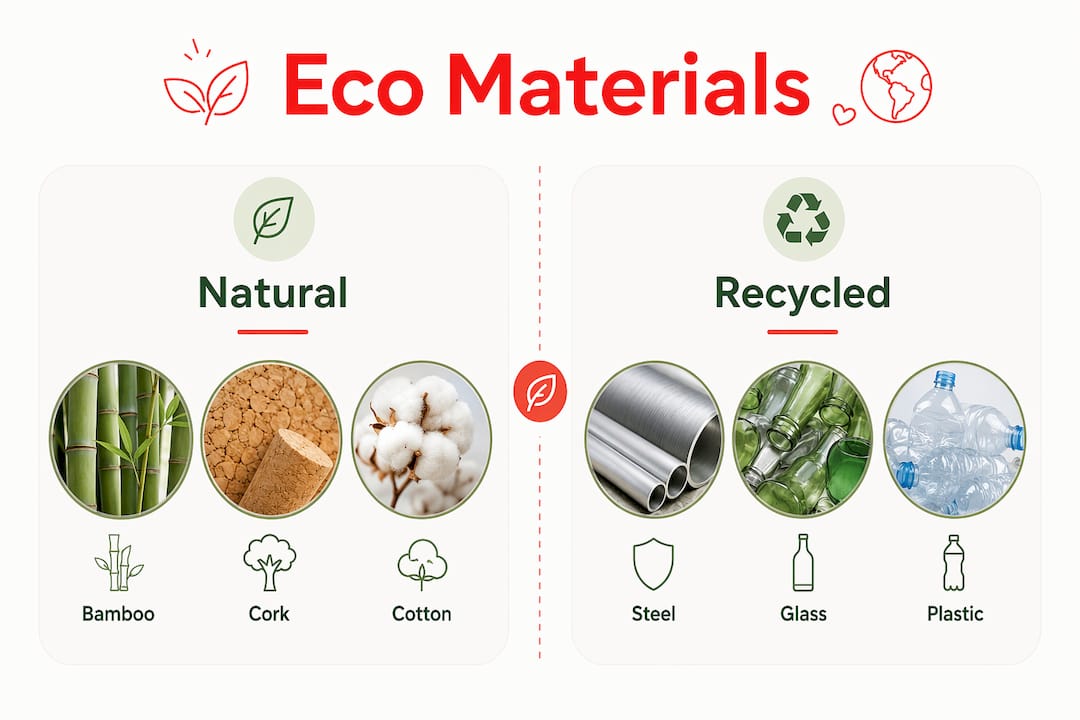
Common eco-friendly materials and where they shine:
| Material | Best Applications |
|---|---|
| Bamboo | Flooring, furniture, structural panels |
| Recycled steel | Structural framing, roofing |
| Hempcrete | Insulation, non-load-bearing walls |
| Cork | Flooring, wall insulation, packaging |
| Reclaimed wood | Flooring, beams, decorative elements |
| Recycled glass | Countertops, tiles, decorative surfaces |
| Mycelium composites | Packaging, insulation panels |
If you are thinking about applying these choices at home, our team at Lizard’s Lunch has covered sustainable living tech tips that pair well with material upgrades.
Why holistic thinking and local sourcing make sustainability real
Choosing a certified material is a great start. Thinking about its entire journey, from extraction through manufacturing, use, and eventual disposal, is what separates surface-level sustainability from the real thing. Life cycle thinking, as the US Department of Energy describes it, reveals hidden environmental costs that a simple product label never will.
One of the most overlooked practices in sustainable material selection is local sourcing. Shipping materials across continents burns fuel and generates emissions that can undercut the environmental benefits of the material itself. Local sourcing reduces embodied carbon significantly while also supporting regional economies and shortening supply chains that are vulnerable to disruption.
Designing for disassembly is another principle worth adopting. When materials and products are built to be taken apart cleanly at end of life, they can be reused or recycled rather than landfilled. This supports circular economy goals and prevents waste by keeping valuable materials in circulation.
Sustainability in numbers: A shift to bio-based construction materials could reduce construction sector emissions by up to 40% by 2050. That figure puts the stakes of material choice into sharp perspective.
Pro Tip: When evaluating a supplier’s sustainability claims, ask specifically whether their certifications are third-party verified. Self-declared “eco” labels carry no independent audit and are the most common form of greenwashing you will encounter.
What the future of eco-friendly materials looks like
The materials space is moving fast, and the next wave of green innovation is already arriving. Mycelium-based composites, grown from fungal root networks, are being developed as biodegradable packaging and insulation alternatives to petroleum-based foams. Mass timber construction, using engineered wood products like cross-laminated timber (CLT), is reshaping what large-scale sustainable building looks like in cities across the United States.
Bioplastics derived from corn starch, sugarcane, and algae are expanding beyond packaging into textiles and consumer electronics. Aerogel insulation, once reserved for aerospace applications, is becoming more accessible for residential use, offering extraordinary thermal performance with minimal material volume. Researchers are also advancing self-healing concrete, which uses bacteria to repair its own cracks, extending structural lifespans and reducing the need for replacement.
The EPA’s greener products framework continues to evolve alongside these innovations, helping consumers and builders identify products that meet rising environmental standards. Digital tools like Building Information Modeling (BIM) now integrate Life Cycle Assessment (LCA) data directly into the design process, so architects and engineers can compare the environmental footprint of material choices in real time before a single component is ordered.
For anyone thinking about how these trends connect to a broader healthy lifestyle, the link is direct. The materials surrounding you every day, in your home, your clothing, and your workplace, shape your health in ways that are only becoming clearer as research advances.
Key Takeaways
Eco-friendly materials deliver measurable benefits for health, the environment, and your finances, and the certifications and standards to identify them are well established.
| Point | Details |
|---|---|
| Health protection | Biocomposites and low-VOC materials can reduce indoor and outdoor human health impacts by more than 50% compared to conventional alternatives. |
| Environmental impact | Materials management accounts for an estimated 42% of total U.S. greenhouse gas emissions, making material choice one of the highest-leverage decisions you can make. |
| Economic value | Sustainable materials yield long-term savings through durability, reduced maintenance, and access to government incentives like ENERGY STAR rebates. |
| Certification matters | FSC, GOTS, and EPA Safer Choice are third-party verified standards that protect you from greenwashing. |
| Holistic selection | Environmental criteria represent 36.4% of the weighting in sustainable material selection frameworks; technical, economic, and social factors make up the rest. |


















Leave a Comment
Your email address will not be published. Required fields are marked with *