
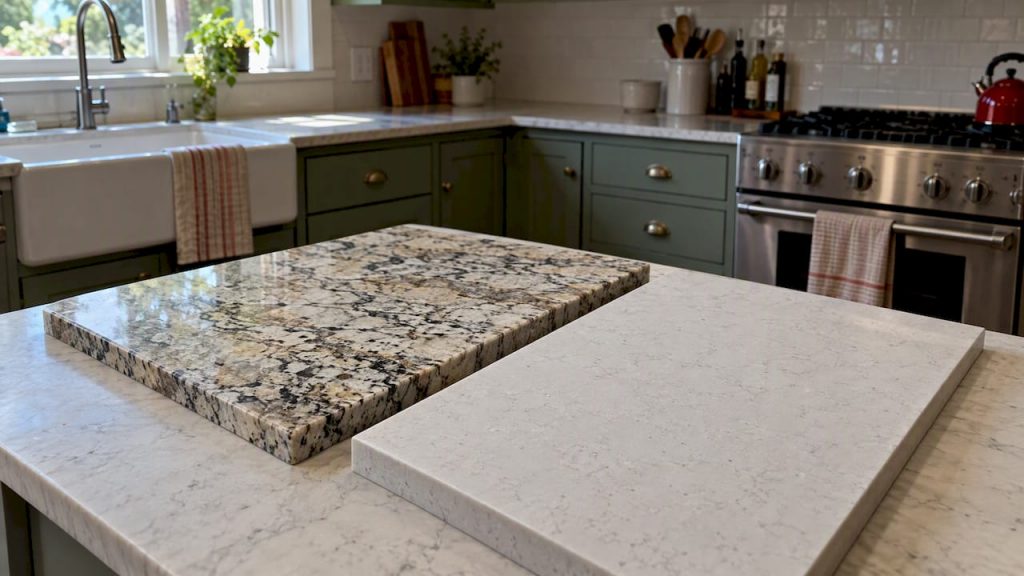
Quartz or granite for your Canadian kitchen? Compare looks, heat and stain resistance, upkeep, installed cost per square foot and safety, then pick with confidence.
Choose quartz if you want a consistent look and a surface you never have to seal. Choose granite if you want one-of-a-kind stone that shrugs off hot pans and often costs a little less. Both are tough, both look wonderful, and both will outlast most kitchen trends, so the real question is which trade-offs fit the way you live. We walk through looks, durability, upkeep, Canadian pricing and a few safety points below, so you can stand in the showroom and know exactly what to ask.
TL;DR
- Quartz is engineered: crushed quartz bound with resin. It gives you uniform colour, no sealing and strong stain resistance, but the resin can be damaged by direct high heat.
- Granite is natural stone: every slab is unique, hot cookware is far less of a worry, and it needs resealing roughly every one to two years.
- Canadian installed cost in one 2026 guide runs $70 to $150 per square foot for quartz and $60 to $130 for granite, so the ranges overlap heavily. Slab choice matters more than the material name.
- Pick by habit: busy family kitchen and hands-off upkeep points to quartz; serious cooks and lovers of natural patterns often lean granite.
Table of Contents
- What you are actually buying
- Looks: natural drama or calm consistency
- Durability: heat, scratches, stains and chips
- Everyday care and cleaning
- What they cost in Canada
- Safety: silica and who it affects
- Beyond the kitchen: bathrooms, islands and outdoors
- Which one should you choose?
- Our perspective
- Work with our team
- FAQ
- Sources
What you are actually buying
The two materials sound similar, which is why people mix them up. They are made in very different ways.
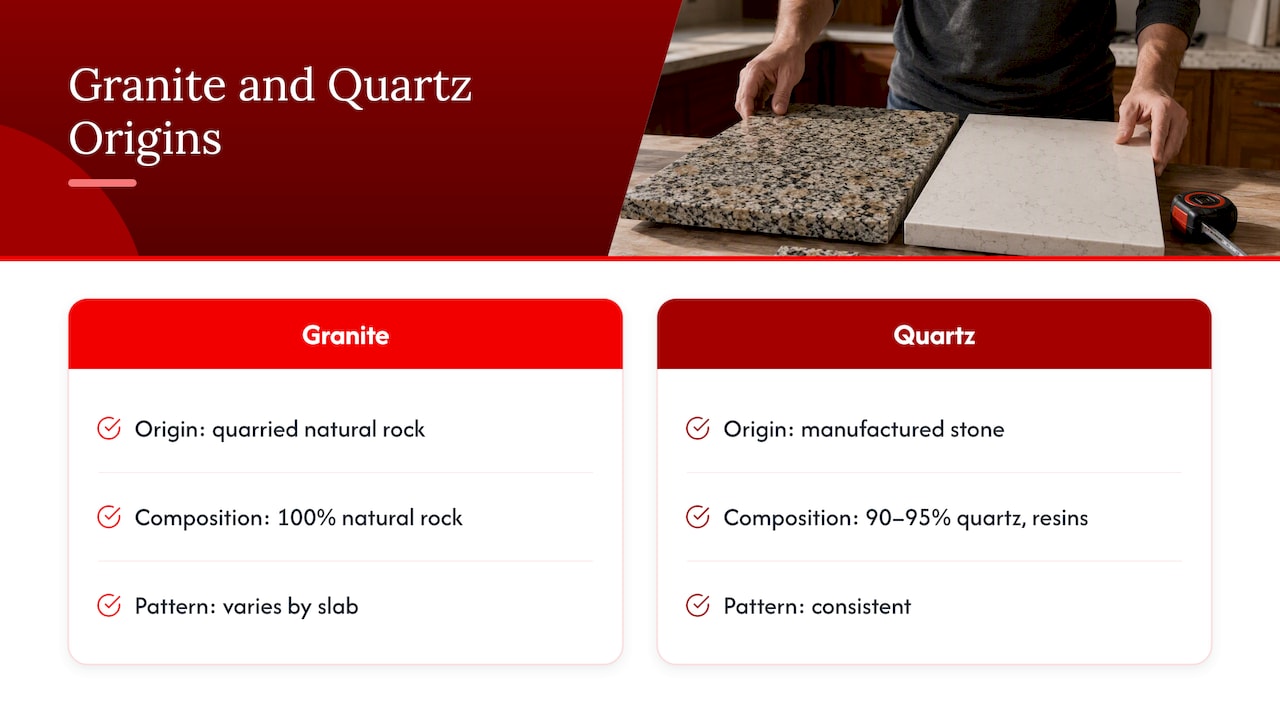
Granite is a natural igneous rock. It is quarried, cut into slabs, polished and fabricated for your kitchen. CCOHS, Canada’s occupational health and safety centre, identifies granite as natural stone, which also answers a question many readers ask: yes, granite is a natural stone.
Quartz countertops are manufactured. According to the same CCOHS page, they are made from crushed quartz rock, resins, additives and other materials, and you may see them called artificial, engineered or manufactured stone. A 2026 Canadian countertop guide puts the mix at roughly 90 to 95 percent crushed natural quartz combined with resins and pigments, while granite is 100 percent natural rock.
That one difference, quarried versus engineered, explains almost everything else in this comparison: why granite varies so much from slab to slab, why quartz is so even, why one tolerates heat and the other tolerates liquids, and why one needs a sealer.
Looks: natural drama or calm consistency
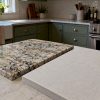
Picture a granite slab and you picture movement: flecks, veins and mineral clusters that no factory can quite copy. Forbes’s geologist’s perspective notes that because granite is natural rock, no two slabs are identical, which is exactly why it can become the centrepiece of a room.
Quartz works the other way. Canadian fabricator guidance describes quartz as offering consistent, predictable colours and patterns across slabs, while granite delivers unique mineral patterns specific to each slab. If you want a clean white, a soft grey or a concrete-look finish that matches from one end of a long run to the other, quartz is the safer bet. Manufacturers can also produce shades that rarely occur in nature.
How to judge a slab in person
Samples under showroom lights can mislead you. A few habits help:
- Look at the full slab, not a palm-sized sample. This matters most for granite, where a small square can hide a dramatic vein or a busy cluster.
- Check the slab you will actually receive. With granite, ask to tag the specific slab. With quartz, ask whether your seams will fall where the pattern repeats.
- Hold the sample at home. Take it to your kitchen and view it in morning and evening light, next to your cabinet colour and flooring.
- Touch it. Quartz often feels smoother and cooler thanks to its resin finish, while polished granite can feel slightly less uniform under your fingertips.
If you are still deciding on the overall palette, our look at kitchen design trends worth bringing home can help you match the countertop to the room rather than the other way around.
Durability: heat, scratches, stains and chips
Both surfaces are famously hard, and most households will never wear either one out. The differences show up in specific situations.
Heat
This is granite’s clearest win. Ontario fabricators note that granite handles hot cookware, while quartz contains polymer resin that can scorch, discolour or crack under direct high heat, which is why trivets are recommended. In practice, that means you can set a warm baking sheet on granite without much thought, while on quartz you should always put a pad or trivet under pots, pans and slow cookers straight from the heat.
Stains
Quartz takes this round. Because it is non-porous, liquids have nowhere to go. The same 2026 guide describes it as ideal for families and busy kitchens that want a set-it-and-forget-it surface. Granite, being natural and porous to some degree, relies on a sealer to keep wine, oil and coffee from soaking in.
Scratches and chips
Both resist everyday scratching well. The same Canadian guide says quartz is the harder of the two, while granite’s natural grain makes it slightly more prone to chipping along edges. Our practical advice: use a cutting board on either one anyway. Knives dull on stone, and a board protects your blades far more than it protects the counter.
Side-by-side summary
| Factor | Quartz | Granite |
|---|---|---|
| Material | Engineered: crushed quartz plus resin and pigments | Natural quarried stone |
| Appearance | Uniform, predictable colour and pattern | Unique to every slab |
| Heat | Resin can scorch or crack; use trivets | Handles hot cookware well |
| Stains | Non-porous, strongly stain resistant | Needs sealing to resist stains |
| Sealing | None | Roughly every one to two years |
| Edge chipping | Less likely | Slightly more prone |
| Installed cost in Canada (one 2026 guide) | $70 to $150 per sq. ft. | $60 to $130 per sq. ft. |
The general view from independent home publishers matches this. The Spruce frames the decision as granite’s natural look and heat resistance against quartz’s consistency and easier maintenance.
Everyday care and cleaning
Upkeep is where many buyers make their final call, so here is what each surface really asks of you.
Cleaning quartz
Quartz is the easy one. Warm water, a few drops of mild dish soap and a soft cloth handle nearly everything. For dried-on spots, soften them with a damp cloth first rather than scraping hard. Skip abrasive scrubbers and harsh solvents, which can dull the finish.
A common question is whether disinfecting wipes are fine on quartz. Because the surface is resin-bound, we would avoid making bleach-based wipes a daily habit. Mild soap and water cleans effectively, and if you want to disinfect, check the care instructions from your slab’s manufacturer first, since products and warranties differ.
Cleaning and sealing granite
For everyday cleaning, use warm water and a gentle, pH-neutral soap or a cleaner made for stone. Avoid acidic cleaners such as vinegar or lemon-based sprays, which can wear down the sealer over time.
Sealing is the part people ask about most. The Canadian guide we cite for cost says granite needs resealing every one to two years, while quartz needs none. A simple home test helps you decide when: drop a little water on the surface. If it beads, the sealer is working. If it soaks in and darkens the stone within a few minutes, it is time to reseal. Sealing is a quick DIY job with a stone sealer, and it is also something your installer can do.
A quick weekly routine
- Wipe up spills the same day, especially oil, wine, coffee and citrus on granite.
- Use trivets under hot pans on quartz and as a habit on both.
- Use coasters and cutting boards.
- Dry the surface after cleaning to avoid water spots and film.
What they cost in Canada
Prices swing with slab grade, edge profile, cutouts, region and the fabricator’s workload, so treat all figures as planning ranges. One 2026 Canadian guide puts quartz at $70 to $150 per square foot installed and granite at $60 to $130. Note how much the ranges overlap: an entry-level quartz can cost less than a premium exotic granite, and the reverse is just as true.
Here is a rough worked example using those ranges for a 40 square foot kitchen:
| Material | Low end (40 sq. ft.) | High end (40 sq. ft.) |
|---|---|---|
| Quartz | $2,800 | $6,000 |
| Granite | $2,400 | $5,200 |
Those totals are simple multiplication of the published per-square-foot range by 40, not a quote. Your own number will depend on sink cutouts, backsplash, edge detail and whether old counters need removing.
The long-term picture
Cost does not end at installation. The same guide notes that because granite needs resealing every one to two years and quartz does not, quartz often works out more cost-effective over its lifespan. Sealer is inexpensive, so the difference is modest, but it does add up in time and effort across a decade or two.
Getting the budget right
Before you commit, price the whole project, not only the slab. New counters often prompt a new sink, faucet, backsplash and lighting. If you plan to add task lighting, it helps to understand under-cabinet lighting costs per foot so that it lands in your plan from the start. Our step-by-step guide to budgeting for a remodel shows how to build in a cushion for surprises, and if resale is on your mind, the ROI of a kitchen renovation is worth a read.
Get at least three written quotes. Ask each to separate material, fabrication, installation, removal of the old top and any plumbing disconnects, so you compare like with like.
Safety: silica and who it affects
You may have seen headlines about silica and engineered stone. It is worth understanding clearly, because it is mostly about the people who cut the stone, not about the finished counter in your home.
CCOHS states that engineered stone can contain up to 90 to 97 percent silica, while natural stone such as granite generally contains less than 45 percent. The concern is dust created during cutting, grinding and polishing. Ontario’s Ministry of Labour alert says workers who make, finish and install natural and engineered stone countertops risk lung disease from crystalline silica, and that the risk is especially high when hand-held tools are used on engineered stone, because of its much higher silica content.
What this means for you as a homeowner:
- Choose a fabricator that cuts in a shop with dust controls. Wet cutting and ventilation are standard protections for workers, so ask how they manage dust.
- Keep DIY cutting out of the plan. Cutting either material at home without proper dust control is not worth the savings. If your installer needs to make adjustments on site, keep children, pets and yourself out of the area and ask the crew about their dust controls.
- Talk to an occupational health professional or your provincial workplace safety body if you work in the trade, since rules differ by province.
This does not make either material unsafe to live with once it is installed and sealed into your kitchen. It does make the fabricator you choose matter.
Beyond the kitchen: bathrooms, islands and outdoors
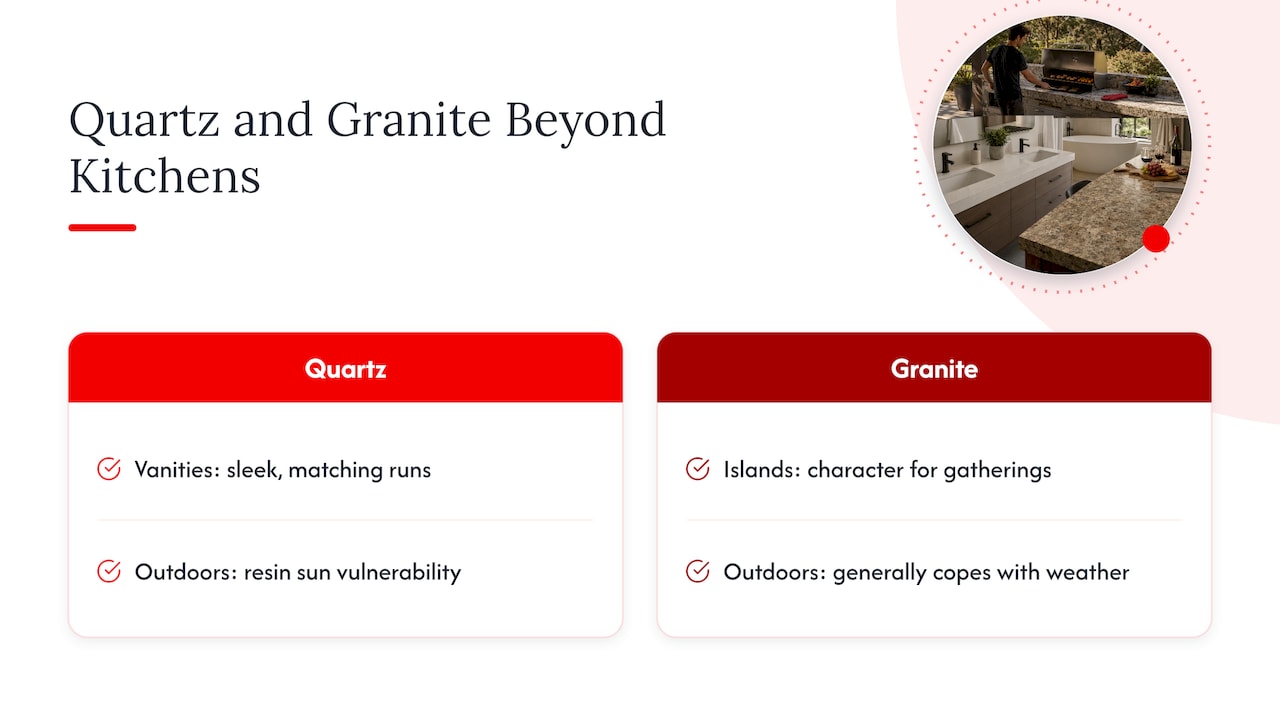
Both materials work well on vanities and islands, and the same trade-offs apply. Quartz’s uniformity suits sleek, matching vanity runs, while granite brings character to an island you want people to gather around.
Outdoors, the picture changes. Granite is natural stone and generally copes with the weather, while quartz’s resin can be vulnerable to prolonged sun exposure, so many manufacturers advise against outdoor use. If you are planning an outdoor kitchen, it is worth reading about whether porcelain worktops outdoors can work, since porcelain is another surface people weigh alongside granite for outdoor cooking spaces. Check the product specification and warranty for any slab before you use it outside.
If you are working in a compact space, our small kitchen makeover examples show how a single continuous surface can make a small room feel larger, which is a point in quartz’s favour. And if neither material feels quite right, our guide to types of kitchen countertops covers ten other options.
Which one should you choose?
Stop asking which material is better, and ask which one fits your kitchen.
Choose quartz if
- You have kids, a busy household or rental-style wear and tear, and you want the lowest-effort surface.
- You love a clean, even look, particularly a white or pale tone, with no surprises from slab to slab.
- You do not want to think about sealing, ever.
- You are happy to use trivets consistently.
Choose granite if
- You cook a lot and regularly move hot pans around.
- You want a surface that is entirely one of a kind, with real geological character.
- You are comfortable with a quick reseal every year or two.
- You want to keep the budget toward the lower end of the range, as granite tends to offer more wallet-friendly options.
A quick tie-breaker
Imagine your most typical Tuesday evening. If it involves a pot straight off the burner, a roasting pan out of a hot oven and the occasional glass of red wine, granite feels natural. If it involves homework, juice boxes and a ten-second wipe-down, quartz is hard to beat.
Whichever you choose, visit a slab yard, tag your slab, get written quotes and ask your fabricator about warranties and care instructions in writing.
Our perspective
We write about home projects for readers who want to enjoy the result as much as the process, and countertops are a perfect example. People often assume there is a universal winner, but the better choice is almost always the one that matches how you cook, clean and live. We have found that the happiest homeowners did two things: they saw the full slab in person, and they were honest with themselves about upkeep.
We would also encourage you to treat the fabricator as part of the product. A well-measured template, clean seams and careful dust control are what make either material look and feel premium for years. Spend your time comparing installers as carefully as you compare slabs, and you will rarely regret the decision.
— Alexander
Work with our team
Do you run a home improvement business, a design studio or a home products brand that serves Canadian homeowners planning kitchen projects? We welcome partnership ideas, and you can learn about our banner ad and guest post options to see how to reach readers who are researching renovations.
FAQ
Which is the most durable, quartz or granite?
Both are highly durable, so it depends on what you ask of them. Granite handles heat better, while quartz resists stains better because it is non-porous and needs no sealing. Quartz is also reported to be slightly harder, while granite is a little more prone to chipping at the edges.
Is granite a natural stone?
Yes. Granite is a natural igneous rock that is quarried in slabs, which is why each one is unique. Quartz countertops, by contrast, are engineered from crushed quartz, resins and pigments.
How do you clean quartz countertops?
Wipe them with a soft cloth, warm water and a little mild dish soap, then dry. Avoid abrasive pads and harsh solvents. For disinfecting, check your manufacturer’s care guide before using bleach-based products regularly.
Does quartz need sealing?
No. Quartz is non-porous, so it needs no sealer. Granite, on the other hand, is typically resealed every one to two years, and a simple water-bead test shows when it is due.
Which is cheaper in Canada, quartz or granite?
Granite is usually a bit cheaper up front. One 2026 Canadian guide lists $60 to $130 per square foot installed for granite and $70 to $150 for quartz, so the ranges overlap. Get several written quotes for the slabs you actually like.
Sources
- CCOHS: Engineered Stone Countertops
- Ontario.ca: Alert, silica exposure during countertop manufacturing and installing
- Quartz vs Granite Countertops: Cost, Durability, 2026 Guide
- Quartz vs Granite Countertops (Ontario 2026): Cost, Heat
- Quartz vs. Granite Countertops: Which Is Better? (The Spruce)
- Quartz Vs. Granite Countertops: A Geologist’s Perspective (Forbes)















Leave a Comment
Your email address will not be published. Required fields are marked with *