
Canada-focused playbook for EnerGuide home evaluations: what gets measured (blower door, insulation, HVAC), how to verify NRCan registered advisors, day…
An EnerGuide home evaluation is Canada’s official, NRCan-registered basement-to-attic assessment of your house’s energy performance. A registered energy advisor measures airtightness, insulation, and mechanical systems, then hands you an EnerGuide rating and a Renovation Upgrade Report. That report becomes your roadmap for prioritizing retrofits and, in many cases, your ticket to rebate eligibility.
TL;DR:
- An EnerGuide evaluation uses a standardized process performed by registered advisors to produce a valid energy performance rating for rebate eligibility.
- The assessment includes a blower door test, insulation checks, and mechanical system reviews to generate an accurate house energy model.
- Costs vary regionally and can be reimbursed up to $600 by some federal programs, with on-site visits taking two to four hours and report delivery taking up to 14 days.
- Preparation involves ensuring unobstructed access, setting the thermostat to 22°C, and shutting down fuel-burning appliances during testing.
- Only NRCan-registered organizations can conduct official evaluations, and homeowners should verify credentials to avoid scams and ensure rebate acceptance.
Table of Contents
- What Is an EnerGuide Home Evaluation (and How Is It Different From a Home Energy Audit in Canada)?
- What Gets Tested During Your Energy Efficiency Assessment?
- How Do You Find a Registered Energy Advisor Near You?
- What Does a Home Energy Audit Cost in Canada, and How Long Does It Take?
- How Should You Prepare Your Home Before the Evaluation?
- What Reports Do You Get, and How Do You Use Them?
- How Can You Spot and Avoid EnerGuide Evaluation Scams?
- Why We Recommend an EnerGuide Evaluation Before Any Major Renovation
- Where to Go Next After Your Evaluation
- Official Resources to Book, Verify, and Interpret Your Evaluation
- Sources
- FAQ
What Is an EnerGuide Home Evaluation (and How Is It Different From a Home Energy Audit in Canada)?
The terms “home energy audit” and “EnerGuide evaluation” get used interchangeably across Canada, but only the EnerGuide home evaluation is a standardized, government-recognized process. EnerGuide home evaluations are administered under a framework run by Natural Resources Canada (NRCan), the federal department responsible for energy policy and efficiency standards nationwide.
A generic home energy audit could mean anything from a contractor eyeballing your attic insulation to a full diagnostic workup. An EnerGuide evaluation is different because it follows a fixed methodology every registered advisor must use, which is exactly why provinces, utilities, and federal rebate programs accept the results as valid documentation. NRCan’s own audit framework describes a systematic process of surveying conditions, gathering data, analyzing findings, and identifying opportunities for improvement, and that same logic underpins how residential evaluations get built.
Who actually performs the work matters as much as the process itself. Only advisors employed by an NRCan-registered service organization can carry out an official evaluation and issue a valid EnerGuide rating. A neighbor’s contractor with a thermal camera might spot a few drafts, but that inspection carries no weight with rebate programs and produces no EnerGuide label.
Here’s what separates a real EnerGuide evaluation from an informal walkthrough:
- Standardized data collection using the same protocols in every province, so a rating in Halifax means the same thing as one in Calgary.
- A licensed, registered advisor, not a general contractor or salesperson, performs the assessment.
- A numeric EnerGuide rating that lets you compare your home’s performance before and after retrofits.
- Program compatibility, since most rebate and grant applications require documentation from a registered evaluation, not a private inspection.
Eligibility is broad: almost any occupied residential building qualifies, from a downtown condo to a century farmhouse, though larger or unusual properties sometimes need extra advisor time.
What Gets Tested During Your Energy Efficiency Assessment?
The evaluation itself is where the real detective work happens, and it goes well beyond a visual walkthrough. An advisor collects physical measurements throughout the house, then feeds that data into modeling software to calculate your EnerGuide rating.
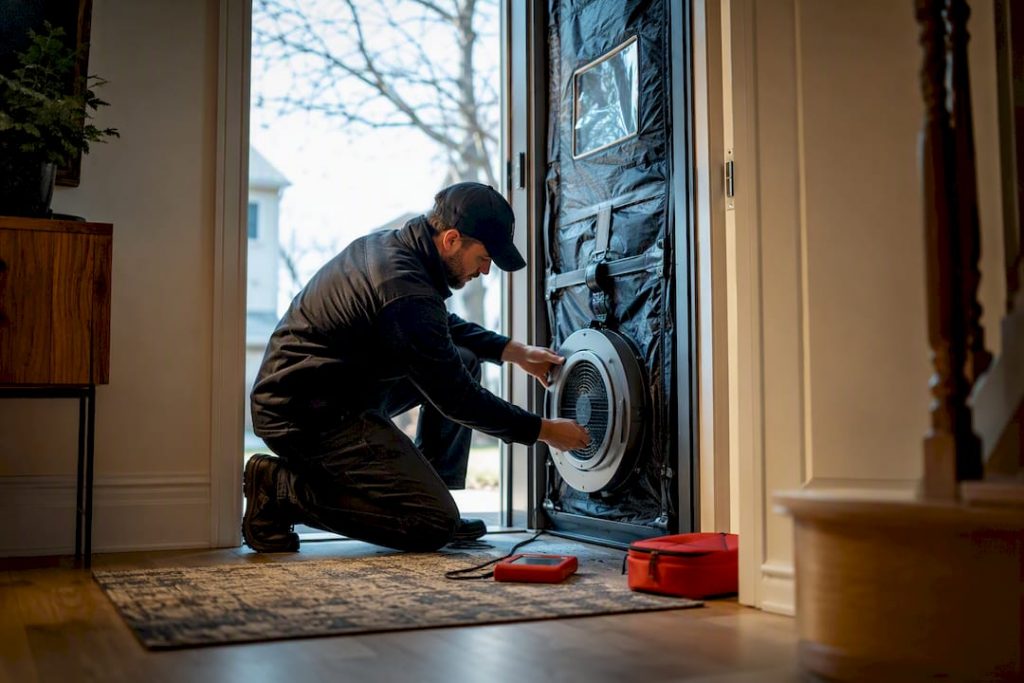
The centerpiece of the visit is the blower door test. The advisor seals your exterior doors with a calibrated fan, depressurizes the house, and measures how much air leaks through gaps, cracks, and poorly sealed penetrations. This single test tells the advisor more about your home’s real-world energy loss than any visual inspection could, because leaks hiding behind drywall or above a dropped ceiling show up in the airflow numbers even when they’re invisible to the eye.
Beyond airtightness, a full home insulation audit and mechanical review typically covers:
- Insulation levels in the attic, walls, foundation, and any exposed floors, checked by location rather than assumed from age or construction type.
- Windows and doors, cataloged by type, age, and estimated performance, since older single-pane units behave very differently from newer double or triple glazing.
- HVAC equipment specs, including furnace or boiler age, efficiency rating, and duct condition.
- Water heater details, covering fuel type, tank size, and estimated efficiency.
- Ventilation systems, noting whether the home has a heat recovery ventilator, exhaust-only fans, or no mechanical ventilation at all.
Every data point feeds directly into the software model that calculates your EnerGuide rating, so a missed measurement anywhere in the house can skew the final score. That’s why registered advisors follow a checklist rather than relying on memory or a quick glance.
The output isn’t just a single number. It’s a full energy simulation of your house, matched against your actual utility patterns and construction details, that becomes the backbone of your Renovation Upgrade Report. If your home has an aging ventilation setup, this is also the stage where an advisor might flag whether a heat or energy recovery ventilator would meaningfully improve indoor air quality alongside efficiency.
How Do You Find a Registered Energy Advisor Near You?
Booking with the wrong provider wastes your money and produces a report no rebate program will accept, so verification comes before scheduling, not after.
NRCan maintains an official directory where you can search for registered service organizations by region. Only companies listed there employ advisors authorized to issue valid EnerGuide ratings, and that registration is the single fact you need to confirm before booking anything.
Before you commit to a booking, run through this checklist:
- Confirm the company appears on NRCan’s current registry, not just an old printout or a business card claim.
- Ask which specific advisor will conduct your evaluation and confirm their certification number.
- Get a written quote that separates the evaluation fee from any add-on services.
- Ask for an estimated delivery date for your reports, since timelines vary by provider workload.
- Clarify invoicing practices, particularly whether payment is due at the appointment or after report delivery.
Pro Tip: Call two or three registered organizations before booking. Fees and availability vary more than most homeowners expect, and a quick round of quotes can save you both time and money without sacrificing quality.
Red flags are just as important as green lights. A legitimate registered organization will never show up unannounced at your door or cold call you’re offering a “free” or discounted evaluation. NRCan is explicit that registered service organizations do not solicit homeowners through unsolicited phone calls, emails, or door-to-door visits. Treat any provider who initiates contact that way as disqualified, regardless of how professional the pitch sounds.
What Does a Home Energy Audit Cost in Canada, and How Long Does It Take?
Cost is usually the first question homeowners ask, and the honest answer is that it varies by province, house size, and provider workload. Fees for a pre-retrofit EnerGuide evaluation depend on regional labor rates, travel distance for rural properties, and whether you’re booking a single evaluation or a paired pre- and post-retrofit assessment.
Some federal rebate initiatives have historically reimbursed homeowners for a portion of these costs. Under past iterations of national retrofit programs, homeowners could receive reimbursement of up to $600 toward the combined cost of pre- and post-retrofit evaluations, though the exact amount and eligibility rules shift as programs get renewed or replaced. Always confirm current terms directly with whichever program you’re applying to rather than assuming past figures still apply.
Timing matters as much as price, especially if you’re coordinating renovation contractors around your evaluation schedule.
- Booking an appointment can take anywhere from a few days to a few weeks depending on advisor availability in your region.
- The on-site visit itself typically runs two to four hours for an average single-family home.
- Advisors may take at least 14 days after the visit to deliver your finished reports.
- When a rebate program requires portal submission, that upload can add further processing time on top of report delivery.
If your evaluation is tied to a specific rebate or grant, read the fine print on required documentation before you book. Some programs mandate both a pre-retrofit and post-retrofit evaluation to qualify for payouts, meaning the audit fee itself becomes part of your total renovation budget, not a one-time sunk cost.
How Should You Prepare Your Home Before the Evaluation?
A blower door test and full insulation audit only produce accurate numbers when the house is in its normal operating condition, which means a little preparation goes a long way toward getting a clean result the first time.
Follow these steps in the days before your appointment:
- Confirm clear, unobstructed access to your attic hatch, crawl space, and any mechanical rooms.
- Set your thermostat to maintain roughly 22°C so the advisor can capture representative heating conditions.
- Clear storage boxes or furniture blocking exterior walls, window sills, or HVAC equipment.
- Remove ashes or embers from any wood-burning appliance well before the visit.
- Make sure exterior power is accessible if your advisor needs it for blower door equipment.
On the day itself, the biggest rule to remember involves your fuel-burning appliances. During the blower door test, you must not run any fuel-fired or wood-burning appliances, because the negative pressure created by the test can pull combustion gases back into the house. Your advisor will walk you through shutting these down and will confirm everything is safely restored to normal before leaving.
Expect your advisor to take photographs of mechanical systems, the attic, and exterior conditions, and to ask you to sign a consent form authorizing the assessment and any related data sharing. You may also be asked for supporting documents like recent utility bills or property tax records to help refine the energy model.
Pro Tip: Seal off any temporary openings, like an open window left cracked for ventilation, before your advisor arrives. Even one open window during the blower door test can throw off airtightness readings enough to skew your entire EnerGuide rating.
What Reports Do You Get, and How Do You Use Them?
Once the on-site work wraps up, you’re not left staring at raw numbers. NRCan-registered evaluations produce a defined set of deliverables designed specifically to guide renovation decisions.
- The EnerGuide rating label gives your home a numeric score reflecting overall energy performance, similar in spirit to a fuel-efficiency rating for a vehicle.
- The Renovation Upgrade Report ranks recommended retrofits by cost-effectiveness, showing which upgrades deliver the most efficiency gain per dollar spent.
- The Homeowner Information Sheet summarizes your evaluation findings in plain language, useful for sharing with contractors or family members who weren’t present for the visit.
The Renovation Upgrade Report deserves the most attention because it’s built to answer the question every homeowner actually cares about: what should I fix first? Rather than a flat list of problems, it typically orders recommendations by return on investment, weighing upfront project cost against projected annual energy savings. A homeowner with an aging furnace and thin attic insulation might discover that insulation delivers a faster payback than a full furnace replacement, even though the furnace feels like the more urgent fix.
Once you have your reports in hand:
- Bring the Renovation Upgrade Report to contractor consultations so quotes reflect the specific measures your advisor recommended.
- Keep digital and physical copies of every report, since rebate programs often require them as proof of eligibility.
- Schedule a post-retrofit evaluation once major upgrades are complete, since many rebate programs require a second EnerGuide rating to confirm improvement before releasing funds.
- Track your utility bills against your pre-retrofit baseline to see whether real-world savings match the modeled projections.
Homeowners weighing which upgrades to tackle first often benefit from reviewing broader guidance on home upgrades that boost comfort and value alongside their personalized report, since the two sources complement each other well.
How Can You Spot and Avoid EnerGuide Evaluation Scams?
Fraud around home energy programs isn’t rare, and government-branded language makes an easy hook for scammers targeting homeowners who’ve heard about rebates but don’t know the verification steps.
The core rule from NRCan is unambiguous: registered service organizations do not solicit homeowners through unsolicited door-to-door visits, phone calls, or emails. If someone knocks on your door claiming to offer a government energy audit, or you receive an unprompted call pushing a “free assessment,” treat it as a scam attempt regardless of how official it sounds.
Protect yourself with these verification habits:
- Search NRCan’s registry yourself before responding to any offer, rather than trusting a name or logo on a flyer.
- Never provide payment information or sign paperwork for anyone who initiated contact with you first.
- Ask for a registration number and verify it independently rather than accepting a verbal claim.
- Report suspected fraud to NRCan or your provincial consumer protection office rather than ignoring it.
Report delivery delays are normal and not a sign of fraud. Since advisors may legitimately take at least 14 days to finalize your EnerGuide rating and Renovation Upgrade Report, and program portal submissions can add further processing time, a slow turnaround usually reflects administrative workload, not a problem with your evaluation.
Why We Recommend an EnerGuide Evaluation Before Any Major Renovation
Our team at Lizard’s Lunch treats an EnerGuide evaluation as the first purchase in any renovation budget, not an optional add-on. Spending on a new furnace or triple-pane windows without knowing your home’s actual weak points is a guess dressed up as a plan. The Renovation Upgrade Report turns that guess into a ranked list, which is exactly what you want in hand before you sit down with contractors.
Bring your report to every quote conversation and ask contractors to explain how their proposal addresses the advisor’s specific findings, not just generic upgrade packages. For readers building out a longer efficiency plan, our guide on why energy efficiency matters for your home is a useful next stop once your report is in hand.
— Alexander
Where to Go Next After Your Evaluation
Once you have your EnerGuide rating and Renovation Upgrade Report, the real work of prioritizing upgrades begins, and that’s where a few practical guides can help fill in the gaps an official report doesn’t cover. Our piece on home upgrades that boost comfort and value breaks down which retrofits tend to show up most often in these reports and what homeowners can realistically expect from each. If you’re looking for smaller wins while you plan bigger renovation projects, energy-saving tips to cut bills covers low-cost changes you can make immediately.
For readers exploring how home upgrades intersect with broader lifestyle choices, our guide on what a healthy lifestyle actually looks like connects home comfort improvements to everyday well being, since a more efficient, better ventilated house often supports healthier daily routines too. None of this replaces your official evaluation. It’s editorial context meant to help you act on what your advisor already told you.
Official Resources to Book, Verify, and Interpret Your Evaluation
Start with NRCan’s page on EnerGuide home evaluations for the full technical breakdown of what advisors measure and how ratings get calculated. To find and confirm a registered provider in your area, use the service organization directory. Homeowners applying for rebates should also review the pre-retrofit evaluation program page for current documentation requirements and timelines.
FAQ
How much does a home energy audit cost in Ontario?
Costs vary by provider and house size rather than by a fixed provincial rate, and some federal programs have historically reimbursed homeowners up to $600 toward combined pre- and post-retrofit evaluation fees. Contact NRCan-registered organizations in your area for current quotes.
Is a Canada energy audit legit?
Yes, but only when performed by an advisor employed by an NRCan-registered service organization. Verify any provider through the official registry before booking, since registration is the only real proof of legitimacy.
What should you expect from a home energy audit?
Expect a two to four hour visit involving a blower door airtightness test, insulation checks throughout the house, and a review of your HVAC, water heater, and windows. You’ll receive an EnerGuide rating and a Renovation Upgrade Report within roughly two weeks or longer, depending on provider workload.
What is the cost of an energy audit?
There’s no single fixed price nationwide, since fees depend on your province, home size, and whether you’re booking a single or paired pre- and post-retrofit evaluation. Getting quotes from two or three NRCan-registered organizations is the most reliable way to gauge current pricing in your area.

















Leave a Comment
Your email address will not be published. Required fields are marked with *