

Learn how to renovate your home without costly mistakes. This guide helps you plan effectively and stay within budget for a smooth remodel.
Figuring out how to renovate your home is exciting until reality hits. Budgets balloon, permits stall everything, and a simple bathroom refresh turns into a three-month ordeal. The good news? Most renovation disasters are completely preventable. They happen because homeowners skip the planning phase, underestimate hidden costs, or tackle tasks in the wrong order. This guide walks you through every critical stage of a successful home remodel, from the initial inspection all the way to your final walkthrough, so you can transform your space with confidence and keep your sanity intact.
Table of Contents
- Key takeaways
- How to renovate your home: start with a real assessment
- Setting a realistic budget before anything else
- Understanding permits and legal requirements
- Executing the renovation in the right order
- The final walkthrough: your last line of defense
- My honest take after watching too many renovations go sideways
- Ready to take your home to the next level?
- FAQ
Key takeaways
| Point | Details |
|---|---|
| Assess needs before spending | Inspect structure, systems, and safety issues first before planning any cosmetic upgrades. |
| Budget with a cushion | 85% of renovation projects exceed original budgets, so set aside 15-20% as a contingency fund. |
| Pull permits early | Structural, electrical, and plumbing work almost always requires permits. Starting without them risks fines and forced demolition. |
| Follow the right sequence | Complete rough-in work and pass inspections before closing walls to avoid expensive rework. |
| Finish with a punch list | A detailed final walkthrough protects your investment and holds contractors accountable before final payment. |
How to renovate your home: start with a real assessment
Before you pick paint colors or browse tile samples, you need an honest look at what your home actually needs. This is the step most homeowners skip, and it costs them dearly later. Think of it as your renovation foundation. Everything else, your budget, your timeline, your project list, depends on what you find here.
Separate needs from wants
There are two categories in any home update: needs and wants. Needs are safety and system issues. Wants are the aesthetic upgrades that make your home feel fresh. Mixing them up leads to projects that run out of money before the structural repairs are done.
Walk through every room with a notepad and inspect the following:
- Structural elements: Check for cracks in foundations, sagging floors, bowing walls, or deteriorating framing. These are non-negotiable repairs.
- Electrical system: Look for outdated wiring, overloaded panels, or missing GFCI outlets near water sources. Faulty wiring is a fire hazard.
- Plumbing: Inspect pipes for corrosion, slow drains, water stains on ceilings, or low water pressure. Leaks hidden in walls can destroy a renovation you just paid for.
- HVAC: An aging furnace or inefficient AC unit will undermine any comfort upgrades you make elsewhere. Note the age and condition of all units.
- Roof and insulation: A compromised roof or poor insulation affects energy bills and interior finishes. Check the attic for moisture, daylight gaps, and insulation depth.
- Cosmetic and layout desires: Only after the above list do you write down the open-plan kitchen, the spa-style bathroom, or the home office addition.
Pro Tip: Take photos during your walkthrough and create a simple spreadsheet with two columns: “Must Fix” and “Would Love.” This visual separation makes budget prioritization dramatically easier when contractor quotes come in.
Once your list is complete, prioritize by safety first, then function, then form. A beautifully renovated kitchen means nothing if the electrical panel behind the wall is a hazard. Use this assessment as your master reference throughout the entire project.
Setting a realistic budget before anything else
Money is where renovations succeed or collapse. Getting your numbers right before a single wall comes down is one of the most valuable home renovation tips you can apply.
The numbers you need to know
A widely used rule of thumb is to spend no more than 30% of your home’s current market value on any single renovation. This ceiling protects you from over-improving for your neighborhood, which rarely pays back at resale. Within that ceiling, you need to plan for every layer of cost.
Here is a comparison of the two main execution paths most homeowners face:
| Factor | DIY approach | Hiring a contractor |
|---|---|---|
| Upfront cost | Lower material costs, zero labor | Higher, includes labor and overhead |
| Risk of error | High for complex trades | Low when licensed professionals are used |
| Time investment | Very high, especially for beginners | Managed by contractor |
| Correction costs | DIY projects need correction roughly 25% of the time, adding 15-30% to budgets | Fewer corrections needed, but change orders are expensive |
| Permit handling | Homeowner must manage | Contractor typically handles or guides |
The hidden budget killer is the mid-project change. Selecting all your materials before demolition begins is not just a good idea; it is a financial safeguard. Changing materials mid-project routinely generates $3,000 or more in change orders, on top of timeline delays.
Pro Tip: Get three quotes for every trade. The middle quote is rarely the best choice purely based on price. Look at scope detail, timeline, and licensing. The contractor who lists every line item is the one who has done this before.
Always add a 15-20% contingency line to your budget from day one. This is not pessimism. This is math. Most renovation budgets are exceeded because of what hides inside walls, under floors, and above ceilings. Asbestos, rot, outdated wiring, improperly supported beams. These discoveries are common, and they are expensive. Your contingency fund is what keeps a surprise from becoming a catastrophe.
Also factor in permit fees, temporary housing costs if needed, furniture storage, and the cost of professional trades for tasks that require licensing.
Understanding permits and legal requirements
Permits feel like a bureaucratic nuisance until you skip one and face a stop-work order or a failed home inspection at resale. Compliance is not optional. It protects your investment, your safety, and your ability to sell the home later.
What needs a permit
Not every renovation requires a permit. Painting walls, refinishing cabinets, replacing fixtures like-for-like, and most cosmetic updates typically do not. But the following almost always do:
- Structural changes, including removing or adding walls
- Electrical work beyond simple fixture swaps
- Plumbing changes or new plumbing runs
- HVAC installations or major modifications
- Window and door replacements that change the opening size
- Additions, decks, and accessory dwelling units
Permit timelines vary significantly by complexity. Residential building permits typically take 6 to 8 weeks for straightforward projects, and up to 12 to 20 weeks for complex ones. Some jurisdictions offer fast-track review in as little as three business days for eligible simple projects. The single biggest factor in permit delays is an incomplete application. Submit everything correctly the first time.
Lead safety in older homes
If your home was built before 1978, lead paint is a serious concern. The EPA requires lead-safe work practices for any renovation that disturbs painted surfaces. This means contractors working in pre-1978 homes must be certified under the EPA Renovation, Repair, and Painting (RRP) rule. The certification requires an 8-hour hands-on course with a practical exam and is valid for five years. There is no fully online path to certification.
Compliance note: Even if you are doing the work yourself, you are legally responsible for lead-safe practices in your own home when children under six or pregnant women live there. Containment, cleanup, and recordkeeping are required, not optional courtesies.
Ask every contractor working in a pre-1978 home for proof of EPA lead renovation certification before signing any contract. It is a simple ask that protects your family and keeps the project legal.
Executing the renovation in the right order
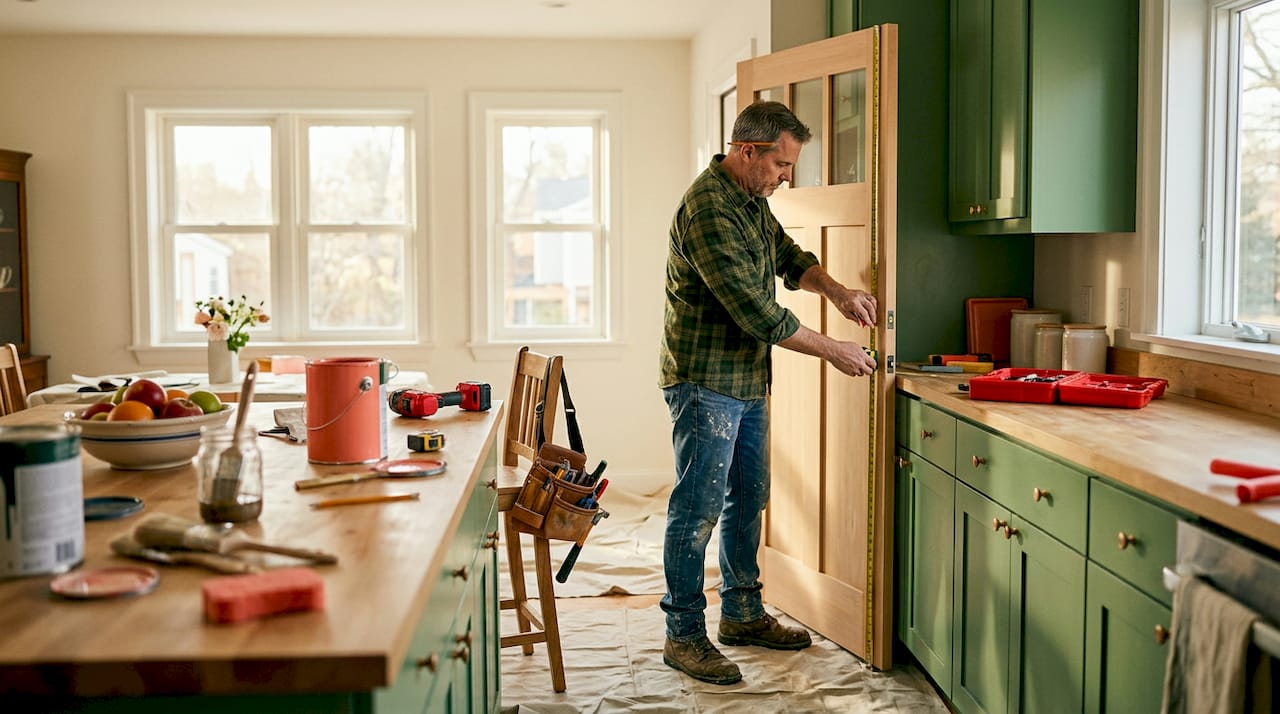
Sequence is everything in home remodeling. Do things out of order and you will be tearing out finished work to fix what should have been done first. This section covers the proper execution flow that professionals follow on every project.
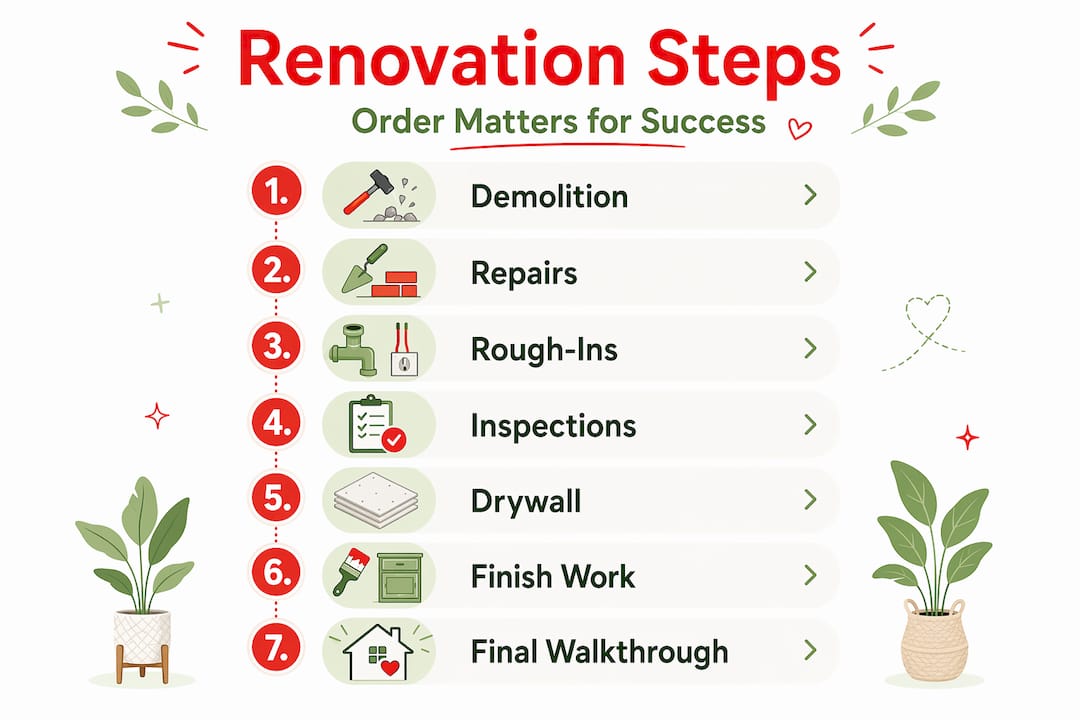
According to professional renovation checklists, the correct sequence moves from demolition through structural work, rough-ins, inspections, insulation, drywall, and only then into finish work.
The seven-phase execution order
- Demolition. Remove everything that is going. Protect areas you are keeping with plastic sheeting and temporary barriers. Demolition reveals what is actually inside your walls, often the source of budget surprises.
- Structural work. Repair or alter the framing, beams, and load-bearing elements. Nothing else can proceed safely until the structural skeleton is sound.
- Rough-in electrical, plumbing, and HVAC. All pipes, wiring, and ductwork go in before the walls close. This is also when you add recessed lighting wiring, in-wall speaker runs, or any smart home infrastructure.
- Inspections. Book your rough-in inspections before touching insulation or drywall. Each inspection booking can add 5 to 10 business days to your timeline, so schedule early. Inspectors must see the work while it is still open.
- Insulation and drywall. Only after inspections are passed do you close the walls. Install insulation, then hang, tape, and finish drywall.
- Finish work. This is the rewarding phase. Flooring, tile, painting, trim, cabinetry, and built-ins all happen here. Work from top to bottom: ceiling, walls, then floors.
- Fixtures and hardware. Light fixtures, faucets, cabinet hardware, switch plates, and appliances come last. Installing these before floors are down or walls are painted leads to unnecessary damage and re-installation costs.
Pro Tip: Take dated photos at each phase before walls close. These photos become your permanent record of where every wire and pipe runs, which is worth its weight in gold during any future repair or renovation.
The single most common DIY mistake in home updating is installing flooring before painting. Overspray and drips are inevitable, and re-finishing floors is far more expensive than protecting them with a drop cloth and doing things in sequence.
Skipping or reordering steps does not save time. It creates rework. A bathroom tile job done before the plumbing rough-in is inspected means jackhammering up those tiles if something needs correction.
The final walkthrough: your last line of defense
The project is done. Or is it? A thorough final walkthrough, often called a punch list review in the construction industry, is how you separate what looks finished from what actually is finished.
Pro Tip: Do your final walkthrough in bright daylight with a high-powered flashlight. Raking light across painted walls reveals texture inconsistencies, missed patches, and uneven roller marks that overhead lighting completely hides.
Here is what to check systematically:
- All surfaces: Look for paint misses, drywall imperfections, grout inconsistencies, and scratched or chipped finishes. Open every cabinet door and check alignment.
- Functional testing: Run every faucet, flush every toilet, test every electrical outlet with a plug tester, and flip every switch. Turn the HVAC system through all modes.
- Doors and windows: Open and close every door and window. They should operate smoothly, latch securely, and seal properly. Sticking doors after renovation often indicate framing or humidity issues.
- Flooring: Walk every square foot and listen for squeaks or hollow spots under tile. Check transitions between floor types for clean, secure installation.
- Exterior: If any exterior work was done, check caulking, flashing, and drainage direction away from the foundation.
Document every issue in writing with photos and share the list with your contractor. A reputable professional welcomes a punch list because it defines exactly what remains. Do not release final payment until all agreed items are resolved. This is your most powerful leverage point, and using it protects both you and the project’s long-term integrity.
Request all warranties in writing before the contractor leaves. Keep a folder with permits, inspection sign-offs, warranties, and your phase photos. This documentation is genuine value at resale time.
My honest take after watching too many renovations go sideways
I have followed enough renovation projects to know that the biggest problems rarely come from bad contractors or bad luck. They come from homeowners who design with their eyes before thinking with their heads.
Function must come before style every single time. I have seen people spend weeks agonizing over backsplash tile while their HVAC system is undersized for the addition they just built. The tile looks beautiful. The house is uncomfortable eleven months of the year.
The mid-project material change is the budget killer I see most often. Someone falls in love with a different countertop material after the cabinets are already in and the plumbing rough-in is done. What feels like a simple swap cascades into new cabinet modifications, a different undermount sink, revised plumbing connections, and a three-week delay. Selecting materials before construction starts is one of the most financially protective decisions a homeowner can make.
Hire certified professionals for the trades that require certification. Full stop. The savings from hiring an unlicensed electrician disappear the moment you need to sell and the work fails inspection. I have watched homeowners pay to have work done twice because they tried to cut corners the first time.
Patience with permits is non-negotiable. Experienced contractors plan their renovation timelines around permit windows because that is the professional reality. If your contractor promises a major structural project with no permit wait time, treat that as a red flag.
Plan thoroughly. Stay flexible. And never, ever start demolition before your materials are ordered.
— Alexander
Ready to take your home to the next level?
You now have the roadmap. Every phase, from the first assessment walk to the final punch list, points toward one goal: a home that works beautifully and holds its value. If you are hungry for what comes next, there is a lot more waiting for you. Explore the top home upgrades that consistently boost both comfort and property value, or discover the best home improvement tech ideas that transform how a space looks and feels. Whether you are planning a full remodel or a focused room refresh, these guides are packed with inspiration grounded in real results. Your next great space is closer than you think.
FAQ
What is the first step to renovating your home?
Start with a full home assessment. Inspect structural, electrical, plumbing, and HVAC conditions before planning any cosmetic upgrades, so your budget addresses real needs first.
How much contingency should I budget for a home renovation?
Set aside 15 to 20% of your total budget as a contingency. Most renovation projects exceed their original budget due to hidden issues uncovered during demolition.
Do I always need a permit to remodel my house?
Not always. Cosmetic work like painting or cabinet refacing typically skips the permit process, but structural, electrical, plumbing, and window or door changes almost always require one.
What order should renovation work be done in?
Follow this sequence: demolition, structural repairs, rough-in trades, inspections, insulation and drywall, finish work, then fixtures. Skipping or reordering steps causes rework and delays.
When should I hire a contractor instead of doing it myself?
Hire licensed professionals for any electrical, plumbing, structural, or HVAC work. DIY corrections on complex trade work add 15 to 30% to original budgets, making professional help the smarter financial choice for technical tasks.
1 comment

















1 Comment
출장마사지
June 10, 2026, 9:45 am집에서 편하게 받을 수 있는 관리라 기대했는데 출장마사지 퀄리티가 생각보다 훨씬 좋아서 전문 관리샵 못지않은 만족감을 느낄 수 있었음
REPLY