

Learn how to declutter home effectively in 2026! Transform your space into a calm, organized haven with practical tips and smart habits.
Decluttering your home is the deliberate process of removing unused, unwanted, or excess items to create a more organized and stress-free living space. Knowing how to declutter home effectively goes far beyond tidying up. Cluttered environments correlate with dysregulated cortisol patterns linked to chronic stress, which means the state of your home directly affects your mental health. The good news is that you do not need a free weekend or a complete overhaul to get started. With the right preparation, a proven step-by-step method, and a few smart habits, you can transform any room into a calm, functional space you actually enjoy being in.
What tools and preparation do you need before decluttering?
Preparation is the difference between a productive decluttering session and an exhausting afternoon of moving things from one pile to another. Getting the right mindset and materials in place before you start saves time and protects your energy.
Setting a realistic time frame
Short 10–15 minute timers or the “five things” approach help overcome decluttering paralysis by making tasks feel manageable. Your brain perceives an open-ended task as a threat, which triggers avoidance. A timer removes that threat by creating a clear finish line. Even one focused 15-minute session per day adds up to meaningful progress within a week.
Pro Tip: Set a kitchen timer for 10 minutes and commit to filling one bag before it goes off. The momentum from finishing that single bag is often enough to keep you going.
Pre-sorting categories that speed up decisions
Pre-sorting items into five categories reduces decision fatigue and keeps the process moving. Those five categories are: donate, gift, throw away, recycle, and sell. Having a labeled bag or box for each category before you start means you never pause to wonder where something goes. Immediate removal of the throw and recycle piles the same day prevents second-guessing and stops clutter from creeping back.
Supplies to gather before you start
You do not need expensive organizers to begin. Collect these basics first:
- Large trash bags (black for trash, clear for donations)
- Cardboard boxes or plastic bins for sorting
- Sticky labels or masking tape and a marker
- A printed or digital decluttering checklist
- A “maybe” box with a lid for undecided items
| Supply | Purpose |
|---|---|
| Large trash bags | Separate trash from donations at a glance |
| Labeled boxes | Speed up sorting into five categories |
| Sticky labels | Mark boxes clearly to avoid confusion |
| “Maybe” box | Hold undecided items for a timed review |
| Decluttering checklist | Track progress room by room |
Having these supplies ready before you open a single drawer removes the friction that causes most people to quit early.
How do you declutter your home step by step?
A room-by-room approach builds confidence and creates visible wins that keep you motivated. Starting with the right space and following a clear sequence makes the entire process feel far less daunting.

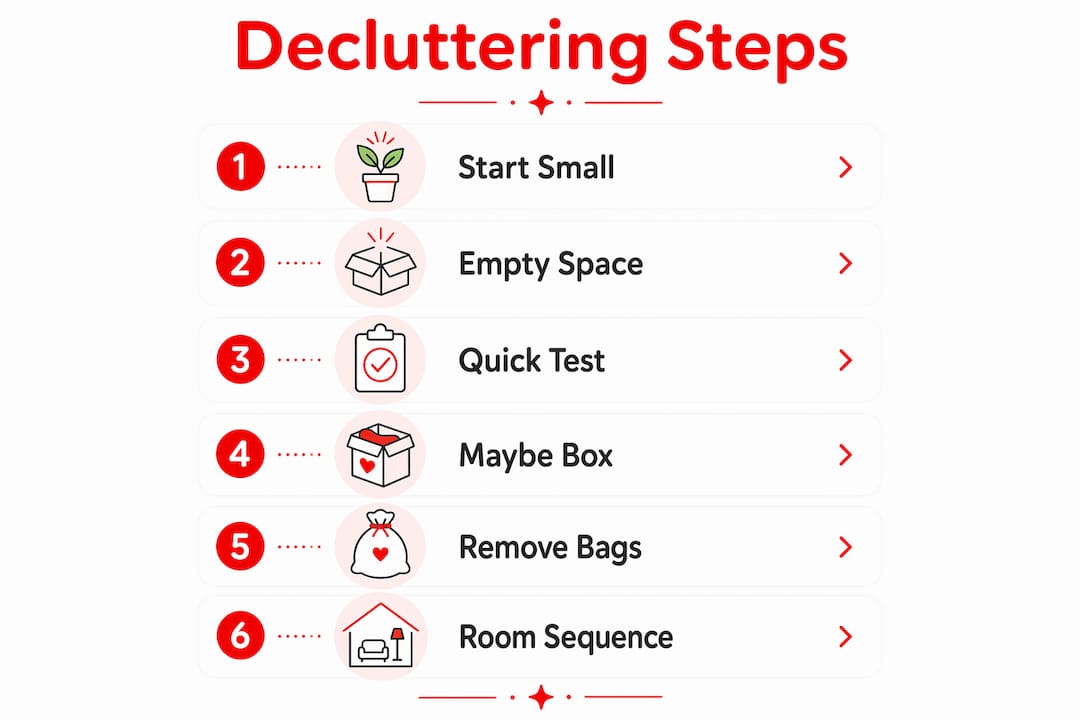
Step 1: Start with the smallest space you can find
The best place to begin is a single drawer, one shelf, or a small corner of a room. Choosing a small starting point gives you a quick, satisfying win. That win releases a small dose of dopamine, which makes you want to continue. Resist the urge to tackle an entire room on day one.
Step 2: Remove everything before you sort
Removing all items from a space before sorting provides a clear psychological reset and prevents you from merely rearranging clutter. When you see an empty drawer or shelf, your brain registers it as a clean slate. That visual reset makes it much easier to decide what actually deserves to go back in. Anything you return to the space should earn its place.
Step 3: Apply a quick decision test to each item
For each item you pick up, ask one simple question: “Have I used this in the last year?” If the answer is no, it goes into one of your five sorting categories. You can also use a joy-based test: if an item adds no value to your daily life and brings no genuine happiness, it is a candidate for removal. Keep the decision fast. Spending more than 10 seconds on an item usually means you are overthinking it.
Step 4: Use a “maybe” box for difficult decisions
Placing undecided items in a sealed box with a 3-month date allows time for natural decision-making and reduces the emotional burden of immediate choices. Write the date on the outside of the box and store it out of sight. If you have not opened the box by that date, donate or discard the contents without reviewing them. This method removes the paralysis that comes from trying to decide everything at once.
Pro Tip: Write the date directly on the tape sealing the “maybe” box. If the box is still sealed when the date arrives, you have your answer.
Step 5: Remove donation and trash bags immediately
Taking out throw and donate bags the same day accelerates momentum and prevents second-guessing. Leaving bags in the hallway or garage for “just a few more days” is one of the most common ways people undo their progress. Put the trash bags at the curb and load the donation boxes into your car right away. Out of sight truly does mean out of mind.
Step 6: Follow a room-by-room sequence for confidence
A logical room sequence prevents you from feeling scattered and helps you see progress clearly. A recommended order for most homes is:
- Bathroom (fewest emotional attachments, fastest wins)
- Kitchen (high-use area, clear categories)
- Bedroom closet (clothing decisions are easier with momentum)
- Living room (shared space, visible impact)
- Home office or desk area (paper and tech clutter)
- Storage areas like attics, basements, or garages (save for last)
Starting with the bathroom gives you an early win in a space where most items are either used regularly or clearly expired. By the time you reach storage areas, you will have built the decision-making muscle you need for harder choices.
What are common challenges and how do you troubleshoot them?
Even with the best preparation, most people hit a wall at some point. Knowing what to expect makes those moments much easier to push through.
Overcoming decluttering paralysis
Clutter forces the brain to expend extra energy filtering stimuli, which results in diminished focus and fatigue. That fatigue is real, and it is not a sign of weakness. When you feel stuck, shrink the task. Instead of “declutter the kitchen,” commit to “clear the counter next to the sink.” Finishing a tiny task breaks the paralysis cycle.
Managing emotional attachment
Sentimental items are the hardest category for almost everyone. Setting specific display zones for sentimental items honors memories while controlling clutter. This is especially true during grief, when objects carry emotional weight that feels impossible to release. A single shelf, a memory box, or a dedicated corner of a room gives those items a home without letting them take over. You are not erasing memories by limiting the physical space they occupy.
Avoiding the “all or nothing” trap
Perfectionism kills more decluttering projects than laziness ever could. Waiting for the perfect free weekend or the perfect organizational system means waiting forever. Progress over perfection is the only standard that works. A partially decluttered kitchen is better than a perfectly planned one that never gets started.
“Decluttering success is defined by creating a space that supports mental well-being, feeling safe and relaxing rather than perfectly spotless. Clutter is not laziness but a cognitive burden that exhausts mental resources, making decluttering a form of brain self-care.”
Sustaining motivation over time
Tracking your effort visually makes a real difference. Take a photo of a space before you start and compare it to the result afterward. That before-and-after contrast is one of the most powerful motivators available. Reward yourself after completing a room, not just after finishing the whole house. Small, consistent rewards keep the process feeling positive rather than punishing.
How do you maintain a decluttered home long-term?
Decluttering once is not enough. The habits you build after the initial clear-out determine whether your home stays tidy or returns to its previous state within months.
Daily habits that prevent clutter buildup
The most effective maintenance habit is a daily 5-minute tidy. Set a timer, pick one area, and return everything to its designated spot. This habit works because it addresses clutter before it accumulates into an overwhelming pile. Pair it with the “one in, one out” rule: every time a new item enters your home, one existing item leaves. This single rule prevents the slow creep of clutter that most people do not notice until it becomes a problem.
Pro Tip: Place a small donation box near your front door or in your closet. Whenever you notice something you no longer use, drop it in the box immediately. When the box is full, it goes straight to the donation center.
Seasonal and annual maintenance
Schedule a light decluttering session at the start of each season. These sessions do not need to be long. Thirty minutes per room, four times a year, keeps your home from ever reaching the point where a full overhaul is needed again. Once a year, pair your deep declutter with a thorough cleaning to reset every area of the home. Checking out home organization hacks can give you fresh ideas for each seasonal round.
Assigning a designated spot for every item
Every item in your home needs a permanent, logical home. When something does not have a designated spot, it ends up on the nearest flat surface. Assign locations based on how often you use an item and where you naturally reach for it. Items used daily belong within easy reach. Items used rarely belong in storage. This system makes tidying up automatic rather than effortful.
- Review your storage at the start of each season and remove anything you have not touched
- Limit storage containers to what you currently own, not what you might own someday
- Use checklists for shared spaces like kitchens and bathrooms to keep everyone on the same page
- Avoid buying new storage solutions until you have finished decluttering. New bins do not solve clutter; they just contain it
Understanding how interior design choices shape home wellness can also help you think about your space more intentionally as you build these habits.
Key takeaways
Effective home decluttering requires preparation, a step-by-step method, and consistent daily habits to produce lasting results.
| Point | Details |
|---|---|
| Prepare before you start | Gather bags, boxes, labels, and a checklist before opening a single drawer. |
| Use five sorting categories | Donate, gift, throw, recycle, and sell to speed up decisions and reduce fatigue. |
| Start small and build momentum | Begin with one drawer or shelf to create a quick win that drives continued effort. |
| Use a “maybe” box | Seal undecided items with a 3-month date to remove paralysis without losing progress. |
| Build daily maintenance habits | A 5-minute tidy and the “one in, one out” rule prevent clutter from returning. |
Why our team thinks decluttering is really about mental clarity
Our team at Lizard’s Lunch has spent a lot of time thinking about why decluttering feels so hard, even when people genuinely want to do it. The honest answer is that most guides treat it as a physical task when it is really a mental one.
The research backs this up. Clutter is a cognitive burden that exhausts mental resources, not a reflection of character or discipline. When you walk into a cluttered room, your brain is already working overtime before you have done a single thing. That is why the first clear surface feels so disproportionately good. It is not just tidiness. It is relief.
What we have found most useful is reframing the goal entirely. The aim is not a perfect home. The aim is a home that does not drain you. Simplifying physical possessions lets you focus on core life goals without constant distraction from low-level clutter management. That is a genuinely different way to live.
The advice we give most often is this: do not wait until you have a full day free. Take 10 minutes tonight and clear one surface. The momentum from that single action is more valuable than any organizational system you could buy. Small wins compound. A home that supports your mental well-being is built one cleared drawer at a time.
— Our team at Lizard’s Lunch
Decluttering and the bigger picture of simple living
A tidy home is one piece of a larger, more rewarding way of living. Once you have cleared the physical clutter, many people find they want to go further, simplifying their routines, their commitments, and their relationship with possessions. The minimalism lifestyle guide on Lizardslunch explores exactly that philosophy, showing how intentional simplicity supports lasting wellbeing. For a broader look at how your environment connects to your overall health, the healthy lifestyle guide covers the full picture. A decluttered home is a genuinely great place to start.
FAQ
What is the fastest way to declutter a home?
Start with the smallest, least emotional space in your home, such as a bathroom or a single kitchen drawer. Use the five-category sorting method (donate, gift, throw, recycle, sell) and remove trash and donation bags the same day to lock in progress.
How do you declutter effectively without feeling overwhelmed?
Set a 10–15 minute timer and commit to one small area at a time. Short timed sessions reduce the brain’s threat response to large tasks and make it easier to start and finish consistently.
What should you do with items you cannot decide on?
Place undecided items in a sealed “maybe” box with a date written on the outside. If the box remains unopened after three months, donate or discard the contents without reviewing them.
Why does clutter cause stress?
Cluttered environments disrupt cortisol patterns linked to chronic stress. Your brain reads visual clutter as unfinished tasks, which keeps your nervous system in a low-level state of alert even when you are trying to relax.
How do you stop clutter from coming back?
Apply the “one in, one out” rule every time a new item enters your home. Pair it with a daily 5-minute tidy and a seasonal review to catch buildup before it becomes a problem.


















Leave a Comment
Your email address will not be published. Required fields are marked with *