

Find out which pans work on induction, how to check yours with a magnet or the coil symbol, and what to look for in a base before you buy.
A pan works on induction when its base is magnetic. That means cast iron, enameled cast iron, carbon steel, and stainless steel made with a magnetic grade of steel. Pans made only of aluminum, copper, or glass will not heat unless they have a magnetic layer added to the bottom. The quickest check is also the cheapest: hold a fridge magnet to the base of the pan. If it sticks firmly, you are ready to cook.
This guide walks you through the rest: why magnets matter, what the coil symbol means, how to handle nonstick pans, what happens when a pan does not match, and how to care for your cookware once it does. We wrote it for Canadian home cooks who are moving to induction or already have a cooktop and a cupboard full of mystery pots.
TL;DR
- Induction heats the pan itself through a magnetic field, so the pan has to be magnetic: cast iron, carbon steel, enameled cast iron, and magnetic stainless steel all qualify.
- Do the magnet test. If a fridge magnet clings to the base, the pan will work. The coil or spiral symbol on the bottom or the packaging is the other quick tell.
- Aluminum, copper, glass, and ceramic pans do not work on their own. They only work when a magnetic layer or disk is built into the base.
- A pan that is merely compatible is not necessarily a good pan. A flat, reasonably thick base heats more evenly and sits better on the glass.
- Using the wrong pan will not harm your cooktop. It simply will not heat, and many cooktops show an error code or beep.
Table of Contents
- Why a pan has to be magnetic for induction
- Which pans work on induction
- The magnet test: a ten-second check
- Reading the induction symbol
- Induction-ready is not the same as well-made
- Nonstick pans on induction
- What happens with the wrong pan
- Getting used to cooking on induction
- Cleaning and caring for induction pans
- How to build a starter set that suits Canadian kitchens
- Our perspective: compatibility is the start, not the finish
- Write for readers who love their kitchens
- FAQ
- Sources
Why a pan has to be magnetic for induction
Induction is different from gas or a traditional electric element. Instead of heating a burner that then heats the pan, an induction cooktop uses electromagnets to generate heat directly in the cookware. Natural Resources Canada describes it as one of the most efficient cooking technologies for exactly that reason: the heat starts in the pan, not in the surface beneath it. The same page also notes the trade-off, which is that induction needs special types of cookware.
That is the whole story behind compatibility. A pan made of magnetic or ferromagnetic metal interacts with the energy the burner produces. A pan that is not magnetic does not interact with it, so the burner does not detect the pan and nothing heats.
We like to picture it as a handshake. The cooktop sends out a signal, and only a magnetic pan answers. No answer, no heat.
Two practical consequences follow:
- Material matters more than brand. A budget pan with a magnetic base can work better than a premium one with a non-magnetic base.
- Shape matters too. A flat bottom makes better contact with the glass, and a base that matches the size of the cooking zone is detected more reliably.
If you are still deciding whether induction is right for your kitchen, our comparison of induction versus gas cooking covers the bigger picture, from speed to running costs to how each feels in daily use.
Which pans work on induction
The materials fall into a few clear groups. Manufacturers and consumer bodies are consistent on this, and the lists line up closely.
Materials that work
- Cast iron. Cast iron, enameled cast iron, and magnetic-grade stainless steel all work on induction. Cast iron is a standout. One appliance maker’s guidance says cast iron is by far the best induction performer, though it is heavy and expensive compared with lighter options.
- Carbon steel. A favorite of people who like a light, responsive skillet. It is magnetic, so it works.
- Magnetic stainless steel. Not all stainless is the same. Some grades are magnetic and some are not (more on that below).
- Enameled steel and enameled cast iron. Bosch’s support page lists ceramic-clad or enameled pots with an iron pan hidden in the ceramic layer among the materials that work.
- Multi-layer (clad) pans with a magnetic exterior. These sandwich an aluminum or copper core between steel layers. The core spreads heat and the magnetic outer layer talks to the cooktop.
Materials that do not work on their own
Bosch lists aluminum, glass, and copper pans as not working, unless they are made with a layer of magnetic material on the bottom. Electrolux’s guidance adds brass, ceramic, and porcelain to the list of materials that are not correct for induction cooking zones.
If you have ever wondered why a favorite pot does nothing on a new cooktop, cookware that induction burners miss is a useful place to see the common culprits explained in plain terms.
Quick reference table
| Material | Works on induction? | Notes |
|---|---|---|
| Cast iron | Yes | Heavy, holds heat well |
| Enameled cast iron | Yes | Same heat behavior, easier to clean |
| Carbon steel | Yes | Lighter than cast iron, heats quickly |
| Magnetic stainless steel | Yes | Check with a magnet |
| 18/10 or 18/8 stainless (non-magnetic) | No, unless the base is magnetic | Common in older sets |
| Clad stainless with magnetic outer layer | Yes | Core metal spreads heat |
| Aluminum only | No | Needs a magnetic base layer or disk |
| Copper only | No | Needs a magnetic base layer |
| Glass, clay, ceramic | No | Only works with an added magnetic layer, which is rare |
Three ways compatible pans are built
NYT Wirecutter’s testing team explains that induction-friendly pans are made in three basic ways: a magnetic bottom (either a clad layer or a disk), a pan made entirely of magnetic metal, or fully clad construction with several metal layers. They also note that pots made of clay, glass, 100% aluminum, copper, and 18/10 or 18/8 non-magnetic stainless steel will not work.
The same testers found that pans with a clad or disk bottom cooked food more evenly on induction, while pans made entirely of magnetic metal tended to have a cooler ring around the outside edge of the base. Their theory is that magnetic sides can draw some heat away from the bottom. It is a useful reminder that the design behind the magnetism affects how a pan cooks.
The magnet test: a ten-second check
The simplest way to confirm compatibility needs no research and no packaging. Consumer Reports recommends placing a fridge magnet against the bottom of the pan. If it sticks, the pan will work. A culinary faculty member quoted there calls ferromagnetic cookware the most important consideration when cooking on induction.
Here is how to do it well:
- Use a magnet with some strength. A flimsy souvenir magnet can give a false “no.”
- Hold it against the outside of the base, the part that touches the cooktop, not the sides.
- Look for a firm grip. A weak pull can mean the magnetic layer is thin or only partial.
- Test the center and the edges if you can. A magnetic ring with a non-magnetic middle exists, and it may heat unevenly.
Is steel cookware compatible with induction?
Often, yes, but the type of steel is what counts. Cast iron, carbon steel, and many stainless steels work. Stainless steel is the tricky one because the grade decides. CHOICE’s home economist says that cast iron, steel, and some enameled steel and stainless steel pans will work if the base is a magnetic grade of stainless steel. When in doubt, the magnet answers the question in seconds.
Reading the induction symbol
Many pans carry a symbol that tells you they are made for induction. Thor Kitchen’s Canadian guide describes it as looking like four loops of coiled wire, and it may also say “induction ready.” Manufacturers add it to packaging so buyers can tell at a glance.
A few places to look:
- The bottom of the pan. Whirlpool Canada says compatible cookware typically has a stamped coil or spiral symbol on the base.
- The packaging. Fisher & Paykel’s Canadian user guide tells owners to look for the symbol on the packaging or the bottom of the pan.
- Both methods together. LG Canada suggests checking for the symbol on the bottom, or giving the pan the magnet test.
If the symbol has worn off or you threw away the box, the magnet is the faster route. Fissler’s guidance makes the same point: when the symbol is missing, a magnet test often gives certainty faster than hunting through old packaging.
Induction-ready is not the same as well-made
Passing the magnet test tells you a pan will heat. It does not tell you how well it will cook. Fissler points out that two pots can look almost identical yet behave very differently on an induction cooktop, because the construction of the base is what differs.
Three things are worth checking.
A flat, solid base
The base should be as thick and flat as possible, according to Electrolux’s guidance. A warped base leaves gaps between pan and glass. That weakens detection and heating, and it can cause buzzing.

Layers and thickness
JennAir Canada explains that the number of layers is paramount, with one layer typically aluminum to spread heat uniformly. Together with thickness, the layers affect how well a pan is detected, how heat spreads, how it holds heat, and how evenly it cooks.
A Canadian retailer’s buying guide gives a practical starting point: for home cooks here, the strongest foundation is usually clad stainless steel supplemented by cast iron or carbon steel. It also cautions that a thin magnetic pan may develop hot spots, warp over time, or make inconsistent contact with the cooktop.
Shape and size
Maytag’s product help recommends a flat bottom, straight sides, a well-fitting lid, and medium-to-heavy thickness. It also says that if a pan is too small, the cooking area may not sense it. Pans smaller than recommended may heat but will not give the best results. As a rule, match the pan to the zone: small pan, small zone; big skillet, big zone.
A note on noise
Some pans hum, buzz, or ping. CHOICE notes that pinging and humming can indicate a poor connection between the cookware and the surface or lower quality materials. Electrolux adds that composite iron bases in lighter pans can be noisy as they heat because of unequal expansion. A little sound is common, especially at high power. A loud rattle is a sign to look at the base.
Nonstick pans on induction
Nonstick pans are where compatibility surprises people most. The nonstick coating itself has nothing to do with it. What matters is what is under the coating and what is built into the base.
Many nonstick pans have an aluminum body. As we saw above, aluminum alone will not heat on induction. Pans of this type work only if they have a magnetic stainless steel disk or layer bonded to the bottom.
Here is a quick routine before you buy or use one:
- Look for the coil symbol on the base or the box, as covered above.
- Do the magnet test on the outside of the base. A firm hold is what you want.
- Check the flatness. A nonstick pan that has warped from years of heat may rock on the glass and heat unevenly.
- Read the care label before the first use, and follow it. T-fal Canada’s use and care sheet says that for nonstick cookware hand-washing is recommended, and that you should wait for the pan to cool and avoid abrasive cleaners, steel wool, scouring powder, and oven cleaner.
If your nonstick pan fails the magnet test, you have two easy paths: keep it for a gas or radiant cooktop in another room, or swap it for a nonstick pan made for induction. A lot of cooks keep one dependable nonstick skillet for eggs and delicate fish and rely on cast iron, carbon steel, and clad stainless for everything else.
What happens with the wrong pan
The worst outcome is usually a bit of confusion, not a broken cooktop.
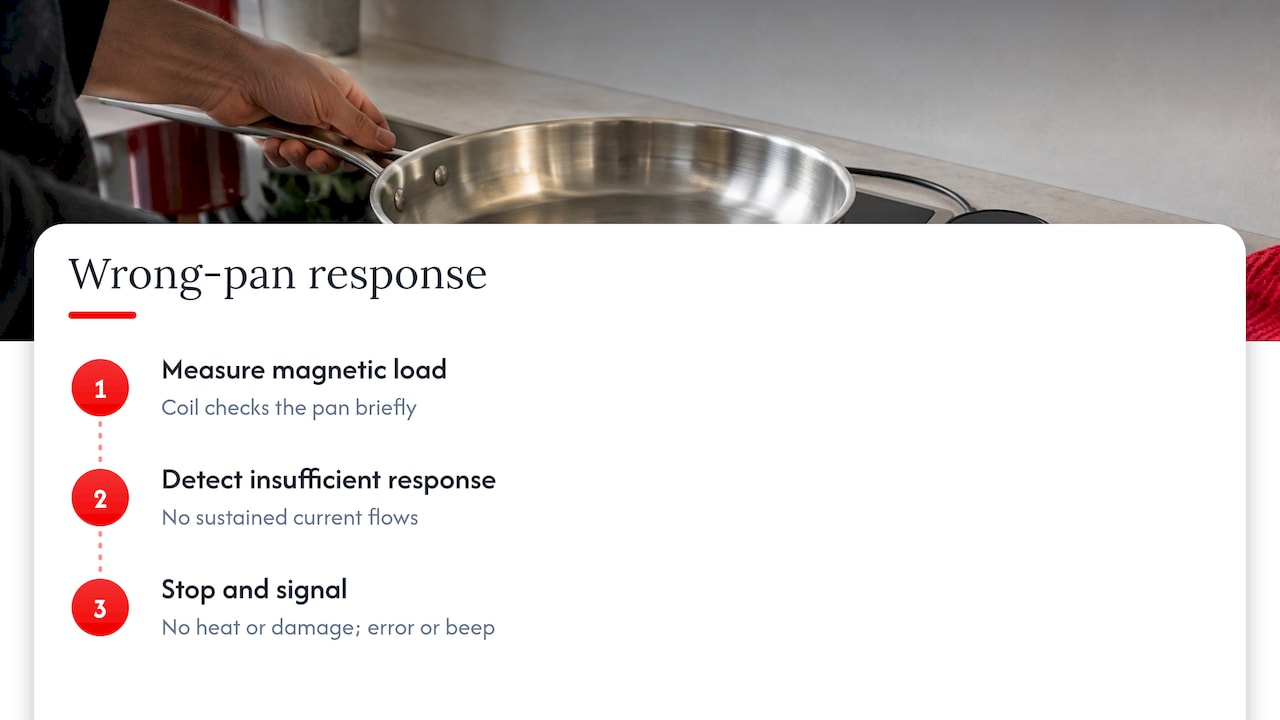
CATA’s explainer describes the sequence: the coil briefly measures the magnetic load, detects an insufficient response, and stops. No sustained current flows and no heat is generated. Many hobs show an error symbol or code, or beep, and the zone typically switches itself off after a few seconds. CATA says no damage is done to the hob.
Whirlpool Canada agrees: non-compatible cookware will not damage the cooktop, it just will not heat. Some cooktops show an error code, others light an indicator.
Codes vary by model. As one example, the Duxtop 9600LS manual says that if the base has low ferrous magnetic content, the “E0” error code may display. Your own manual will list the codes for your model, so keep it handy.
There is one case worth a second look. If a pan heats a little but not properly, it may be partly magnetic or too small for the zone. Try a pan with a bigger, flatter base, or move to a smaller zone.
Getting used to cooking on induction
Once your cookware is sorted, there is a short learning curve. Iowa State University Extension’s AnswerLine blog points out that induction heats cookware directly, which gives even cooking and less energy loss. Some habits change as a result:
- Preheating is quick. Food can overcook until you learn that pans do not take long to preheat and that a lower setting is often enough.
- Shaking or moving the pan can make the element cut off prematurely or shut off without warning.
- Digital thermometers can be affected by the magnetic field, so an analog thermometer is a safer choice.
- The glass can get hot. The surface warms through contact with the pan, so never assume it is cool to the touch.
That last point is a safety habit worth building. After you take a pan off, treat the zone as hot until the indicator says otherwise.
Cleaning and caring for induction pans
Good care keeps both the pan base and the glass in shape, which keeps contact (and detection) reliable.
The pans
Zwilling’s care guidance for its Staub and Ballarini cookware is a good model for most pans: always let the cookware cool before cleaning, because running cold water over a hot pot can cause cracks or breakage. Clean with warm water, liquid dish soap, and a soft sponge or brush. Skip oven cleaners, metal brushes, and scouring pads, which can permanently damage the cookware.
The cooktop
The same guidance says to lift pans rather than slide them on induction and other glass ceramic surfaces, to protect the glass. Fisher & Paykel also warns that heavy-duty scourers, some nylon scourers, and harsh or abrasive cleaners may scratch the surface, so check the label of any cleaner you use.
If your cast iron or carbon steel pans have rough bottoms, take extra care. Lifting is better than dragging on any glass cooktop.
How to build a starter set that suits Canadian kitchens
You do not need to replace everything at once. A sensible order looks like this:
- A clad stainless skillet or sauté pan. The everyday workhorse. Check that the outer layer is magnetic.
- A cast iron or enameled cast iron pot. For stews, braises, and baking bread in winter. Heavy, but unbeatable at holding heat.
- A carbon steel or cast iron skillet. For searing and high-heat cooking.
- One nonstick pan made for induction. For eggs and delicate foods. Confirm with the symbol and a magnet.
- A saucepan with a lid that fits snugly. Choose a flat base that matches your smallest zone.
If you are also looking at the tools that go with the pans, our roundup of kitchen gadgets worth the space can help you pick helpers that earn their drawer room. And if your project includes a kitchen refresh, our guide to under cabinet lighting for Canadian kitchens shows how to light the counter where you will be working with all of this new cookware.
Our perspective: compatibility is the start, not the finish
We think the best way to approach induction is to treat compatibility as the entry ticket and construction as the real decision. The magnet test and the coil symbol answer one question: will this pan heat? They do not answer the question that matters most in a busy kitchen: will it heat evenly, sit flat, and last?
That is why we encourage readers to look past the label. A flat, solid base, sensible thickness, and a magnetic outer layer give you a pan that performs, not just a pan that qualifies. Build around a few dependable pieces, such as clad stainless, cast iron, and carbon steel, and add specialty pans as your cooking habits show you what you need.
We also believe in taking the stress out of the switch. Induction is quick, responsive, and efficient, and a small amount of knowledge about your pans lets you enjoy all of that from the first meal. Our team at Lizard’s Lunch will keep exploring kitchen, home, and lifestyle topics so you can make confident choices and find new opportunities to improve how you cook and live.
Alexander
Write for readers who love their kitchens
If you run a brand, shop, or service that helps people cook, shop, and set up their homes, our team reaches readers who are looking for exactly this kind of practical guidance. We offer Banner Ads and Guest Posts for businesses that want to be seen by curious, research-minded readers. Visit the page to see how it works and get in touch.
FAQ
What pans work on induction?
Pans made of cast iron, enameled cast iron, carbon steel, and magnetic stainless steel work. So do multi-layer pans with a magnetic outer layer. Pans made only of aluminum, copper, or glass will not heat unless they have a magnetic layer or disk in the base.
How can I tell if my pan is induction ready?
Hold a fridge magnet to the bottom of the pan. If it sticks firmly, the pan will work. You can also look for the coil or spiral symbol on the base or the packaging, which often comes with the words “induction ready.”
Is stainless steel always compatible with induction?
No. Some stainless steel grades are magnetic and some are not, and 18/10 or 18/8 stainless is non-magnetic on its own. Many stainless pans work because they have a magnetic base or outer layer, so check with a magnet before you rely on a pan.
Will a non-compatible pan damage my induction cooktop?
No. The cooktop simply does not detect the pan, so it does not heat. Many models show an error code, light an indicator, or beep, and the zone usually switches itself off within seconds. Check your user manual for what the codes mean on your model.
How do I clean induction pans without damaging them?
Let the pan cool first, then wash with warm water, dish soap, and a soft sponge. Avoid metal scrubbers, scouring pads, and oven cleaner. On a glass cooktop, lift pans instead of sliding them to avoid scratching.
Sources
- Cooking appliances, Natural Resources Canada
- Everything you need to know about induction cooking, JennAir Canada
- The Ultimate Guide to Induction-Compatible Cookware
- What is induction safe cookware, Bosch
- What cookware works on induction, Electrolux
- The 7 Best Induction Cookware, NYT Wirecutter
- How to tell if a pot or pan is induction-compatible, Consumer Reports
- Induction cooking: fact vs fiction, CHOICE
- How to buy the right pots and pans for induction cooking, CHOICE
- Choosing cookware for induction cooktops, Thor Kitchen
- What cookware to use with induction cooktops, Whirlpool Canada
- Induction cooktop user guide, Fisher & Paykel
- What is induction cooking, LG Canada
- How to identify induction cookware, Fissler
- Induction cookware buying guide for Canadian kitchens
- Induction compatible cookware, Maytag
- Use and care instructions, T-fal Canada
- What happens if you use a non-induction-compatible pan, CATA
- Duxtop 9600LS induction cooktop user manual
- Induction cooking: what you need to know, Iowa State University Extension
- Care instructions for Staub and Ballarini products, Zwilling
















Leave a Comment
Your email address will not be published. Required fields are marked with *