
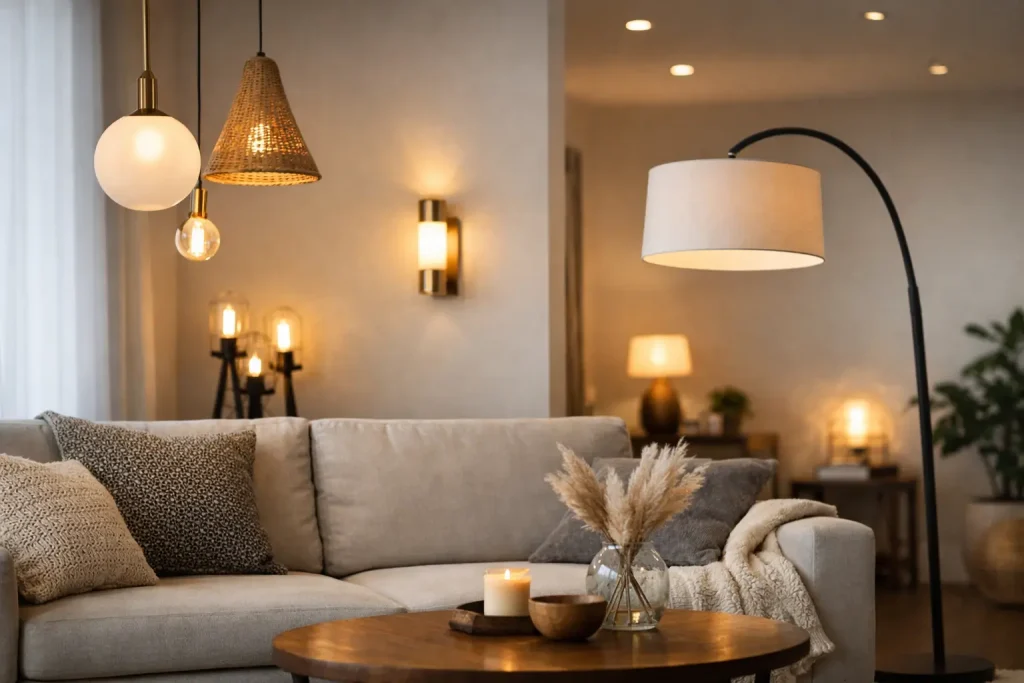
Find living room lighting ideas that layer ceiling fixtures, lamps, and accent light to make your space warmer, more flexible, and better for daily life.
A single overhead fixture can make a living room feel flat, no matter how good the sofa, rug, or paint color looks. The best living room lighting ideas use layers: one source for general visibility, another for tasks like reading, and a third to create mood. That combination gives the room a polished, comfortable feel without requiring a major renovation.
Start With Three Layers of Light
Think of living room lighting as a team rather than a single purchase. Ambient lighting fills the room, task lighting helps with specific activities, and accent lighting adds depth. You do not need every lamp switched on at once, but having options matters when the room serves as a movie zone, reading nook, play space, and place to host guests.
For ambient light, consider a ceiling fixture, recessed lights, track lighting, or a pair of floor lamps that bounce light upward. Task lighting usually comes from table lamps, swing-arm lamps, or a focused floor lamp near a chair. Accent lighting can come from picture lights, wall sconces, LED strips, or a small lamp on a bookcase.
A dimmer is one of the highest-impact upgrades you can make. It lets bright daytime lighting become a softer evening setting in seconds. If wiring changes are not realistic, use dimmable bulbs with compatible plug-in lamps or smart bulbs controlled from an app or remote.
15 Living Room Lighting Ideas to Try
1. Center a statement fixture over the seating area
A chandelier, pendant, or semi-flush mount gives the room a clear focal point. In spaces with standard-height ceilings, semi-flush fixtures are often the safer choice because they provide visual interest without hanging too low. Save dramatic pendants for tall ceilings or areas where people will not walk underneath them.
2. Use a large arc floor lamp instead of a ceiling light
An arc lamp can reach over a sectional or coffee table, supplying useful ambient light without the cost of installing a new ceiling box. It works especially well in rentals and rooms with no overhead fixture. Choose a weighted base, and leave enough clearance so the shade does not hover uncomfortably close to someone sitting down.
3. Put table lamps on both sides of the sofa
Matching lamps bring classic balance, but they do not have to be identical. Two lamps with a similar shade shape, height, or finish can look coordinated while keeping the room from feeling overly formal. This setup is particularly effective when the sofa sits against a wall and needs more visual structure.
4. Create a true reading corner
A favorite chair deserves light aimed at the page, not just a glow somewhere nearby. Place a pharmacy-style floor lamp, adjustable sconce, or swing-arm lamp slightly behind and beside the chair. Look for a bulb that delivers roughly 800 to 1,100 lumens for comfortable reading, then add a dimmer if the chair also serves as a relaxing evening spot.
5. Add wall sconces to free up table space
Sconces make small living rooms work harder. They can replace bulky side-table lamps, frame artwork, or add light beside a sofa. Hardwired sconces look built in, but plug-in versions offer a much easier route for renters or anyone avoiding electrical work. Use cord covers or route the cord neatly behind furniture for a cleaner finish.
6. Light a dark corner with an uplight
Corners tend to disappear after sunset, making a room feel smaller than it is. An uplight or torchiere floor lamp directs light toward the ceiling and walls, visually expanding the space. This is a useful counterbalance to heavy furniture, dark paint, or a large TV wall.
7. Put picture lights over art or shelves
Artwork can look impressive in daylight and vanish at night. A slim picture light draws attention to a favorite print, while puck lights or narrow LED bars can illuminate bookshelves and display cabinets. Keep the effect subtle. The goal is to create a gentle point of interest, not turn every shelf into a spotlight.
8. Make the TV wall easier on the eyes
Watching television in a completely dark room can create harsh contrast between the bright screen and surrounding wall. Soft bias lighting behind the TV reduces that effect and makes the setup feel more intentional. Choose a warm white option for a relaxed look, or a color-changing strip if the room is also used for gaming and movie nights.
9. Choose warm bulbs for everyday comfort
For most living rooms, bulbs in the 2700K to 3000K range deliver a warm, inviting white light. Higher Kelvin ratings can look cleaner and brighter, but they may read as clinical in a room designed for relaxing. If your living room doubles as a home office, use a brighter task lamp at the desk rather than making the whole room cooler in color.
10. Mix metal finishes with intention
Lighting is an easy way to introduce brass, black, nickel, bronze, or chrome. Mixing finishes is fine when there is a connecting detail, such as black lamp bases that echo a curtain rod or brass sconces that complement cabinet hardware nearby. Too many unrelated finishes can make the room look collected by accident rather than designed on purpose.
11. Use a lantern or sculptural lamp as decor
A lamp does not have to be purely functional. A ceramic base, textured shade, woven lantern, or sculptural fixture can add personality before it is even turned on. This approach is especially useful in neutral rooms that need a little shape, texture, or color without adding more furniture.
12. Add smart bulbs for flexible scenes
Smart bulbs are practical when one room has many uses. Set a bright scene for cleaning, a warm low setting for watching a movie, and a balanced level for guests. They are also helpful for lamps positioned behind furniture, where reaching for a switch is inconvenient. Just make sure the wall switch remains on, or the smart features will not work.
13. Try recessed lights only when the layout supports them
Recessed lighting creates a clean ceiling and broad coverage, but it is not automatically the best answer. A grid of downlights can cast unflattering shadows and make a cozy room feel overly bright if it is poorly planned. Use them to support other sources, not replace every lamp. Adjustable recessed fixtures are useful for highlighting art, fireplaces, or architectural features.
14. Soften light with the right shade
The shade controls how a lamp performs. Linen and fabric shades diffuse light softly, while metal shades direct it downward for a stronger task-light effect. Light-colored shades usually brighten the room more than dark shades. If a lamp looks good but feels dim, changing the shade can be a more affordable fix than replacing the whole piece.
15. Keep scale in proportion
Small lamps beside a deep sectional often look lost, while an oversized chandelier can overwhelm a compact room. Before buying, measure the surrounding furniture and consider sightlines from the entryway. A fixture should feel substantial enough to belong, but it should not block conversation, compete with the television, or dominate a low ceiling.
Plan Your Lighting Around How You Actually Live
The right setup depends on your routines. A living room used mostly for family movie nights benefits from dimmable lamps, soft wall lighting, and TV bias lighting. A room that hosts friends may need brighter ambient lighting distributed across the space so faces are easy to see. If you read, craft, or work there, prioritize adjustable task lights near the places where those activities happen.
Avoid relying on bare, exposed bulbs as the only source of light. They can look stylish in the right fixture, but they often produce glare. Likewise, do not place every light source at the same height. Combining ceiling lighting, floor lamps, table lamps, and low accent lights gives the room a more relaxed, layered rhythm.
Before committing to expensive fixtures, test the layout with the lamps you already own. Move one into a dark corner, try another beside the sofa, and use different bulb brightness levels for a few evenings. The most successful lighting plan is the one that makes your living room easier to use and more enjoyable to come home to.


















Leave a Comment
Your email address will not be published. Required fields are marked with *