

Discover what wearable technology is and how it can enhance your health and daily life in our comprehensive 2026 guide. Click to learn more!
Wearable technology is defined as electronic devices worn on the body that collect, analyze, and transmit biometric and environmental data in real time. The industry term for this category is “wearables,” and it covers everything from smartwatches and fitness trackers to smart rings, smart glasses, and even sensor-embedded clothing. These devices sit at the intersection of personal health and everyday convenience, quietly working in the background so you never have to think about them. What makes wearables genuinely exciting is not just what they track. It is how they translate raw body data into insights that can change the way you live, sleep, and manage your health.
What is wearable technology and how did it get here?
Wearable technology started as a simple pedometer strapped to your waist. Today, it is a category of devices capable of detecting atrial fibrillation, monitoring blood oxygen levels, and even running an AI-powered coding workspace from a pair of glasses. The leap from step counter to health monitor happened because sensors got smaller, processors got faster, and wireless connectivity became universal. The result is a device category that feels personal in a way no smartphone ever could.
The core promise of wearables is continuous presence. Your phone sits in your pocket. Your smartwatch or smart ring stays on your body around the clock. That physical closeness is what makes the data meaningful. A single heart rate reading tells you little. A continuous 24-hour record tells your doctor a great deal.

You can explore the different types of watches to understand how the watch category alone has expanded far beyond timekeeping into full health monitoring territory.
What are the main types of wearable devices available today?
The wearable market covers several distinct device categories, each designed for a different use case and lifestyle. Here is a breakdown of the most common types you will encounter:
- Smartwatches. Devices like the Apple Watch Series 10 and Samsung Galaxy Watch 7 combine fitness tracking, smartphone notifications, and health monitoring in one wrist-worn package. Apple Watch is notable for its AI-driven atrial fibrillation detection, a feature that has genuinely saved lives.
- Fitness trackers. Brands like Fitbit and Garmin focus on activity metrics: steps, calories, heart rate, and sleep stages. These tend to be lighter and more affordable than full smartwatches, making them a strong entry point for new users.
- Smart rings. The Oura Ring 5 is the most recognized name here. It tracks heart rate variability, sleep quality, blood oxygen, and stress in a form factor you can wear 24 hours a day without noticing it. Entry-level smart rings start around $99.99, while premium options like the Oura Ring 5 sit in the $299 to $549 range. The Rogbid SR15 Ultra is a newer contender, adding a built-in display, haptic notifications, and Bluetooth 5.2 in a titanium body with 5ATM water resistance.
- Smart glasses. Monako Glass represents one of the most ambitious examples in this category. It functions as an AI-powered coding workstation worn on your face, using a gesture recognition Vision Engine and bone conduction microphone for hands-free control. Meta Ray-Ban smart glasses take a more consumer-friendly approach, blending AI assistance with a normal glasses aesthetic.
- Smart clothing. Sensor-embedded garments from companies like Hexoskin track breathing rate, heart rate, and movement during athletic performance. This category is still maturing but shows real promise for clinical and sports applications.
- Ambient AI wearables. Devices like the Looki L1 operate passively throughout your day, recording and organizing life events with privacy-first architecture. This is the newest and most experimental category in the wearable space.
Each type serves a different need. The right choice depends on what you want to track, how much you want to spend, and how much device you are willing to wear.
How does wearable technology work?
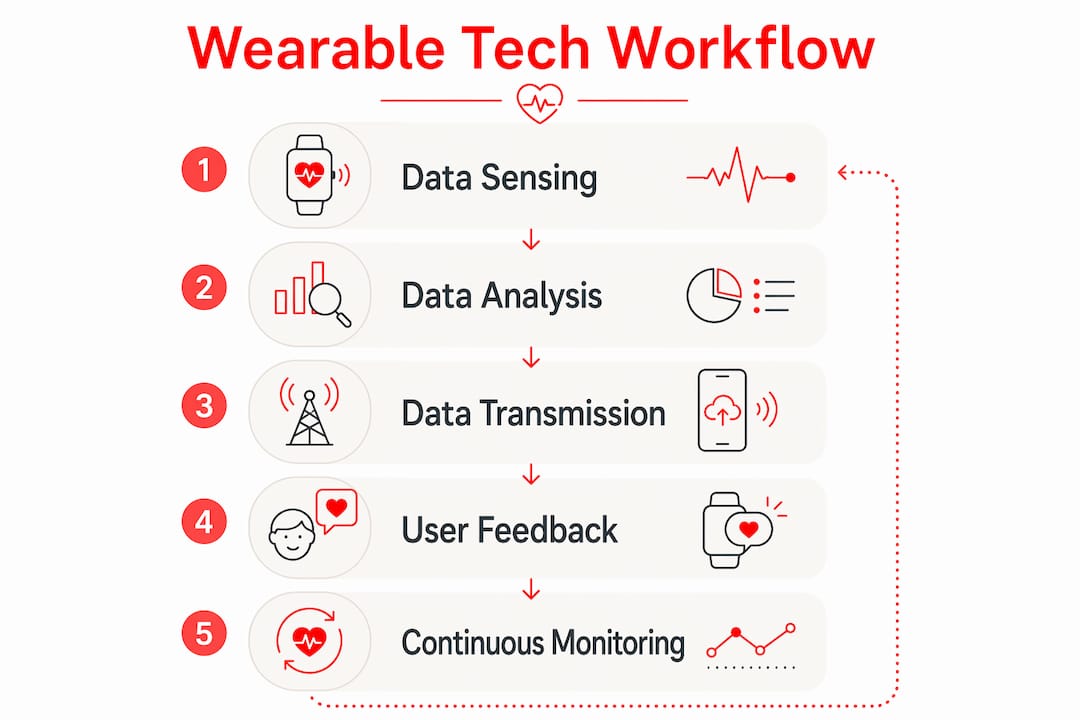
Every wearable device runs on three core components: sensors, a processor, and wireless connectivity. Understanding how these work together helps you appreciate why wearables can do things your phone simply cannot.
- Sensors collect raw data. Optical heart rate sensors use light to detect blood flow. Accelerometers measure movement and orientation. Electrodermal sensors measure skin conductance as a proxy for stress. More advanced devices add GPS, temperature sensors, SpO2 sensors for blood oxygen, and even electrical sensors for ECG readings. The Rogbid SR15 Ultra, for example, combines heart rate, SpO2, and sleep tracking sensors in a ring smaller than most wedding bands.
- The processor interprets the data. Raw sensor output is noisy and often meaningless on its own. The onboard processor runs algorithms that filter out noise, identify patterns, and convert signals into readable metrics. On more capable devices, this processing happens locally on the chip. On others, raw data is sent to the cloud for heavier analysis.
- Wireless connectivity transmits the results. Most wearables use Bluetooth to sync with a paired smartphone app, where data is stored, visualized, and analyzed. Some devices also connect via Wi-Fi or cellular. Cloud platforms then apply machine learning models to your historical data to surface trends over time.
What separates wearables from smartphones is 24/7 sensor sampling. Your phone’s sensors are mostly idle. Your wearable never stops. That persistent on-body presence is what makes medical-grade monitoring possible, including heart rate variability tracking and continuous glucose monitoring.
Battery life and water resistance are two practical constraints that shape every design decision. High-activity AI devices like certain smart pendants last around 12 hours on a charge. A basic smart ring focused on passive health tracking can last up to 30 days. Most devices carry a 5ATM water resistance rating, meaning they handle showers and swimming without issue.
Pro Tip: If you plan to wear a device overnight for sleep tracking, prioritize battery life and weight over feature count. A device you take off at bedtime gives you incomplete data.
Smartwatch vs. smart ring vs. smart glasses: which fits your life?
Choosing between wearable form factors is not just a tech decision. It is a lifestyle decision. Each form factor makes a different set of tradeoffs between comfort, features, battery life, and style.
| Form Factor | Key Strength | Battery Life | Best For |
|---|---|---|---|
| Smartwatch | Full feature set, notifications, apps | 1–3 days | All-day connectivity and health tracking |
| Smart ring | Discreet, comfortable, sleep-friendly | Up to 30 days | Passive health monitoring, minimalists |
| Smart glasses | Hands-free AI, augmented reality | 4–8 hours | Tech enthusiasts, productivity-focused users |
| Fitness tracker | Lightweight, affordable, focused | 5–7 days | Entry-level fitness and activity tracking |
| Smart clothing | Precise biometric capture during activity | Varies | Athletes and clinical monitoring |
The Oura Ring 5 is a compelling example of how comfort drives adoption. It is 40% smaller than its predecessors, and users consistently report forgetting they are wearing it during sleep. That matters enormously for sleep data quality. A device you remove at night is a device that cannot track your most important recovery window.
Smart glasses like Monako Glass sit at the opposite end of the spectrum. They are bold, visible, and packed with features including gesture and bone conduction controls. They attract users who want their wearable to do heavy lifting, not just count steps. The tradeoff is battery life and social visibility. Not everyone wants to wear a computing device on their face at dinner.
Style also plays a real role in this decision. Smart rings look like jewelry. Smartwatches look like watches. Smart glasses look like glasses, most of the time. If you care about how your device fits into your wardrobe, the 2026 fashion trends show that minimalist, understated tech accessories are gaining ground over bulkier, more conspicuous designs.
Pro Tip: Try wearing a borrowed or loaned device for a full week before buying. Comfort preferences are deeply personal, and what works for someone else may not work for you.
How is AI transforming wearable technology for health and convenience?
AI is the force turning wearables from data collectors into genuine health partners. Without AI, your smartwatch gives you a heart rate number. With AI, it tells you whether that number is normal for you, trending in a concerning direction, or indicating a condition worth discussing with your doctor.
Here is how AI integration is reshaping the wearable experience:
- Pattern recognition at scale. AI models trained on millions of labeled biometric data points can detect conditions like atrial fibrillation from Apple Watch ECG readings. This is not simple threshold alerting. It is neural network-level diagnostics running on your wrist.
- Passive ambient operation. Devices like the Looki L1 operate continuously in the background, documenting your day and organizing information without requiring you to press a button. This ambient approach represents a shift from reactive tools to proactive assistants.
- Privacy-first architecture. Continuous data recording raises real concerns. The Looki L1 addresses this with end-to-end encryption and AWS and Google Cloud firewalls protecting personal life-logs. Privacy-first design is becoming a competitive differentiator, not just a compliance checkbox. The ethical dimensions of AI in wearables are worth understanding, and Lizardslunch covers the AI ethical issues that apply directly to this space.
- Hands-free interaction. Monako Glass uses a Vision Engine for gesture recognition and a bone conduction microphone so you never need to touch the device. This kind of interaction model makes wearables genuinely useful during activities where your hands are occupied.
- Personalized health baselines. AI learns your individual patterns over time. Your resting heart rate, your typical sleep architecture, your stress response. Deviations from your personal baseline become meaningful signals rather than noise.
The market shift from simple step counters to AI-powered health monitors represents one of the most significant changes in consumer technology over the past decade. The devices getting the most attention in 2026 are not the ones with the most sensors. They are the ones that make the most sense of the data they already have.
Key takeaways
Wearable technology works best when the device disappears into your routine, collecting data continuously and surfacing insights only when they matter.
| Point | Details |
|---|---|
| Core definition | Wearables are body-worn electronics that collect, analyze, and transmit biometric data in real time. |
| Device variety | Smartwatches, smart rings, fitness trackers, smart glasses, and smart clothing each serve different needs and lifestyles. |
| AI is the differentiator | AI converts raw sensor data into health diagnostics, turning passive tracking into proactive health monitoring. |
| Comfort drives adoption | Smaller, lighter devices like the Oura Ring 5 see higher sustained use because people actually keep them on. |
| Privacy matters | Leading AI wearables now use end-to-end encryption and secure cloud platforms to protect continuous personal data. |
Why wearables are finally living up to their promise
I have followed wearable technology since the first Fitbit hit the market, and for years my honest assessment was that the category was more hype than substance. Step counts and calorie estimates are not health insights. They are activity logs dressed up as wellness tools.
What changed my view was the combination of two things: better sensors and smarter software. The moment Apple Watch started detecting atrial fibrillation with clinical-grade accuracy, the category crossed a threshold. These devices stopped being fitness toys and started being medical tools you happen to wear on your wrist.
The smart ring category reinforces this. The Oura Ring 5 is not exciting because it looks good, though it does. It is exciting because it tracks your readiness, recovery, and sleep architecture in a way that genuinely informs how you should approach your day. I have spoken with people who changed their sleep habits, reduced alcohol consumption, and caught early signs of illness based on data from a ring they almost never think about.
My concern is not the technology. It is the privacy layer. Continuous biometric recording is deeply personal data. The companies handling it well, like Looki with its encryption-first approach, are setting a standard the rest of the industry needs to follow. You should read the privacy policy of any wearable you buy with the same care you would give a medical device. Because increasingly, that is exactly what these things are.
The future of wearable tech is not more features. It is smarter interpretation of the features already there, delivered with less friction and more trust. That is a future worth getting excited about. You can also explore how smart gadgets improve daily life to see how wearables fit into the broader picture of technology-assisted living.
— Alexander
Discover more about tech and healthy living at Lizardslunch
Wearable technology sits at the crossroads of gadgets and personal health, and understanding that intersection makes you a smarter consumer. Lizardslunch covers both sides of that equation with depth and enthusiasm. If you want to understand the broader picture of how technology shapes your daily routines, the guide on gadgets in daily life breaks down the real benefits and honest tradeoffs of living with connected devices. You will find practical perspectives on everything from health tech to home gadgets, written for people who want to make informed choices rather than just follow trends. Explore the full range of lifestyle and technology content at Lizardslunch and find your next great read.
FAQ
What is wearable technology in simple terms?
Wearable technology is any electronic device worn on the body that collects and transmits data, such as a smartwatch, fitness tracker, or smart ring. These devices monitor health metrics like heart rate, sleep, and activity in real time.
What are the most common examples of wearable technology?
The most common examples include Apple Watch, Fitbit, Garmin fitness trackers, the Oura Ring 5, and smart glasses like Meta Ray-Ban. Each device type targets a different combination of health tracking, notifications, and convenience.
How does a smart ring differ from a smartwatch?
A smart ring focuses on passive health monitoring with battery life up to 30 days and a discreet form factor, while a smartwatch offers a broader feature set including apps and notifications with a typical battery life of 1–3 days. The right choice depends on whether you prioritize comfort and longevity or full connectivity.
Are wearable devices safe for continuous use?
Most wearables are rated water resistant to 5ATM and designed for 24/7 wear, making them safe for daily and overnight use. Privacy is a more relevant concern than physical safety, and leading devices now use end-to-end encryption to protect continuous biometric data.
How does AI improve wearable health tracking?
AI trains on millions of labeled biometric data points to detect patterns like atrial fibrillation, stress spikes, and sleep disruptions that simple threshold alerts would miss. This transforms wearables from passive loggers into devices that surface meaningful, personalized health insights without requiring any effort from you.















Leave a Comment
Your email address will not be published. Required fields are marked with *