
Discover what is slow travel and how it enriches your journeys. Embrace deeper cultural connections and learn local life on your adventures.
Slow travel is the practice of spending more time in fewer places, trading the frantic checklist of a packed itinerary for something far more rewarding: genuine immersion in local life. Rather than racing through five cities in seven days, you settle into one neighborhood, learn its rhythms, and leave knowing it rather than just having seen it. As a key 2026 travel trend, slow travel shifts the focus from rushed sightseeing to deeper cultural connection and reduced travel burnout.
The core of slow travel is a mindset, not a minimum number of nights. You can practice it on a long weekend by exploring a single town on foot instead of driving to three. Here is what that mindset looks like in practice:
- Depth over breadth: Choose one or two destinations instead of many, and stay long enough to feel at home.
- Local living: Shop at neighborhood markets, eat where residents eat, and learn a few words of the local language.
- Flexible pacing: Leave room in your days for spontaneous conversations, unexpected festivals, and genuine rest.
- Mindful presence: Pay attention to what is around you rather than rushing to the next photo opportunity.
- Reduced footprint: Fewer flights and longer stays naturally lower your environmental impact.
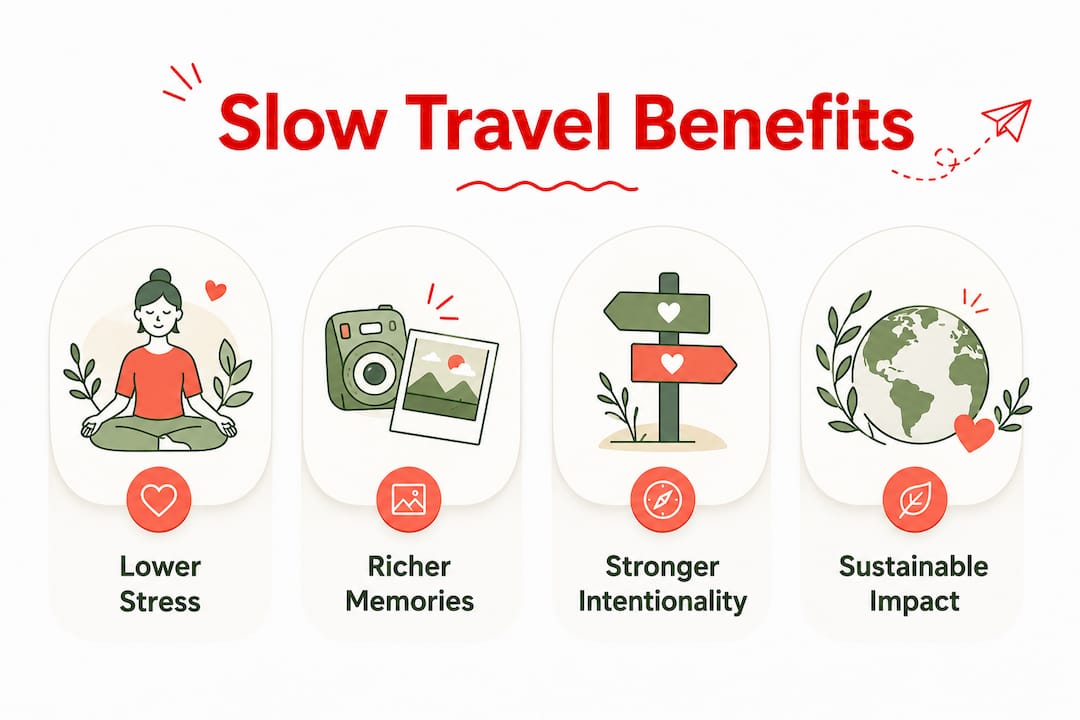
The payoff is real. Travelers who slow down report less stress, richer memories, and a far stronger sense of having actually experienced a place rather than consumed it.
Why the benefits of slow travel go deeper than you might expect
Slow travel delivers advantages that touch nearly every part of your trip, from your wallet to your well-being. The benefits stack up quickly once you understand how they connect.
- Less stress, more presence: Rigid, packed itineraries are one of the biggest drivers of travel burnout. When you remove the pressure to “see everything,” you can actually enjoy what is in front of you. Travelers report that flexibility for journaling, language learning, and spontaneous community interaction comes naturally when fewer rigid plans are in place.
- Genuine cultural connection: Spending a week in one place gives you time to build real relationships with locals, not just transactional exchanges at tourist counters.
- Real cost savings: Longer stays unlock weekly or monthly rental rates that are far cheaper than nightly hotel prices. Fewer flights and less transport spending add up fast. Extended stays open access to affordable rentals and minimize expensive tourist traps.
- Environmental responsibility: Every flight you skip matters. Slow travel reduces carbon emissions by favoring local transportation and longer stays over repeated air travel.
- Economic benefit to local communities: Slow travelers spend directly at small businesses, local restaurants, and neighborhood markets rather than at international chains. This reduces financial leakage and keeps money circulating in the local economy.
- Better memories and photography: Experiences tied to a place you truly know produce far more vivid memories than a blur of airport lounges and tourist attractions.
- Personal well-being: Rest days and low-activity periods are not wasted time. They restore energy and allow genuine reflection, which is something a packed tour schedule rarely permits.
How to actually practice slow travel on your next trip
Adopting a slower pace does not require quitting your job or booking a year abroad. Small shifts in how you plan and move make an enormous difference.
- Pick fewer destinations: Resist the urge to visit every city on your list. One region explored deeply beats five cities skimmed superficially.
- Book accommodations built for longer stays: Vacation rentals, guesthouses, and house-sitting arrangements are designed for extended visits and often include kitchens, which cuts food costs dramatically.
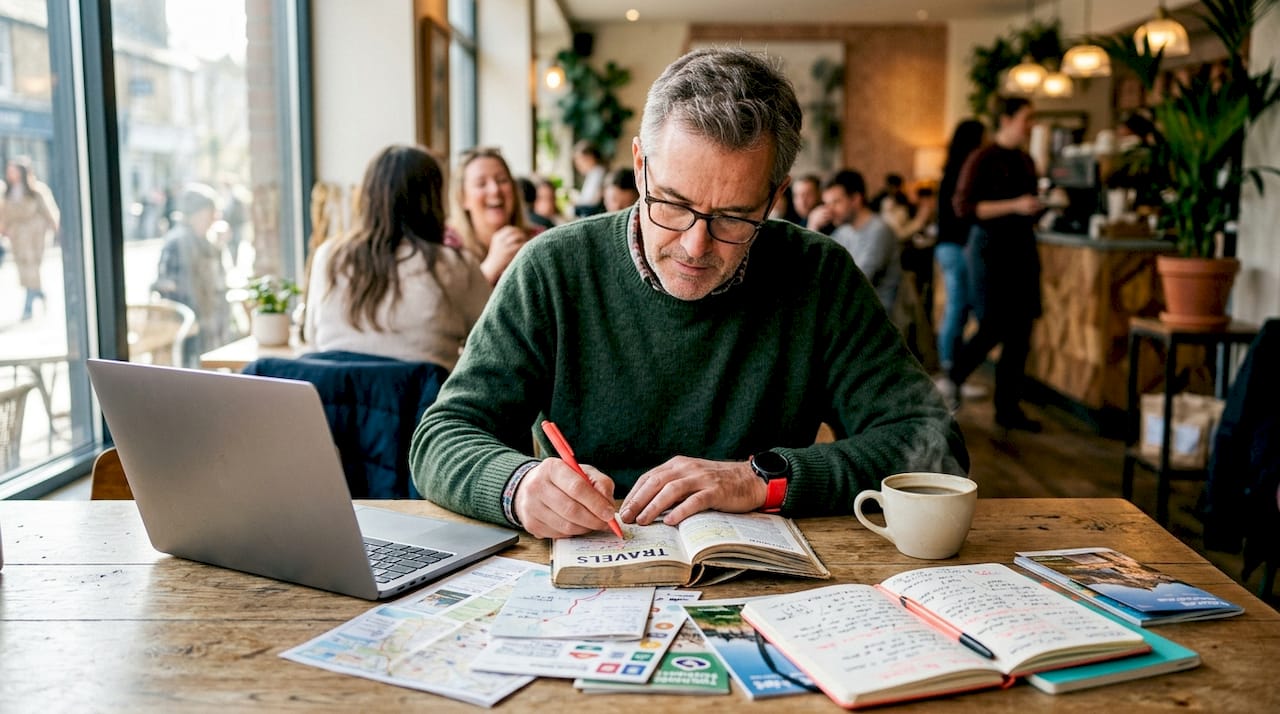
- Engage with daily local routines: Visit the morning market, take a cooking class, or simply sit at a neighborhood café for an hour. These ordinary moments become the memories you actually keep.
- Use slower transportation: Trains, buses, ferries, and cycling connect you to the landscape in a way that airports never do. Biking through a region, for example, lets you stop whenever something catches your eye. Local cycling communities often organize routes and events that are perfect entry points for slow travelers.
- Build in rest days: Schedule days with no agenda. Wander without a destination. Sit in a park. This is not laziness; it is the point.
- Travel off-peak: Quieter seasons mean fewer crowds, lower prices, and more authentic interactions with locals. Our guide on traveling off-peak covers exactly how to make this work financially.
- Start small: You do not need a month abroad to try this. A slow weekend in a nearby town, exploring one neighborhood on foot, is a genuine starting point.
Pro Tip: The hardest part of slow travel for most people is the guilt of “doing nothing.” Resist it. Leaving space in your day is not wasted time; it is where the most unexpected and memorable experiences tend to appear.
The philosophy behind slow travel and what makes it different
Slow travel is not a new invention. Its roots trace directly to the Slow Food movement, founded in Italy by Carlo Petrini in 1986 as a protest against fast food culture, and to the Cittaslow network, which emerged in the 1990s to certify cities committed to a slower, more deliberate pace of life. Both movements share a core conviction: speed and quantity are poor substitutes for quality and presence.
Applied to travel, that conviction becomes a philosophy of immersion. According to Robinson (2011), the central shift in slow tourism is moving from achieving a quantity and volume of experiences toward the quality of fewer and more meaningful ones. You are not a spectator passing through; you are a temporary resident learning how a place actually works.
Several characteristics define this approach:
- Minimizing travel distance between destinations to reduce both cost and carbon impact.
- Maximizing time at each location rather than rushing to the next.
- Learning new skills such as cooking local dishes, speaking the language, or understanding local crafts.
- Eating and shopping locally at markets and small producers rather than tourist-oriented chains.
- Minimizing mechanization by favoring walking, cycling, or slow transit over cars and planes.
- Experiencing authenticity by engaging with how residents actually live, not a curated tourist version of it.
One common misconception is that slow travel means doing nothing or being passive. It does not. The activity component in slow tourism tends to be knowledge and learning based rather than purely entertainment based, which means you often come home with more intellectual and emotional depth than a fast trip ever provides. Another misconception is that slow travel requires weeks or months. As a flexible mindset, it applies equally to a three-day trip focused on one neighborhood as to a three-month stay abroad.
Slow travel overlaps with what is sustainable travel in meaningful ways, but they are not identical. Sustainable travel, as defined by the UN Environment Programme and UN Tourism, covers the full economic, social, and environmental impact of tourism. Slow travel naturally supports many of those goals, particularly by reducing flights and supporting local economies, but its primary motivation is personal depth of experience rather than ethical obligation.
What experts and recent research say about slow travel in 2026
Slow travel has moved from niche philosophy to mainstream travel trend, and the data and expert voices behind it are worth knowing.
“The pace, not the amount of activity, defines slow travel. It’s about intentionality and presence, allowing moments like spontaneous festivals or conversations to define the experience rather than an itinerary checklist.”
— Travel expert Gi Shieh, as reported by the Kansas City Star
That framing captures something the research consistently confirms. Intentionality is the core mindset. Slow travel is not about being idle; it is about being deliberate with where your attention goes.
On the trend side, reviews mentioning farm stays on major travel platforms grew 300% year over year among younger travelers, with Gen Z leading a clear shift toward rural and agricultural experiences aligned with slow travel values. That is not a small signal. It suggests a generational recalibration of what a good trip looks like.
Academically, slow tourism is recognized as a distinct alternative to mass tourism, characterized by reducing mobility, investing time in local history and culture, and supporting the environment. Researchers note that the activity component in slow tourism is more knowledge and learning based than entertainment based, which means the intellectual and emotional returns tend to outlast the trip itself. Slow travelers also economically empower destinations by supporting localized economies more effectively than fast tourists, keeping spending within communities rather than routing it through international chains.
The cultural framing matters too. Slow travel is widely understood as a reaction against convenience obsession and superficial tourism, a conscious choice to prioritize quality presence over rapid consumption of sights.
Real-world examples of slow travel in action
Slow travel looks different for every traveler, but a few examples illustrate how the principles play out in practice.
The month-long apartment rental in Lisbon: Instead of booking a hotel and hitting every museum in three days, a traveler rents an apartment in the Mouraria neighborhood for four weeks. They shop at the local market on Tuesdays, take a Portuguese language class twice a week, and discover a fado bar that no guidebook mentions because a neighbor mentioned it in passing. By week three, the café owner knows their order. That kind of familiarity is simply not available on a three-day visit.
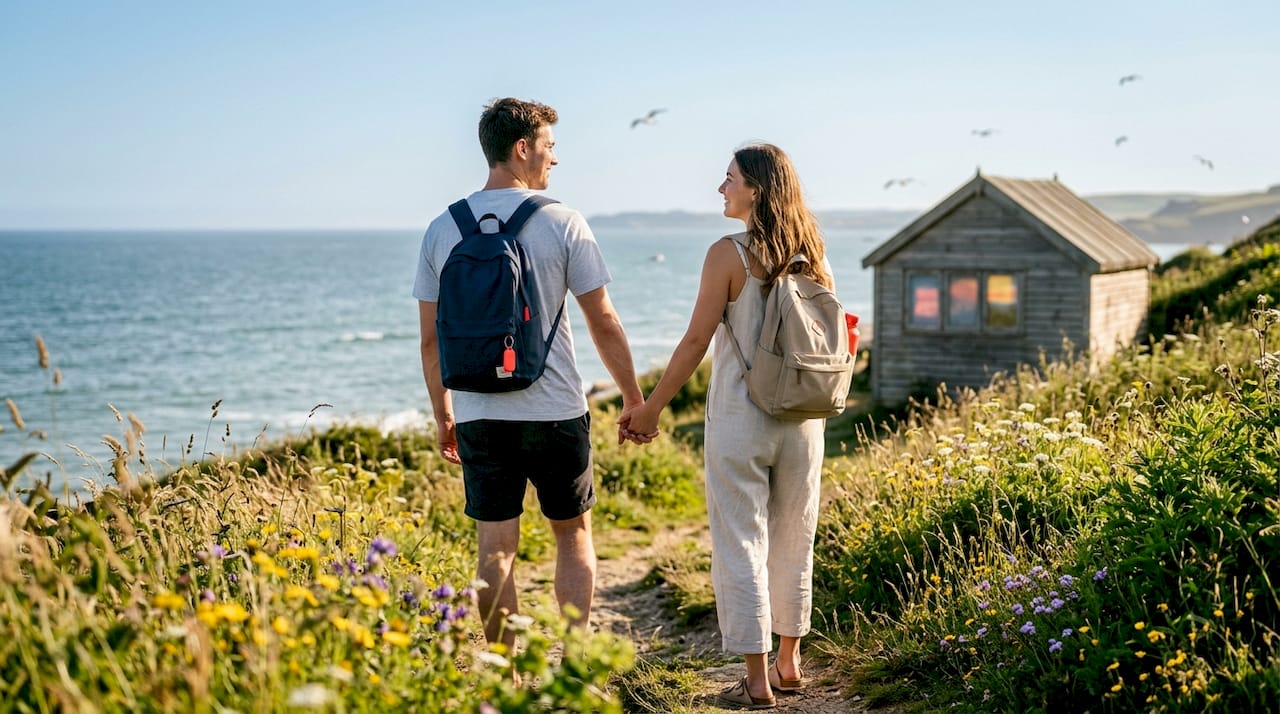
The slow road trip through rural Appalachia: Rather than driving straight to a destination, a couple plans a two-week loop through small towns in western North Carolina and eastern Tennessee, spending three or four nights in each place. They visit working farms, attend a local bluegrass festival they stumbled upon, and eat at diners where the menu has not changed in thirty years. The charming small towns model applies equally to American regions rich in local character.
The urban slow traveler in Tokyo: Slow travel does not require rural settings. Spending three weeks in a single Tokyo neighborhood, learning the train system, finding a favorite ramen shop, and attending a local community event produces a completely different experience than a week-long highlights tour of the city. You stop being a tourist and start being a temporary resident.
The weekend slow traveler: Even a two-day trip to a town two hours from home can embody slow travel principles. Pick one neighborhood. Walk it. Eat somewhere with no online presence. Talk to someone. The mindset scales down without losing its value.
Honest challenges of slow travel and how to handle them
Slow travel is not without friction. Knowing the real obstacles ahead of time makes them far easier to manage.
Time constraints are the most common barrier. Most American workers have limited vacation days, which makes month-long stays feel out of reach. The practical solution is to apply slow travel principles to whatever time you have. A focused four-day trip to one city beats a scattered ten-day sprint across five countries for depth of experience.
Choosing where to stay takes more research. Vacation rentals and guesthouses suited for longer stays require more upfront planning than booking a chain hotel. Platforms that specialize in weekly and monthly rentals, along with house-sitting networks, are worth exploring early in your planning process.
Social pressure to “do more” is real. When friends ask what you did on your trip and your answer is “mostly wandered one neighborhood and cooked a lot,” the response can feel deflating. Reframing the conversation around what you learned and who you met rather than how many sights you checked off helps, and it usually shifts the conversation in an interesting direction.
Slow travel can feel isolating on longer trips. Spending weeks in one place without a built-in social structure requires more initiative. Joining a local class, a community cycling event, or a neighborhood group activity solves this quickly and often produces the most memorable interactions of the trip.
Budgeting requires a different mental model. Slow travel is often cheaper overall, but the upfront cost of a longer rental can feel higher than a few hotel nights. Running the numbers weekly rather than nightly almost always reveals the savings.
Where slow travel works best: destinations and place types
Some places are simply better suited to the slow travel approach than others, and knowing which to seek out saves you from choosing a destination that fights against the mindset.
Small and mid-sized cities tend to reward slow travel most generously. Places like Oaxaca in Mexico, Porto in Portugal, Chiang Mai in Thailand, and Asheville in North Carolina have enough cultural depth to sustain weeks of exploration without the overwhelming pace of a major metropolis. They have distinct neighborhoods, active local food scenes, and communities that are genuinely accessible to visitors who stay long enough.
Rural and agricultural regions are experiencing a surge in slow travel interest, driven partly by the farm stay trend among younger travelers. Wine regions like Sonoma County in California or the Willamette Valley in Oregon, farming communities in Vermont, and agricultural areas throughout the American South offer immersive experiences that are almost impossible to access on a short visit.
Cittaslow-certified cities are worth seeking out specifically. The Cittaslow network, which grew from the Slow Food movement, certifies towns committed to preserving local culture, food traditions, and a deliberate pace of life. These places are, by design, built for the kind of experience slow travel seeks.
Coastal and island communities outside peak tourist season offer a combination of natural beauty and genuine local access that disappears in summer. The off-season version of a place is often its truest version.
Your own region deserves more credit than most travelers give it. Slow travel does not require a passport. Spending a long weekend in a town two hours from home, with the intention of actually knowing it rather than just visiting it, is a legitimate and often surprisingly rewarding form of the practice. If you want to travel lighter and smarter on any of these trips, our minimalist packing guide is a practical starting point.
Key Takeaways
Slow travel delivers its greatest rewards when you commit to depth over breadth, choosing fewer destinations and staying long enough to actually know them.
| Point | Details |
|---|---|
| Mindset, not a time minimum | Slow travel applies to any trip length; a focused weekend in one neighborhood counts. |
| Local spending benefits communities | Slow travelers spend directly at small businesses, reducing financial leakage from local economies. |
| Farm stay interest is surging | Reviews mentioning farm stays grew 300% year over year among younger travelers on major platforms. |
| Fewer flights lower your footprint | Longer stays and reduced air travel cut carbon emissions compared to fast, multi-destination tourism. |
| Rest days are part of the plan | Unscheduled time is where the most authentic and unexpected travel experiences tend to happen. |

















Leave a Comment
Your email address will not be published. Required fields are marked with *