

Discover why hobbies matter for your well-being: they enhance mental, emotional, social, and physical health when practiced consistently.
Hobbies matter because they reliably boost mental, emotional, social, and physical well-being, but only when you engage with them consistently rather than treating them as an occasional afterthought. A pooled analysis of more than 93,000 adults age 65 and older across 16 countries found that people who kept up hobbies reported fewer depressive symptoms and greater life satisfaction over four to eight years, according to UCL’s summary of the Nature Medicine research. UCLA Health backs this up with a simpler framing: hobbies support mental well-being, cognitive function, and physical health all at once, though the size of each benefit depends on what you choose to do.
Do not expect an overnight transformation. Experts interviewed by Time generally recommend sticking with a new hobby for a few months before you judge whether it is working. That window covers the awkward beginner phase and gives your brain and body enough repetition to register a real change, not just a passing mood boost from novelty.
Key Takeaways
Hobbies improve mental, physical, and social well-being through active skill building, and most people notice real change within 10 to 12 weeks of consistent engagement.
| Point | Details |
|---|---|
| Mental health gains are real | Consistent hobby engagement is linked to fewer depressive symptoms and higher life satisfaction in large cohort research. |
| Cognitive and physical benefits differ by type | Active hobbies support cardiometabolic health; mentally demanding hobbies are linked to lower dementia risk. |
| Social hobbies add a bonus layer | Group activities cut isolation and build communication skills beyond solo well-being effects. |
| Expect a 10 to 12 week runway | Give any new hobby about three months before deciding whether to keep it. |
| Start small and low-cost | A $15 to $50 trial with two short weekly sessions beats waiting for the “right” hobby. |
Table of Contents
- Why Hobbies Matter for Your Mental and Emotional Health
- Physical and Cognitive Benefits: How Hobbies Protect Your Body and Brain
- How Hobbies Strengthen Relationships and Give You a Sense of Purpose
- The Stress and Physiology Connection: What Happens in Your Body
- How Hobbies Support Career Sustainability and Job Performance
- Hobby Ideas by Category, With a Starter Action for Each
- A 10 to 12 Week Plan for Choosing and Keeping a Hobby
- What the Strongest Research Actually Shows, and Where It Falls Short
- Our Take: Start Before You Feel Ready
- Where This Research Comes From
- Sources
Why Hobbies Matter for Your Mental and Emotional Health
Hobbies matter for mental health because active engagement with a skill, hands-on activity, or creative outlet lowers depression risk and raises life satisfaction, and this isn’t a fringe claim. It comes from a body of evidence Harvard Health describes as five large studies covering more than 93,000 older adults across multiple countries, tracked over several years. Harvard is careful to flag that the design is observational, meaning researchers watched what happened rather than randomly assigning people to take up knitting or chess. That distinction matters for how confidently you can read the results, but the pattern holds up across a lot of different populations.
The specific outcomes researchers keep finding include:
- Lower rates of depressive symptoms in adults who maintain a hobby versus those who don’t
- Higher self-reported life satisfaction, sustained over multi-year follow-up periods
- Greater resilience during stressful life transitions, such as retirement or bereavement
- Improved self-efficacy, the belief that you can handle new challenges competently
What separates a hobby from, say, scrolling your phone for two hours is active skill acquisition. Time cites Professor Daisy Fancourt, whose research draws a clear line between passive leisure and pursuits that require you to learn, practice, and improve. That active ingredient is what produces what researchers call eudaimonic well-being, a deeper sense of meaning, rather than the fleeting hedonic pleasure of binge watching a show. If you have ever wondered why fishing gets debated as a sport rather than just a pastime, this is part of the answer: the skill component changes how your brain files the experience.
Physical and Cognitive Benefits: How Hobbies Protect Your Body and Brain
Active hobbies improve cardiometabolic health and sleep, while mentally demanding hobbies appear to lower dementia risk, and the two categories work through different pathways. A cohort study of roughly 50,000 Japanese adults age 65 and older, indexed on PubMed, found that people who kept up more hobbies had a lower risk of developing dementia. UCLA Health goes further, noting that researchers have identified more than 600 distinct pathways connecting leisure activities to measurable health outcomes.
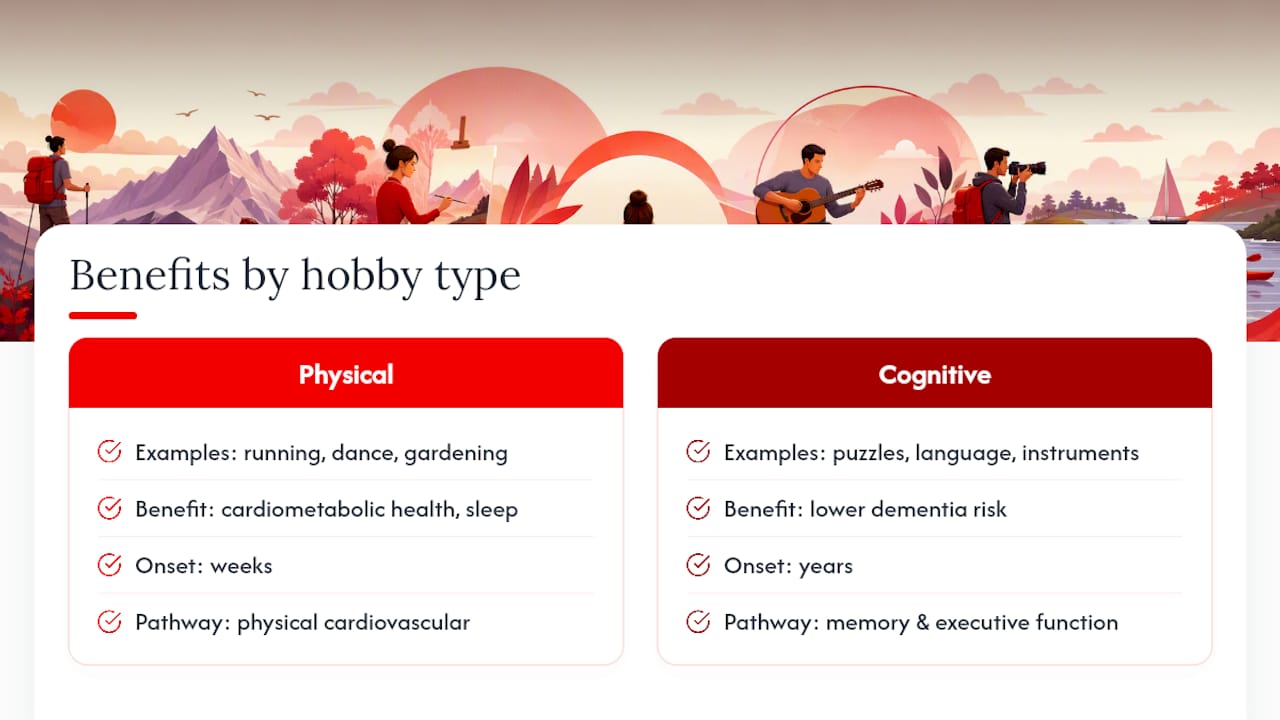
The type of hobby shapes which benefit you get. Running, swimming, and dance train your cardiovascular system and often improve sleep quality within weeks. Gardening blends light physical labor with sensory engagement and has been linked to better mood and lower blood pressure. Puzzles, language learning, and instrument practice recruit memory and executive function in ways that seem to build cognitive reserve over years, not days. If you’re rethinking your daily routines around what actually supports a healthy lifestyle, pairing a physical hobby with a cognitively demanding one covers more ground than doubling down on one type alone.

Dosage matters, though the research is not uniform on exact thresholds. Some studies on creative hobbies point to benefits emerging around two or more hours per week of consistent practice. The pattern across the literature is consistent: immediate mood lifts show up fast, but the cognitive protection against age-related decline tends to build over years of sustained engagement, not a single enthusiastic month.
How Hobbies Strengthen Relationships and Give You a Sense of Purpose
Group-based hobbies deliver a second layer of benefit beyond solo well-being. They cut isolation, sharpen communication skills, and in several observational studies are associated with lower mortality risk compared to no hobby engagement at all, according to WebMD. This is where hobbies and mental health intersect most visibly with social life, because a shared pursuit gives people a reason to show up for each other regularly.
Consider how this plays out across different settings:
- Belonging: a community choir gives members a weekly reason to gather and a shared goal that doesn’t depend on small talk
- New social skills: a recreational soccer or pickleball league forces quick, nonverbal coordination that transfers to workplace teamwork
- Mentorship roles: an experienced woodworker teaching a maker meetup gets a purpose boost from passing on a skill
- Community purpose: a volunteer restoration group ties personal enjoyment to a visible, shared outcome
- Identity and meaning: a long-running book club or chess league gives members a label (“I’m a chess player”) that outlasts any single session, an idea explored in this piece on chess and community engagement
The identity piece is easy to underestimate. Telling yourself “I paint” or “I play chess” reshapes how you interpret setbacks in that activity and in life generally, an effect closely tied to how chess storytelling and community reinforce a player’s sense of belonging over time.
The Stress and Physiology Connection: What Happens in Your Body
Many hobbies produce measurable stress relief within a single session, and that relief shows up in physiological markers, not just self-reported mood. National Geographic cites studies where short art-making sessions produced fast confidence gains alongside reductions in cortisol, the hormone your body releases under stress. A leisure-research review indexed on PMC points to broader mechanisms, describing how hobby engagement can influence endocrine, immune, and central nervous system activity in ways that plausibly connect to long-term health.
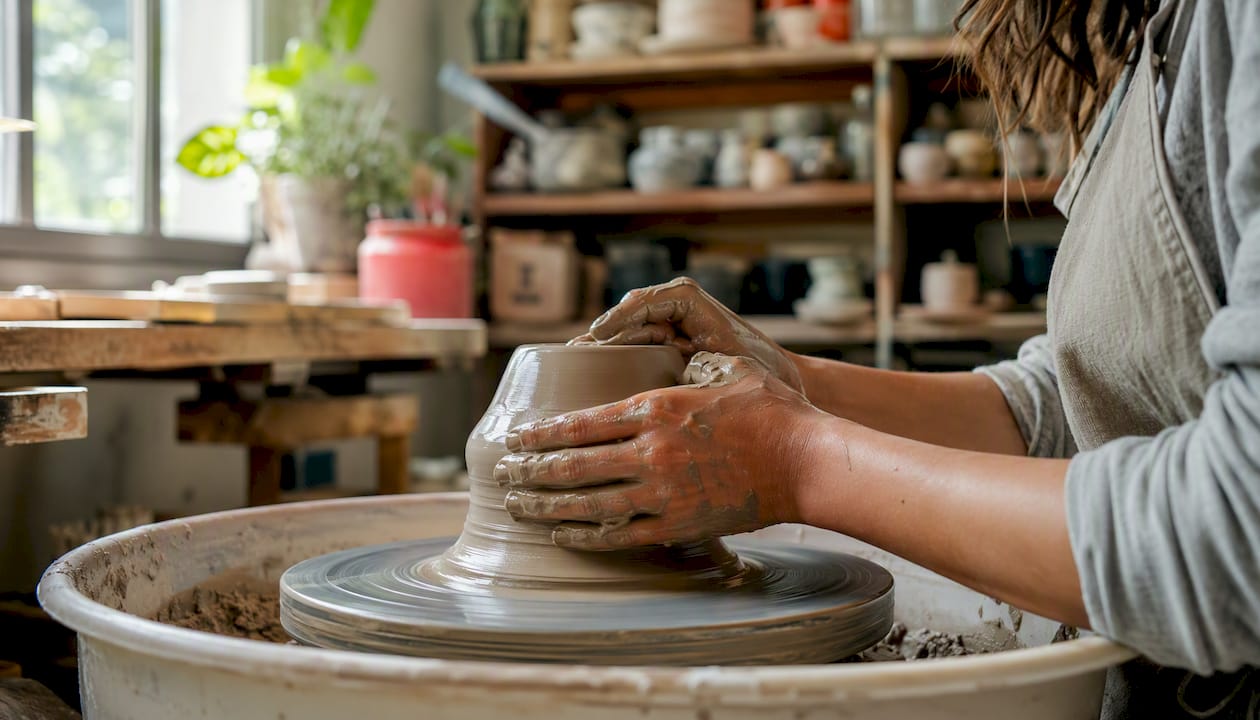
Physical hobbies work through a more familiar pathway: consistent movement lowers resting heart rate and blood pressure over time, the same cardiovascular pathway behind general exercise recommendations. A brisk hike, a dance class, or even a regular gardening session nudges these numbers in the right direction.
Pro Tip: If you’re trying a creative hobby specifically for stress relief, judge it by how you feel 15 minutes in, not by the finished product. The cortisol drop happens during the making, not the admiring.
One caveat matters here. Hobbies can meaningfully reduce everyday stress, but they are not a substitute for medical or psychiatric care. If you are dealing with persistent anxiety, depression, or a diagnosed condition, a hobby is a complement to treatment, not a replacement for it. Our guide to mental well-being has more on when to bring in a professional.
How Hobbies Support Career Sustainability and Job Performance
Hobbies improve creative problem-solving, focus, and resilience on the job, largely because the skills you build outside work don’t stay outside work. A Healthline summary of an APA poll found that people who engaged in creative activities more frequently were more likely to report very good or excellent mental health, and better mental health tends to show up as steadier attention and fewer burnout symptoms during the workweek.
The transfer is concrete. A woodworker who spends weekends solving spatial puzzles brings sharper problem-solving instincts to a Monday planning meeting. A community theater actor who has memorized blocking and lines develops presentation skills that make client pitches feel less daunting. A recreational runner who has trained for a 10K learns pacing and delayed gratification, both of which translate directly to managing a long project timeline. Even time management itself gets practiced: fitting a hobby into a busy week is a rehearsal for prioritizing anything else.
There’s a trap worth naming here. The moment you start tracking a hobby’s output the way you track work output, comparing your painting to someone else’s feed, chasing a personal record every session, you risk turning intrinsic motivation into another performance metric. Keep at least one hobby that exists purely because you enjoy it, with no scoreboard attached. That protection is part of what preserves the stress-relief benefit in the first place, and it’s a theme we return to often in our thinking on work-life balance.
Hobby Ideas by Category, With a Starter Action for Each
Plenty of hobby routes deliver real benefits, so the smartest way to choose is by what you actually want more of: calm, connection, movement, or mental sharpness.
Creative
- Watercolor painting: buy a $15 starter set and paint for 20 minutes tonight, no plan required
- Journaling: write for 10 minutes before bed using a single prompt, “what surprised me today”
- Home art curation: hang one new piece this weekend using ideas from conversation-starting art styles
Physical
- Running: walk/jog for 20 minutes this week using a free interval app, no gear needed
- Swimming: book one lap-swim session at your local pool this week
- Gardening: plant one pot of herbs on a windowsill this weekend
Social
- Community choir: attend one open rehearsal, most welcome drop-ins with no audition
- Recreational sports league: sign up for a single “trial week” through a local rec center
Intellectual
- Chess: play one game on a free app or with a friend tonight
- Language learning: complete one 15-minute lesson on a language app this evening
Outdoor
- Hiking: pick a 3-mile trail nearby and go this weekend
- Birdwatching: sit in a park for 30 minutes with a basic bird ID app open
If you’d rather channel a hobby into something you’ll live with, browse a few engaging seasonal hobby projects for ideas that scale up over a few weekends instead of one sitting.
A 10 to 12 Week Plan for Choosing and Keeping a Hobby
Commit to trialing a new hobby for about 10 to 12 weeks before deciding whether to keep it, drop it, or swap it, a window backed by Time’s reporting on how long it typically takes to move past the awkward beginner stage. That timeframe gives you enough repetition to notice a real shift in mood or skill, rather than judging a hobby off one frustrating first attempt.
- Pick a low-cost trial. Choose an entry point under $50 and skip the expensive gear until you know you’ll stick with it.
- Schedule short weekly sessions. Two 30-minute blocks a week beats one exhausting three-hour session that you dread repeating.
- Track progress and feelings. Jot one line after each session: what you did and how you felt, so week 10 doesn’t rely on faulty memory.
- Adjust or switch after roughly 12 weeks. If it isn’t clicking, that’s a data point, not a failure, and it’s fine to pivot to a different category entirely.
Cost and time commitments vary a lot by hobby: a sketchbook and pencil set runs under $20, while joining a recreational sports league might run $50 to $150 for a season. Most hobbies that stick require somewhere between one and four hours per week, which is realistic to fit around a job and family life.
Pro Tip: Reduce decision fatigue by setting a 20 to 30 minute minimum session rule. Telling yourself “I only have to do this for 20 minutes” removes the excuse that you don’t have time, and most people keep going past the timer anyway once they’ve started.
Accountability tricks help more than willpower does. Habit stacking, attaching your hobby session to something you already do daily, works better than relying on motivation alone. Group sign-ups work even better, since showing up for a class or league means letting someone else down if you skip.
What the Strongest Research Actually Shows, and Where It Falls Short
Large observational cohorts and a handful of experimental studies converge on the same conclusion: hobbies support well-being, but how strongly depends heavily on study design. The biggest, most cited evidence comes from pooled analyses of older adults, while the mechanisms explaining why come from smaller, more targeted research.
A few limitations show up consistently across this research. Most of the strongest evidence is observational, meaning it shows association rather than proof that the hobby caused the improvement. Populations studied lean toward older adults, so evidence for younger and middle-aged groups is thinner. And most benefits, especially cognitive ones, need sustained engagement over months or years to show up clearly, not a single weekend project.
The practical takeaway is not to wait for perfect proof. The direction of the evidence is consistent enough, across enough different populations and hobby types, that starting is a reasonable bet even before every mechanism is nailed down.
Our Take: Start Before You Feel Ready
Our team at Lizard’s Lunch believes the biggest barrier to hobby benefits isn’t finding the right one, it’s waiting to feel motivated before you start. That’s backward. Motivation tends to follow action here, not precede it.
If you’re dealing with a diagnosed mental health condition or persistent symptoms that feel bigger than everyday stress, a hobby is a helpful complement to care, never a replacement for it. Talk to a professional, and treat the hobby as one part of a broader plan, something we cover in more depth in our guide to true well-being. For everyone else, the lowest-friction move is picking one small, cheap starter project this week rather than researching the “perfect” hobby for another month. Our seasonal hobby project roundup is a reasonable place to browse if you’re stuck on where to begin.
If your hobby draws you toward hands-on home projects, that instinct is worth following too. A little momentum from finishing something with your hands, whether it’s a birdhouse or a full room refresh, tends to spill over into confidence elsewhere. Our home renovation ideas guide is built for exactly that kind of hobby that doubles as a home upgrade.
Where This Research Comes From
These sources anchor the evidence behind why hobbies matter, and they’re worth bookmarking if you want to dig deeper.
- Having a hobby tied to happiness and well-being | Harvard Health
- 3 proven health benefits of having a hobby | UCLA Health
- Why having a hobby is good for your brain and body | National Geographic
- Hobbies May Be the Key to a Satisfying Life. Here’s How to Find One | Time
- PMC review on leisure and health mechanisms
- PubMed-indexed study on leisure activities and dementia risk
- Health Benefits of Hobbies | WebMD
This is general information, not a substitute for professional medical or psychological advice. If you’re managing a mental health condition, check with a qualified provider before relying on lifestyle changes alone.
















Leave a Comment
Your email address will not be published. Required fields are marked with *