

Explore actionable examples of sustainable tourism that empower local communities and enhance your travel experience today.
If you want a shortlist you can act on today: slow travel with a single basecamp, community-led walking or craft tours, GSTC-verified eco-lodges, wildlife-friendly excursions with strict distance rules, snorkeling trips inside marine protected areas, regenerative farm stays, accessible tourism programs built for travelers with disabilities, and homestays owned and run by local families. Each one shifts money and decision-making toward the people who live at the destination rather than a distant operator, and each one has a public standard behind it you can check before you book. The UNWTO and the Global Sustainable Tourism Council both publish the criteria that separate a genuine example from a marketing slogan, and Our team at Lizard’s Lunch has spent enough time cross-checking these claims to know where travelers usually get fooled.
Here’s the fast version, then we’ll get into how to verify each one:
- Slow travel: pick one region and stay a week instead of hopping through three cities.
- Community-based tours: book walking, cooking, or craft experiences run by local guides, not outside agencies.
- Certified eco-lodges: look for GSTC-aligned properties with published water and energy practices.
- Wildlife-friendly excursions: choose operators with enforced viewing distances and no animal touching.
- Marine-protected-area snorkeling: dive or snorkel only where reef fees fund ranger patrols.
- Regenerative farm stays: support working farms that restore soil instead of just hosting guests.
- Accessible tourism: seek destinations investing in ramps, lifts, and sensory-friendly programming.
- Local-ownership homestays: put your lodging spend directly into a family’s income, not a franchise.
Recent traveler surveys back this shift: A significant share of travelers now say they plan to avoid overcrowded destinations, and many intend to travel more in the off-season, which tracks almost exactly with the basecamp and slow-travel model above. Pick one example from the list, then do one verification step (check the operator’s GSTC status or ask about local hiring) before you hand over your deposit.
Key Takeaways
Sustainable tourism works when travelers combine slower itineraries, verified operators, and direct local spending instead of relying on any single “green” choice.
| Point | Details |
|---|---|
| Pick one basecamp | Stay longer in one region instead of splitting nights across multiple cities. |
| Verify before booking | Check GSTC alignment and ask operators about local hiring and revenue sharing. |
| Favor community ownership | Book homestays and tours run directly by local residents, not outside agencies. |
| Reduce transport footprint | Choose direct flights or ground transport, since takeoff and landing burn disproportionate fuel. |
| Watch for real evidence | Trust operators with published data over those using vague eco-labels alone. |
Table of Contents
- What Sustainable Tourism Actually Means
- Sustainable Tourism Examples by Category
- How to Plan a Trip Around These Examples
- Verifying Claims and Spotting Greenwashing
- The Evidence That These Examples Work
- Where to Verify Claims and Learn More
- What We’d Actually Try First
- Frequently Asked Questions
- Sources
What Sustainable Tourism Actually Means
Sustainable tourism means travel that takes full account of its current and future economic, social, and environmental effects, addressing the needs of visitors, the industry, the environment, and host communities all at once. That’s the working definition behind both the UNWTO framework and the GSTC criteria used to certify hotels, tour operators, and entire destinations.
Three principles hold that definition together. Environmentally, it means minimizing resource use and protecting biodiversity rather than just avoiding visible litter. Socio-economically, it means keeping tourism revenue circulating in the local economy instead of flowing out to foreign-owned chains. Culturally, it means respecting the customs and living heritage of a place instead of treating it as a photo backdrop. The United Nations ties this directly to Sustainable Development Goal 8.9 (promoting sustainable tourism that creates jobs) and SDG 12.b (developing tools to monitor tourism’s sustainability impacts), which gives the whole idea a measurable policy anchor instead of leaving it as a feel-good phrase.
Sustainable tourism should take full account of its current and future economic, social, and environmental impacts, addressing the needs of visitors, the industry, the environment, and host communities.
That framing matters because it stops the conversation from being only about carbon. A trip can lower emissions and still fail communities if none of the spending stays local, which is exactly why the categories below pair an environmental action with an economic one.
Sustainable Tourism Examples by Category
Ecotourism looks like guided visits to protected forests or wetlands where entrance fees directly fund ranger salaries and habitat restoration. It works because the Global Ecotourism Network and GSTC both require documented conservation spending, not just a “nature-based” label. Your action: ask what percentage of your ticket price goes to conservation before you buy it.
Community-based tourism means locally owned tour companies, homestays, and craft cooperatives run the experience from start to finish. Costa Rica has built much of its national tourism economy around this model, weaving protected rainforest access with community-run lodges. Regenerative tourism goes a step further, actively restoring ecosystems rather than just avoiding harm; farm stays that rebuild soil health through rotational grazing or composting are a clean example. Slow travel means picking one base and taking day trips instead of changing hotels every two nights, a habit our guide to why traveling off-peak saves more and shows you more breaks down in more detail.
On the accommodation side, look for eco-lodges built around GSTC-aligned practices, including properties like Six Senses Fiji, where on-site solar microgrids and greywater recycling systems cut resource use at the property level rather than relying on offsets bought elsewhere. Wildlife-friendly tours enforce strict viewing distances and ban feeding or touching. Marine and blue-economy protection shows up as reef fees that fund ranger patrols in marine protected areas. Accessible tourism includes destinations investing in step-free paths and sensory-friendly programming, an approach the European Union has documented through projects like the Seatrac beach-access system. Low-impact transport means choosing trains, buses, or carefully planned road trips over short-haul flights whenever the route allows it.

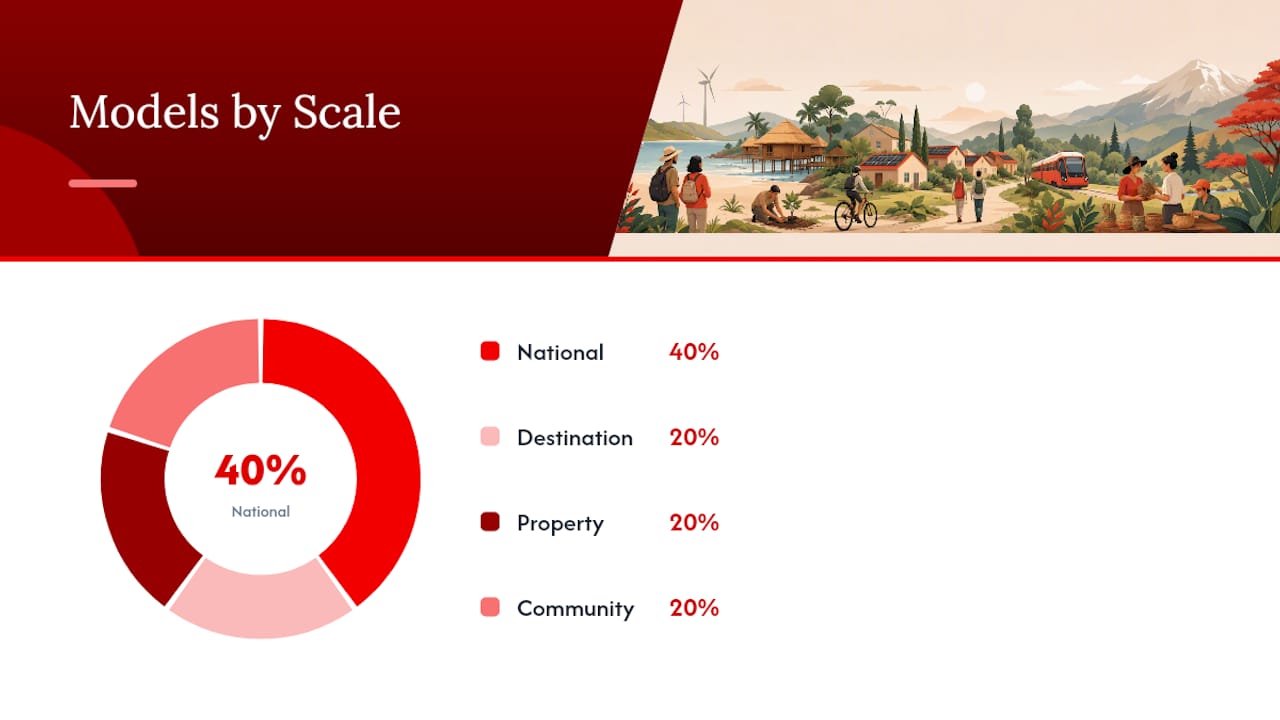
| Model | Scale | What Makes It Work | Verified Data Point |
|---|---|---|---|
| High-value, low-impact tourism (Bhutan-style policy) | National | Daily sustainable development fee limits visitor volume | Fee revenue funds conservation and public services |
| Nature-based economy (Costa Rica-style model) | National | Protected-area network tied to tourism revenue | Ecotourism forms a major share of the national tourism sector |
| Destination certification (Slovenia’s Green Scheme) | Destination | Standardized criteria applied across towns and regions | Certified destinations align directly with GSTC benchmarks |
| Property-level microgrids (Six Senses Fiji) | Property | On-site solar power and greywater recycling | Documented renewable and water-recycling infrastructure |
| Community co-ownership (Mdumbi-style model) | Community | Local residents hold ownership stakes in tourism operations | Revenue stays inside the host community rather than exiting to outside owners |
Pro Tip: Stack your examples instead of picking just one. Book a community-led tour in the morning and stay at a GSTC-aligned lodge at night, so both halves of your trip reinforce the same principle instead of canceling each other out.
How to Plan a Trip Around These Examples
Turning these categories into an actual itinerary takes a little upfront work, but the sequence is simple.
- Choose one basecamp instead of a multi-city hop, and build day trips out from there.
- Book direct flights or ground transport where possible, since takeoff and landing burn a disproportionate share of a short-haul flight’s total fuel.
- Extend your stay at that one location rather than splitting the same number of nights across three destinations.
- Filter accommodations for GSTC alignment or a comparable independent certification before comparing price.
- Prioritize local guides and community-owned operators over international agencies reselling the same experience.
- Pack light using a minimalist packing approach, and carry reef-safe sunscreen and a refillable water bottle instead of buying single-use plastic at your destination.
On the ground, the behaviors that matter most are simple: pack out what you pack in, buy food and crafts from local vendors instead of chain outlets, and respect access rules in protected areas even when nobody is enforcing them. The World Wildlife Fund’s traveler guidance backs all of this up as core, low-effort behavior that meaningfully cuts a trip’s footprint.
Pro Tip: If you normally take three separate long weekends a year, try converting two of them into one longer trip. You cut a full round of takeoffs and landings, the highest-emission part of any flight, while still getting the same total vacation time.
Verifying Claims and Spotting Greenwashing
Before booking, run through a short checklist: does the operator align with GSTC criteria, do they publish an annual sustainability report with actual numbers, do they state a science-based climate target, and do they explain in concrete terms how revenue reaches the local community? A property or tour that can’t answer these clearly is worth a second look.
Red flags are easy to spot once you know what to look for:
- Vague language like “eco-friendly” or “green” with no third-party audit behind it.
- No mention of local hiring, wages, or revenue-sharing anywhere on the site.
- Promotional photos of nature with zero data on water, waste, or energy use.
- Wildlife encounters that allow touching, feeding, or close-contact photos.
Ask operators directly: What percentage of your staff is hired locally? Where does tour revenue go? What’s your water and waste policy? What rules govern wildlife viewing distances? A confident, specific answer is a good sign; a marketing brochure response is not. Greenwashing usually hides behind adjectives instead of numbers, so the fastest filter is simply asking for the number.
The Evidence That These Examples Work
Nature-based tourism produces measurable outcomes, not just goodwill. The World Bank has documented multiple cases where tourism revenue directly funds protected areas, community programs, and even post-conflict economic recovery, which means the money travelers spend on entrance fees and guided tours often becomes conservation funding rather than disappearing into overhead.
One clear case study: on Príncipe island, tourism-linked pressure and community action removed 30,000 plastic bottles from the biosphere reserve as part of a no-plastic campaign tied to the island’s tourism economy. That’s a concrete conservation result, not an abstract promise.
| Impact Area | Example | Result |
|---|---|---|
| Protected-area funding | National park entrance fees | Revenue supports ranger patrols and habitat management |
| Community recovery | Post-conflict tourism development | Documented income and stability gains in World Bank case studies |
| Plastic reduction | Príncipe biosphere reserve | 30,000 bottles removed through tourism-linked cleanup campaign |
The main barriers travelers run into are cost, accessibility of certified options in remote regions, and the sheer difficulty of telling a real certification from a marketing badge. The fix is rarely to spend more; it’s to spend more deliberately, checking one credential before booking instead of assuming the label is enough.
Where to Verify Claims and Learn More
A handful of sources do most of the heavy lifting if you want to check an operator’s claims yourself:
- GSTC Criteria — the baseline standard for certifying hotels, tour operators, destinations, and attractions.
- UNWTO Sustainable Development — policy-level framing and climate-action commitments from the UN tourism body.
- UN Sustainable Development Goals: Tourism — the SDG 8.9 and 12.b language that anchors the whole concept.
- WWF Responsible Travel Tips — practical, low-effort traveler behaviors.
A useful order of operations: check certification first, then look at operator transparency (do they publish real numbers), then look for actual evidence of local benefit. If a listing skips straight from a green logo to a booking button with nothing in between, that’s your signal to keep digging. For cultural-heritage-specific examples, Thai Explorer’s guide to Thai cultural activities is a solid reference for community-respectful programming done well.
What We’d Actually Try First
Our team at Lizard’s Lunch keeps coming back to the same recommendation: skip the multi-country itinerary and try one longer stay in a single region, paired with at least one community-led day tour. It’s the easiest of all these examples to execute because it doesn’t require finding a perfectly certified property; it just requires slowing down and asking better questions before you book.

If you want a concrete starting point, pick one GSTC-verified or comparably certified property for your next trip and run through the sample questions from the verification section before you pay a deposit. Ask about local hiring and where the tour revenue actually goes. It takes maybe ten minutes and changes which businesses get your money.
Try it once, on one trip, and pay attention to what’s different: the pace, the conversations with local guides, the sense that your money stayed close to where you spent it. We’d genuinely like to hear how it goes.
Frequently Asked Questions
What are some simple examples of sustainable tourism for a first trip?
Start with a longer stay in one basecamp, a community-led walking or food tour, and a GSTC-aligned hotel. All three are widely available and easy to verify before booking.
How do I know if an eco-lodge is actually sustainable?
Check whether it’s GSTC-certified or aligned with GSTC criteria, and look for published details on water use, energy sourcing, and local staffing rather than just the word “eco” in its name.
Does staying longer at one destination really reduce environmental impact?
Yes. Combining several short trips into one longer stay cuts the number of high-emission takeoffs and landings you’re responsible for and reduces the logistics footprint of constant relocation.
What’s the difference between ecotourism and regenerative tourism?
Ecotourism aims to minimize harm to an ecosystem, while regenerative tourism actively restores it, through practices like soil-rebuilding farm stays or habitat replanting programs funded by visitor fees.
Is community-based tourism more expensive?
Not usually. Locally run tours and homestays are often priced comparably to standard packages, and more of that spending stays with the people hosting you rather than an outside agency.
Sources
- Sustainable tourism
- Sustainable Tourism Development (World Bank working paper)
- Responsible travel tips | World Wildlife Fund
- GSTC Criteria
If you spot an outdated fact or want to flag another example worth covering, reach out to our team at Lizard’s Lunch. We update these guides as certification standards and destination data change.
















Leave a Comment
Your email address will not be published. Required fields are marked with *