
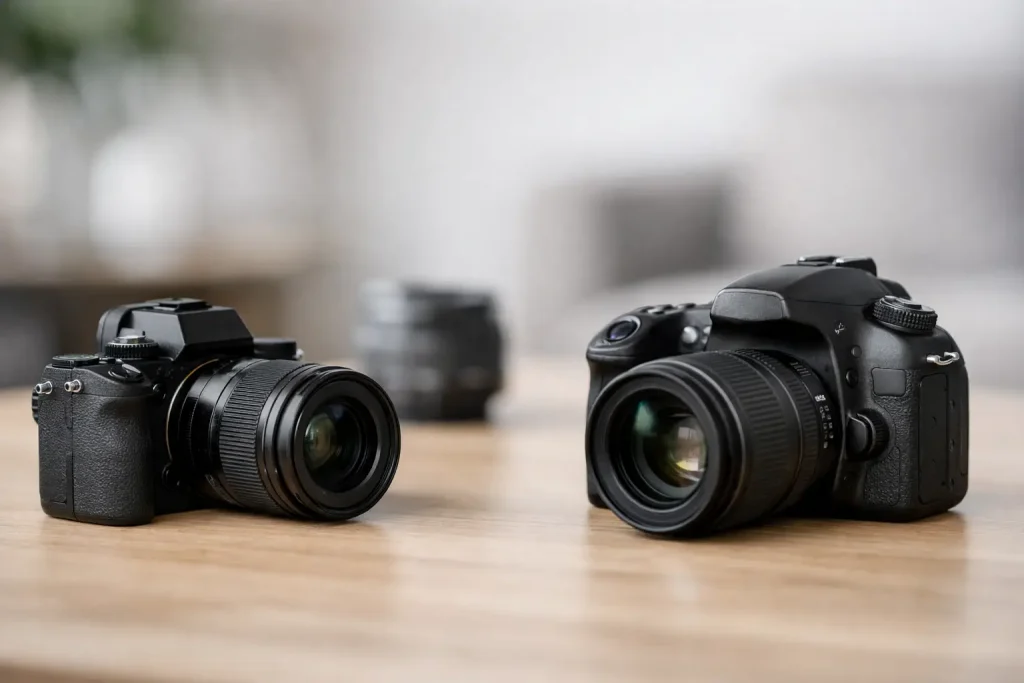
Mirrorless camera vs DSLR comes down to speed, size, lenses, battery life, and budget. Find the camera type that best fits your photo and video goals today.
A camera body can look like the biggest decision in photography, but the real question is what happens after you leave the store. Will it fit in your day bag? Can you find a lens for the shots you want? Will it still feel enjoyable after an hour of photographing your kid’s game or a sunset on vacation? The mirrorless camera vs DSLR choice is less about declaring one format the winner and more about matching a tool to the way you actually shoot.
For most first-time buyers in 2026, mirrorless is the easier recommendation. It is where major camera development, autofocus innovation, and new lens releases are concentrated. That does not make DSLRs obsolete, though. A well-priced DSLR can still produce excellent photos, offer longer battery life, and give budget-minded photographers access to a huge used-lens market.
Mirrorless Camera vs DSLR: The Core Difference
A DSLR uses a mirror inside the camera body to reflect light from the lens up into an optical viewfinder. When you press the shutter, that mirror flips out of the way so light can reach the sensor. The familiar mechanical click and brief viewfinder blackout are part of that process.
A mirrorless camera removes the mirror and optical viewfinder assembly. Light travels directly from the lens to the image sensor, which sends a live preview to the rear screen and, on most interchangeable-lens models, an electronic viewfinder. What you see can reflect your exposure, white balance, depth of field, and color settings before you take the photo.
Neither design automatically creates sharper images. Sensor size, lens quality, lighting, technique, and processing matter far more. You can find APS-C and full-frame sensors in both formats, and excellent images can come from either one. The differences show up in handling, features, and the long-term system you buy into.
Why Mirrorless Has Become the Default Choice
Mirrorless cameras are generally smaller and lighter than comparable DSLRs. That is a meaningful advantage for travel, hiking, everyday family photos, and anyone who has stopped carrying a camera because it felt too bulky. The size difference can shrink once you add a large professional zoom lens, but a compact mirrorless body with a small prime lens remains an easy kit to bring along.
Autofocus is another major reason many shoppers choose mirrorless. Modern models can recognize and track faces, eyes, animals, birds, vehicles, and other subjects across much of the frame. For a parent trying to photograph a fast-moving toddler or a beginner shooting a dog at the park, that technology can save a lot of missed shots.
The electronic viewfinder also offers practical help while learning. If a scene is too dark, too bright, or oddly colored, you can often spot the problem before pressing the shutter. Features such as focus peaking, exposure simulation, live histograms, and magnified manual focus make mirrorless cameras especially approachable for photographers who want feedback in real time.
Video is usually stronger on mirrorless models as well. Most current mirrorless systems offer better autofocus during recording, higher-resolution options, faster frame rates, and more video-friendly tools. If you expect to mix still photography with YouTube videos, travel clips, interviews, or social content, mirrorless is usually the more flexible starting point.
The Trade-Offs of Going Mirrorless
Mirrorless convenience comes with a few compromises. Electronic viewfinders and constant live-view operation use more power, so battery life is often shorter than on a DSLR. Bringing a spare battery is common for day trips, events, or long shooting sessions.
Some photographers also prefer the direct, natural view through a DSLR’s optical viewfinder. An electronic viewfinder is bright and informative, but it is still a small screen. In very low light or high-speed action, lower-end mirrorless cameras may show lag or a less fluid preview than premium models.
Price can be another factor. New mirrorless cameras cover a wide range, but the newest bodies and lenses can be expensive. A low-priced body is not always a bargain if the lenses you will need later are costly.
When a DSLR Still Makes Sense
A DSLR is a smart buy when value, battery life, and traditional handling matter most. Because manufacturers have shifted their focus to mirrorless, new DSLR options are limited. At the same time, that shift has created a strong used market for DSLR bodies and lenses. A careful buyer can often build a capable kit for less money than a comparable new mirrorless setup.
DSLRs tend to have deeper grips, more physical buttons, and a solid, balanced feel with larger lenses. Those details matter if you have bigger hands or dislike working through screen menus. Their optical viewfinders work without draining the battery and show the scene directly through the lens, which many photographers find comfortable during long outdoor shoots.
Battery endurance is a clear DSLR advantage. Depending on the model and shooting style, a DSLR may capture several times more photos on one charge than a mirrorless camera. That can be useful for camping, travel days away from outlets, school events, or hobbyists who simply do not want to manage extra batteries.
A DSLR can be particularly appealing for portrait, landscape, and casual photography, where subject-tracking speed is less critical. Canon and Nikon DSLR systems also have decades of lenses available, including affordable older primes, telephoto zooms, and specialty glass. Just remember that availability is not the same as future growth. The best new lenses and camera features are increasingly being designed for mirrorless mounts.
Choose Based on What You Photograph
The right camera becomes clearer when you start with your typical subjects rather than a feature checklist.
Travel, family photos, and everyday use
Choose mirrorless if portability and easy autofocus are high priorities. A lightweight body paired with a versatile zoom or compact prime lens is easy to pack and quick to use. The live preview can also reduce the learning curve when you are moving from a phone camera.
Sports, wildlife, and active kids
Mirrorless is generally the stronger option, especially if your budget reaches a model with reliable subject detection and fast burst shooting. Eye tracking and broad autofocus coverage are useful when subjects move unpredictably. A DSLR can still handle action well, but learning its autofocus modes may take more practice.
Portraits and landscapes on a tight budget
A used DSLR kit may offer outstanding value. Spend enough of the budget on a good lens, because lens choice often affects portrait background blur, low-light capability, and image quality more than jumping to a newer body. A DSLR with a sharp 50mm or 85mm-style portrait lens can produce results that look anything but dated.
Video, content creation, and hybrid shooting
Choose mirrorless. Look beyond resolution alone and consider autofocus performance, image stabilization, microphone input, recording limits, overheating behavior, and the availability of the lenses you want. A camera that records 4K is not automatically the best video camera if it struggles to stay focused or is awkward to hold while filming.
Do Not Buy a Body Without Pricing the Lenses
Camera bodies get attention because their specifications are easier to compare, but lenses shape your experience for years. Before committing to a system, price the lenses that match your plans: a general-purpose zoom, a low-light prime, a portrait lens, or a telephoto for sports and wildlife.
Also consider whether you are buying new or used. Used DSLR lenses can make a DSLR kit exceptionally affordable. Mirrorless buyers may be able to adapt older DSLR lenses, particularly within the same brand, but adapters can add size, cost, and occasional autofocus limitations. Native mirrorless lenses are usually the cleanest solution, even if they cost more.
Ergonomics deserve a real-world test, too. Hold the camera with the lens you are likely to use. Check whether your fingers crowd the grip, whether key controls are reachable, and whether the menus make sense to you. A slightly less advanced camera that you enjoy using will outperform an impressive model left at home.
The Best Choice for Most Buyers
If you are purchasing your first interchangeable-lens camera or starting fresh, mirrorless is the safer long-term investment. It offers smaller bodies, excellent autofocus, stronger video features, and a system that is still actively expanding. It is especially compelling for travelers, parents, creators, and anyone who wants technology that makes shooting easier.
Choose a DSLR when your budget is limited, you value long battery life and an optical viewfinder, or you find a used kit with the lenses you need at a great price. It remains a capable, enjoyable way to learn photography and capture professional-looking images.
Whichever direction you choose, leave room in the budget for a lens, a memory card, and time to practice. The camera that earns a spot by the door and gets used for real moments is the one that will make the better photographs.















Leave a Comment
Your email address will not be published. Required fields are marked with *