
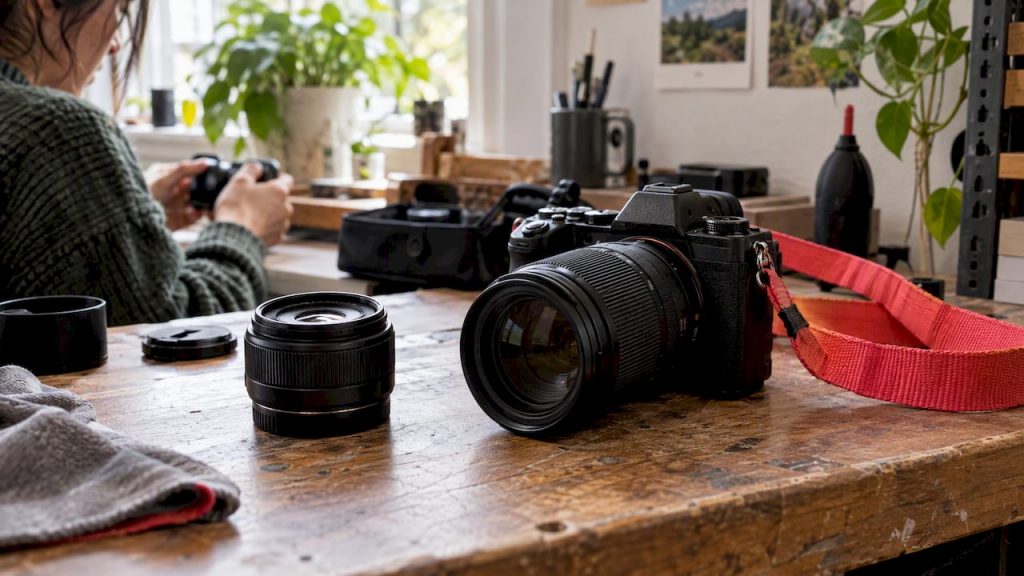
Prime or zoom lens? See how they differ in sharpness, aperture, size and cost, and which one suits travel, portraits, events and everyday shooting.
A prime lens has one fixed focal length and a zoom lens covers a range, and that single difference shapes everything else: size, weight, light-gathering, flexibility and how you think about a photo. If you want one lens that handles most situations, a zoom is the easier choice. If you want a small, bright lens that pushes you to compose carefully, a prime is hard to beat. Most photographers end up owning both, and this guide shows you how to decide which comes first.
TL;DR
- A prime lens has a fixed focal length, while a zoom lens gives you a range. You change the framing of a prime by moving your feet.
- Primes are typically sharper than similarly priced zooms, and they usually open to wider apertures. Modern zooms have closed much of the gap.
- Zooms win on versatility, fewer lens changes and travel convenience. Primes win on size, low-light performance and a deliberate approach to composition.
- Choose by what you shoot, how much you carry and what you can spend. A first kit of one standard zoom plus one affordable prime covers most needs.
Table of Contents
- What the difference actually is
- Sharpness and image quality
- Aperture and low light
- Size, weight and how it feels to carry
- Versatility and speed of shooting
- Cost: what you really pay
- Prime vs zoom at a glance
- Which one for which kind of photography?
- Prime lenses and the habit of composing
- How to choose: a simple decision path
- Common mistakes to avoid
- Perspective
- Looking to reach photography fans?
- FAQ
- Sources
What the difference actually is
A prime lens is built around one focal length, such as 35mm or 50mm. The angle of view never changes. A zoom lens has a ring that moves internal elements so you can pick any focal length within its range, such as 24–70mm.
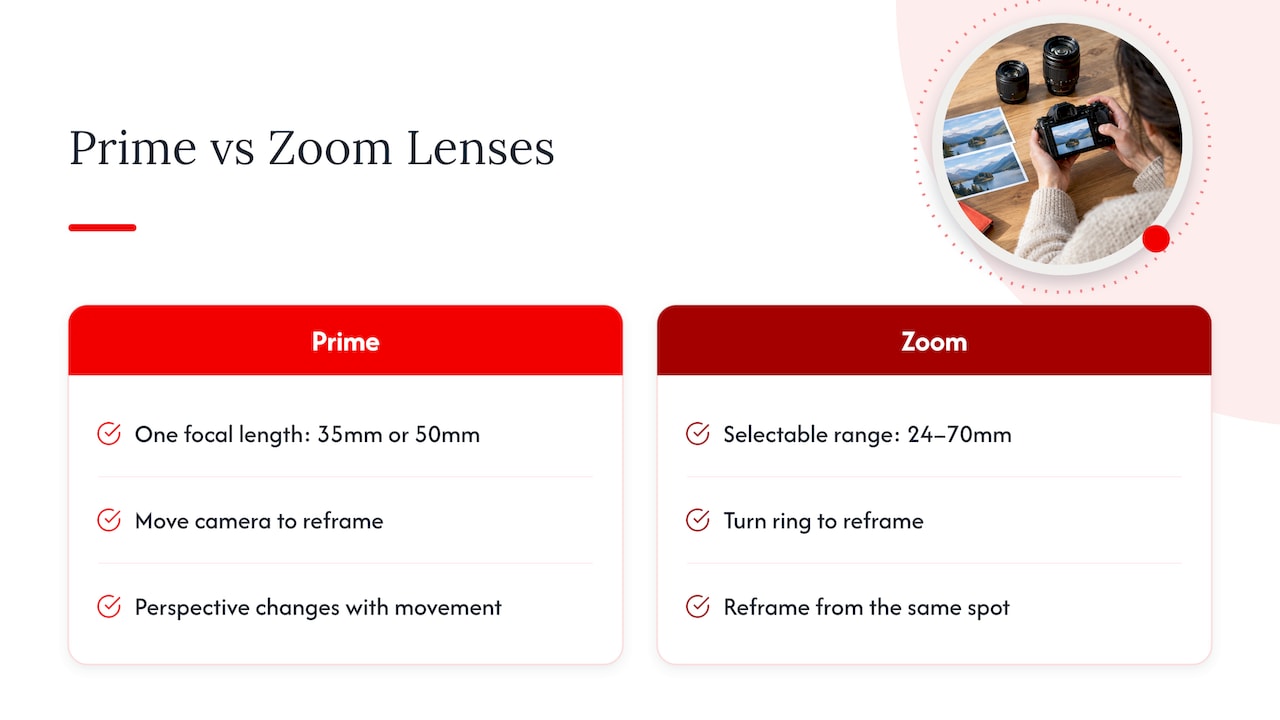
According to DPReview’s guide to prime and zoom lenses, a prime keeps a single focal length, so you generally move the camera to change framing, while a zoom lets you turn the ring. That sounds like a small thing. In practice it changes your whole routine in the field.
The question “can you still zoom with a prime?” has a short answer. Not optically. As Sony’s lens guide puts it, you cannot change the focal length of a prime, so you step toward or away from your subject to change the composition. Cropping later in editing is possible, but it is not the same as zooming, because you lose resolution with every crop.
There is also a perspective point worth knowing. Canon Europe’s explanation of focal length notes that with a prime, perspective changes only when you physically move the camera. Stepping closer to a portrait subject does more than enlarge them. It changes the relationship between the subject and the background. A zoom lets you reframe from the same spot, which is handy, but it does not give you that change in perspective.
Sharpness and image quality
This is the question most readers type first: are primes sharper? The honest answer is “usually, at the same price, but less than it used to be.”
DPReview says primes were historically sharper and that this is still typically true for budget-friendly options, but modern zooms are often nearly as good as primes, and sometimes as good. Nikon’s comparison says the same thing from the manufacturer’s side: primes are typically sharper than similarly priced zooms, while top-of-the-line zooms can produce very sharp images, and top primes can match or surpass them.
Why does the price comparison matter? A lens designer working on a prime only has to correct optical flaws at one focal length. Canon’s Snapshot article explains that primes can be easier to optimize for that single focal length, while zooms must correct aberrations across several. A zoom that does this well across its whole range needs more glass and tighter engineering, which is why premium zooms cost so much.
Here is how that plays out when you shop:
- At a modest budget, a prime usually gives you the sharper, cleaner image per dollar.
- At a professional budget, a high-end zoom and a high-end prime can both deliver outstanding results, so sharpness stops being the deciding factor.
- At extreme zoom ranges, expect compromises. DPReview points out that a 24–70mm zoom combines wide-angle, normal and telephoto coverage, while more extreme ranges can trade away image quality.
For most people sharing photos online or printing at normal sizes, the gap between a good zoom and a good prime is far smaller than the gap between a good lens and a poor one. Technique, light and focus accuracy matter more than the lens type.
Aperture and low light
The clearest practical advantage of primes is the maximum aperture. A lens with a small f-number, like f/1.8, opens wide and admits a lot of light. Sony notes that fast primes with small f-numbers let in more light, which can reduce camera shake and image noise indoors or in low light.
That has three effects you can see:
- Faster shutter speeds in dim rooms. More light lets you freeze movement without raising ISO as high.
- Cleaner files. A lower ISO usually means less noise.
- Softer backgrounds. A wide aperture gives you the shallow depth of field that makes portraits look polished.
National Geographic’s lens guide makes the portrait connection directly: fixed lenses are straightforward, often offer high image quality at lower cost, and suit portraits because they tend to have wider maximum apertures.
If you often shoot in restaurants, at family gatherings indoors, in churches, or at dusk on a city street, this is where a prime earns its place in the bag. Zooms with a bright, constant wide aperture exist, but they tend to be big, heavy and expensive. That is a trade-off to weigh against your budget and your shoulder.
Size, weight and how it feels to carry
Carry a camera all day and you will feel the difference. DPReview observes that budget primes, especially wide-angle and normal ones, are generally much smaller and lighter than zoom lenses. A compact prime on a mirrorless body can feel like a point-and-shoot, and it draws less attention on the street.
National Geographic gives the other side of the argument for travelers: one zoom can take the place of a bagful of lenses, though zooms are bigger and heavier than fixed lenses. So the weight question is really a count question. One heavy zoom may be lighter than three primes together.
If you are also deciding on a camera body, our guide to mirrorless cameras versus DSLRs explains how body size changes the whole equation, since a small body paired with a small prime is a very different kit from a large body with a big zoom.
Versatility and speed of shooting
This is where zooms pull ahead. If your subject keeps changing distance, you need to reframe fast. Nikon recommends zooms for subjects at varying distances, including events, sports and wildlife, because you can change the framing without moving or switching lenses.
Sony adds that zooms help when you are traveling light or when movement is difficult, with fireworks displays and sporting events as examples. If you cannot step forward because there is a fence, a crowd or a cliff edge, a zoom is your “feet.”
At weddings, parties and other busy gatherings, the ability to go from a wide room shot to a tight close-up in seconds is a real advantage. Roaming photographers who move through a crowd rely on exactly this flexibility, and if you are curious how that style of coverage works, this piece on roaming event photography shows how coverage is shaped when you cannot plan every shot.
There is a protective benefit too. Nikon says that reducing lens changes can help protect equipment during a shoot, because the lens, body and sensor are vulnerable when exposed. In dusty, sandy or rainy places, staying on one zoom is a sensible habit.
Cost: what you really pay
Price comparisons are only fair when you compare like with like. Nikon notes that zooms can be more cost-effective when you want several focal lengths, since one lens replaces several. Meanwhile, as National Geographic points out, fixed lenses often deliver high image quality at lower cost.
Both can be true. If you need three focal lengths, three budget primes can cost less than one premium zoom, but you carry three lenses and swap between them. If you need one focal length, a single prime is often the cheapest way to get excellent quality and a wide aperture.
A useful way to think about it:
- Cost per focal length: zooms often win when you need many.
- Cost per stop of light: primes often win.
- Cost per pound carried: depends on how many primes you pack.
Check current Canadian retail prices before you decide, because lens pricing changes often and varies by mount and brand.
Prime vs zoom at a glance
| Factor | Prime lens | Zoom lens |
|---|---|---|
| Focal length | One fixed value | A range, adjustable by ring |
| Framing | Move your feet | Turn the zoom ring |
| Sharpness at similar price | Typically better | Often close, especially modern designs |
| Maximum aperture | Often wider, good for low light | Often narrower, bright versions are bigger and costlier |
| Size and weight | Usually smaller and lighter | Usually larger and heavier |
| Lens changes | More frequent | Fewer |
| Best for | Portraits, street, low light, learning composition | Travel, events, sports, wildlife, quick reframing |
Which one for which kind of photography?
Travel and everyday photos
For travel, a standard zoom is the safe pick. Canon Europe gives a broad 24–105mm zoom as an everyday example, suited to general scenes. National Geographic’s travel view is that a zoom’s ability to replace several lenses can outweigh its extra size and weight.
If you pack light and enjoy walking around, a small prime is a joyful companion for a day out. You can read more about building a travel kit in our guides to the best photography and videography equipment for traveling and travel cameras for adventurous photographers. If you like to take your time with a destination, the slow approach in our slow travel guide suits a one-prime walk particularly well.
Portraits
A prime with a wide aperture is the classic portrait tool. It isolates your subject, performs well in window light, and gives you that soft backdrop. National Geographic’s reasoning, that fixed lenses tend to have wider maximum apertures, is why primes are so often recommended for people photography. Moving closer or farther also lets you control perspective, which Canon’s focal length guide highlights as something only physical movement changes with a prime.
Events, sports and wildlife
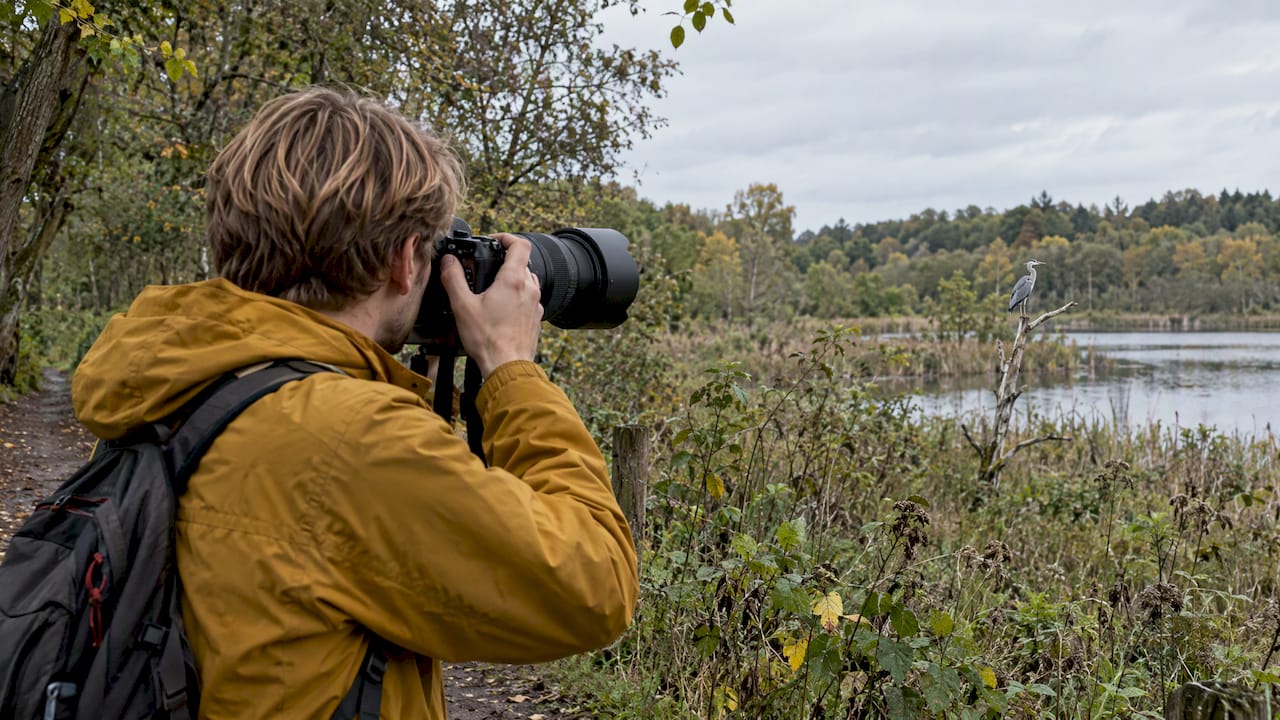
Here subjects move and you cannot always move with them. Nikon recommends zooms for these situations. Canon Europe offers a 100–500mm zoom as a wildlife example, where subject distance can vary a great deal. A zoom in this range lets you react to the moment instead of walking toward a bird that will not wait.
Landscapes and architecture
Landscape photographers use both. A wide zoom lets you refine composition without relocating, which helps on a ridge where your options are limited. A wide prime keeps things light for long hikes and often performs well when you need top corner-to-corner quality. If you enjoy the craft, our look at famous landscape photographers is a good source of inspiration, and our guide to photo editing software for outdoor photography covers what happens after the shutter clicks.
Interiors and property photos
Tight rooms limit how far you can step back. Canon’s Snapshot article says a zoom is preferable in constrained spaces or when varied framing is needed quickly. If you shoot small interiors, a wide zoom is the practical choice, and clean, well-lit shots matter just as much as the lens. These listing photography tips for home sellers show what a good property image needs in terms of light and presentation.
Prime lenses and the habit of composing
One of the most repeated arguments for primes is not technical at all. Nikon says a prime forces the photographer to think actively about composition. Canon’s Snapshot adds that a prime is useful when you have room to move and want to practice composition.
Try this exercise. Put a 35mm or 50mm prime on your camera and leave everything else at home for a week. You will start noticing:
- How far you need to stand from a subject to get the shot you want.
- How a small step left or right changes the background.
- How foreground, subject and background relate to each other.
Then move back to a zoom and see how your framing decisions have changed. Many photographers find they zoom with more intention afterward. If you want to go deeper into the craft, this overview of the role of composition in photography is a good next read.
How to choose: a simple decision path
DPReview’s advice boils down to this: choose according to your needs, preferences and budget, taking a zoom for versatility or a prime for composition, small size and weight, or a fast aperture without spending a fortune. Here is a way to apply it.
- List what you shoot most. Write down your top three subjects. Moving subjects and unpredictable distances point to a zoom. Still subjects, people and low light point to a prime.
- Be honest about carrying. If you will leave a heavy lens at home, it is the wrong lens, however good it is.
- Check your space. Tight rooms, crowds or cliffs favor zooms. Open streets and studios favor primes.
- Set a budget for the whole kit. Include a possible second lens. One strong lens is better than two mediocre ones.
- Test before you buy. Handle both types in a shop if you can, and compare how they feel on your camera body.
- Plan your workflow. Better lenses mean more detailed files to manage. Our photography workflow guide helps you organize and process them.
Sample starter kits
- The one-lens traveler: one standard zoom that covers wide to short telephoto. It handles streets, landmarks, meals and group shots without a swap.
- The portrait and low-light fan: one fast normal prime. It is small, bright and inexpensive compared with a fast zoom.
- The all-rounder: a standard zoom as the daily lens and one small prime for evenings and indoor shots. This is the pairing we suggest most often.
- The wildlife or sports shooter: a telephoto zoom first, since changing distances are the main challenge.
Common mistakes to avoid
Buying the widest zoom range available. A giant range is convenient, but DPReview notes that more extreme ranges can trade away image quality. A moderate range is often the better balance.
Expecting a prime to fix everything. A sharp lens will not rescue a blurred shot caused by slow shutter speed or missed focus. Learn the basics of exposure first.
Skipping the lens when upgrading a camera. Lenses usually outlast bodies, so spending on glass is often a smarter long-term move than chasing the newest body.
Ignoring weight. A heavy kit that stays at home takes no photos.
Changing lenses in poor conditions. Nikon’s point about exposure of the lens, body and sensor is worth remembering in wind, sand or rain. A single zoom keeps things sealed.
Perspective
Our team has read through plenty of lens advice, and the most useful lesson is that this is rarely a contest with one winner. Both lens types teach you something. A zoom teaches you what focal lengths you actually like, because you can see your choices stack up in your photo library. A prime then lets you commit to the one you love.
Our view is that you should start with the lens that matches the way you move through the world. If you wander, stop often and shoot whatever appears, a standard zoom will give you more keepers. If you slow down, work a scene and care about the light, a small prime will reward you.
We also like to encourage curiosity. Borrow a lens, rent one for a weekend, or try a trip with a single focal length. The best photography opportunities often come from limits you set on purpose, and a lens swap can open a new way of seeing.
Alexander
Looking to reach photography fans?
If you run a photography business, a gear brand or a creative service and want to reach readers who care about cameras, travel and hobbies, we offer banner placements and guest posts. See the options on our advertise with us page.
FAQ
Which is better, a prime lens or a zoom lens?
Neither is better in every situation. A prime is typically sharper at a similar price, usually has a wider aperture and is smaller. A zoom offers flexibility and fewer lens changes. Choose by what you shoot and how you like to work.
Are prime lenses sharper than zooms?
Typically yes when you compare lenses at a similar price, and this is especially true for budget options. Modern zooms are often nearly as good, and top-end zooms can produce very sharp images. At professional price levels the difference becomes small.
Can you still zoom with a prime lens?
Not optically. A prime has one fixed focal length, so you change the composition by moving closer or farther from your subject. You can crop in editing, but you lose resolution when you do.
Why would you use a prime lens?
People choose primes for image quality, a wide aperture for low light and soft backgrounds, a compact size and a more deliberate approach to composition. They are a popular choice for portraits, street photography and indoor shooting.
Is one zoom lens enough for travel?
For many travelers, yes. One zoom can replace several lenses, and that convenience often outweighs the extra size and weight. A broad standard range covers most scenes, and you can add a small prime later for evenings.
Sources
- Prime and zoom lenses explained: pros, cons and how to decide, DPReview
- Prime vs. Zoom Lens: What’s the difference?, Nikon USA
- Zoom and prime lenses, Sony USA
- Understanding focal length, Canon Europe
- Prime Lens or Zoom Lens: Which Should I Buy?, Canon Snapshot
- How to Choose the Right Camera Lens, National Geographic
- What is a roaming photographer?
- Top listing photography tips for home sellers
- The role of composition in photography explained













Leave a Comment
Your email address will not be published. Required fields are marked with *