
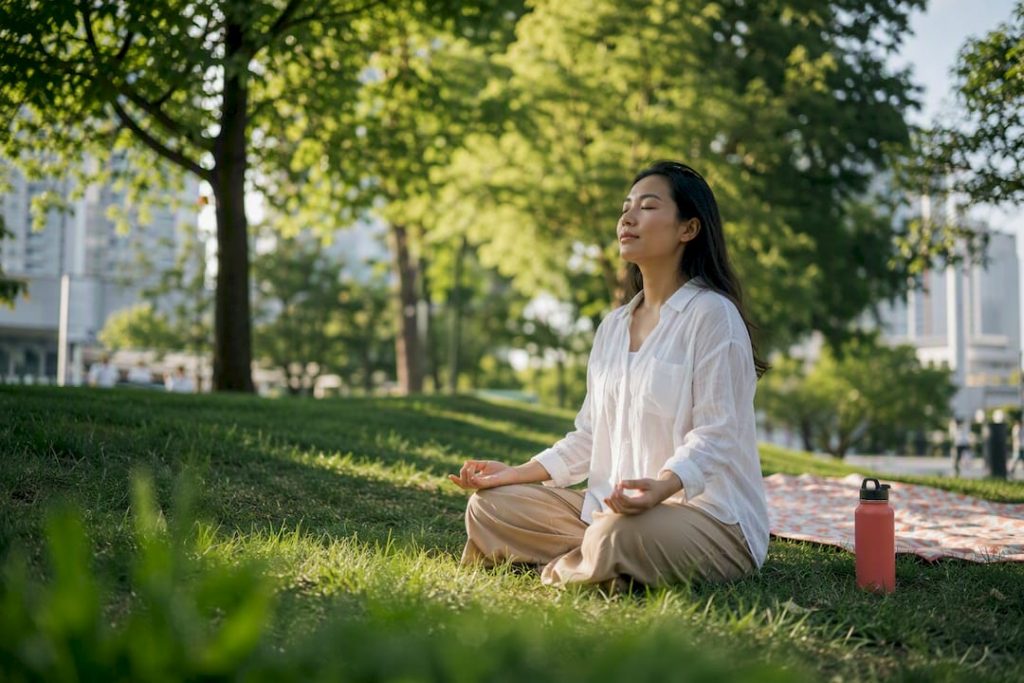
Discover effective stress management techniques you can fit into your busy schedule. Start feeling calmer and more balanced today!
Use timed breathing, short bouts of brisk movement, progressive muscle relaxation, and daily sleep and exercise habits to lower stress with proven techniques that work to stay consistent and effective.How to Manage Emotions: Proven Techniques That Work Start with a five minute breathing practice right now, and aim for 20 to 30 minutes of activity most days. These are the techniques with the strongest track record, and none of them require a retreat, an app subscription, or a free afternoon.
Here’s the checklist to work from:
- Timed breathing (box breathing or 4-6-8) for immediate calm, 2 to 5 minutes
- Brisk movement — a walk, stairs, or a few minutes of stretching to burn off cortisol
- Progressive muscle relaxation (PMR) worked lower body to upper body, 5 to 10 minutes
- Mindfulness or guided meditation, 5 minutes to start, building toward 20
- Sleep hygiene — a fixed wake time matters more than any single relaxation trick
- Exercise toward the CDC’s 150-minute weekly target, split into 20 to 30 minute blocks
- Social connection, even one honest conversation a day
- Journaling, one line on what triggered stress and what actually helped
None of these are one-time fixes. Stress management works the way strength training works: the payoff compounds with repetition, not intensity on day one.
Key Takeaways
Consistent daily practice of a small set of breathing, movement, and cognitive techniques reduces stress more reliably than occasional intense relaxation sessions.
| Point | Details |
|---|---|
| Start with breathing | Use box breathing or 4-6-8 breathing for 2 to 5 minutes during acute stress spikes. |
| Hit the weekly movement target | Break the CDC’s 150-minute weekly activity goal into 20 to 30 minute daily sessions. |
| Practice PMR in order | Work tension and release from feet to face, pausing 10 seconds after each release. |
| Journal for patterns, not venting | Log one trigger and one coping win nightly to build a personal playbook. |
| Know the red flags | Persistent panic, suicidal thoughts, or rising substance use mean it’s time to contact a professional. |
Table of Contents
- Quick Stress Management Techniques for Right Now
- What Daily Habits Actually Lower Your Baseline Stress?
- How Do You Practice Meditation, PMR, and Visualization Correctly?
- What Cognitive Tools Actually Change How Stress Feels?
- How Do You Build a Weekly Routine That Actually Sticks?
- When Does Stress Cross Into Something You Shouldn’t Manage Alone?
- Why Community and Support Networks Matter Beyond a Chat With a Friend
- An Editorial Take on What Actually Works
- Sources
Quick Stress Management Techniques for Right Now
When stress hits and you need relief in minutes, not weeks, three tools do the heavy lifting: breathing, grounding, and short movement. Here’s how to run each one.
1. Box breathing. Inhale for 4 seconds, hold for 4, exhale for 4, hold for 4. Repeat for four rounds. This pattern slows the heart rate and signals the nervous system to shift out of fight-or-flight, which is why tactical and clinical guides recommend it before high-pressure moments.
2. The 4-6-8 breath. Inhale for 4 seconds, hold for 6, exhale slowly for 8. The longer exhale is the active ingredient. It activates the vagus nerve more than the inhale does, which is why this version works well right before sleep.
3. Grounding, the 5-4-3-2-1 method. Name 5 things you see, 4 you can touch, 3 you hear, 2 you smell, 1 you taste. It interrupts spiraling thoughts by forcing the brain to process concrete sensory input instead of the anxious loop.
4. Emergency PMR. Full-body versions take 10 minutes, but the emergency version takes two: clench your fists and shoulders for 5 seconds, release for 15 and notice the contrast, then do the same with your jaw and forehead.
Use breathing when your mind is racing but your body is still. Use grounding when you feel detached or panicky. Use a short walk or stair climb when the stress is physical restlessness that breathing alone won’t burn off.

Pro Tip: If you have a history of panic attacks or a respiratory condition like asthma, skip breath-holding patterns and stick to slow, even breathing without pauses. Forced breath control can trigger dizziness or a panic response in some people, so the Mayo Clinic’s guidance on relaxation techniques is worth reading before you commit to any single method.
What Daily Habits Actually Lower Your Baseline Stress?
The techniques above handle spikes. Your baseline stress level, the resting hum you feel most days, comes down to four habits: movement, sleep, food, and people.
Movement doesn’t need a gym membership. The CDC’s target of 150 minutes of physical activity per week breaks down to just over 20 minutes a day, and it doesn’t need to happen in one block. A couple of short walks throughout the day can effectively meet activity goals. Parking farther from the entrance, taking stairs, or turning a phone call into a walking call all count.
Sleep is the habit most people sabotage without noticing. Three rules matter more than the rest combined:
- Wake up at the same time every day, weekends included; your wake time anchors your whole circadian rhythm
- Cut caffeine after early afternoon since it has a half-life of several hours
- Turn off screens 30 to 60 minutes before bed, since blue light delays melatonin release
Nutrition doesn’t require a diet overhaul. Blood sugar swings from skipped meals or heavy sugar intake spike cortisol, then crash it, which mimics and amplifies stress symptoms. Balanced meals with protein and fiber blunt that swing. Alcohol is worth watching too. It feels relaxing in the moment but fragments sleep later that night, so the calming effect is a loan you repay with interest.
Social time is the habit people cut first when busy, and it’s the wrong one to cut. The APA’s guidance on healthy coping lists social support as one of the most consistent buffers against chronic stress. That doesn’t mean a night out. It can mean a 10-minute call with a friend or, as our piece on how animals help us cope covers, even time with a pet measurably lowers stress hormones.
Small, boring, repeated choices beat occasional heroic ones. That’s the actual mechanism behind baseline stress reduction.
How Do You Practice Meditation, PMR, and Visualization Correctly?
Relaxation techniques fail for most beginners not because the techniques don’t work, but because people try the 20-minute version on day one, get bored or frustrated, and quit. Start smaller.
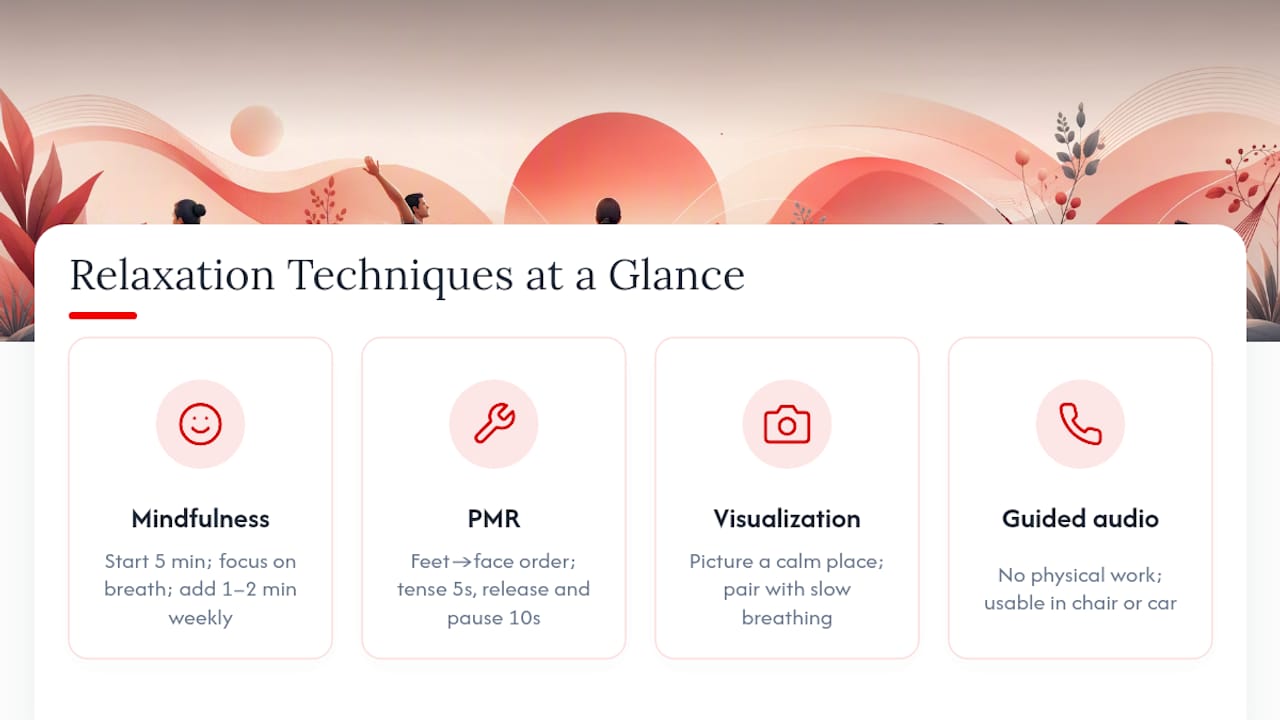
1. Mindfulness meditation, the 5-minute starter. Sit upright, close your eyes, and just notice your breath without changing it. When your mind wanders (it will, repeatedly), gently return attention to the breath. That’s the entire practice. Harvard Health’s overview of relaxation techniques frames this return to focus, not the absence of distraction, as the actual skill being built. Add a minute or two each week until you reach 15 to 20 minutes.
2. Progressive muscle relaxation, done in order. Start at your feet and work upward: feet, calves, thighs, abdomen, hands, arms, shoulders, face. Tense each muscle group for 5 seconds, then release and pause for at least 10 seconds to actually notice the contrast. Rushing the release phase is the single biggest mistake people make with PMR, since the release is where the relaxation response actually happens, not the tension.
3. Visualization paired with breathing. Picture a specific calm place in detail (temperature, sounds, light) while breathing slowly. Pairing a mental image with a physical rhythm makes the visualization stick better than imagery alone.
4. Choosing between yoga, tai chi, and guided audio. Yoga suits people who want a physical workout layered with breathwork. Tai chi suits people with joint pain or limited mobility, since it’s low-impact and slow. Guided audio meditation suits anyone who wants zero physical component and can be done in a chair, in a car, or during a break.
Pro Tip: Don’t try to master all four in one week. Pick the one that matches your current energy level and mobility, run it daily for two weeks, then add a second.
What Cognitive Tools Actually Change How Stress Feels?
Breathing calms the body. Cognitive tools change the thought loop that keeps triggering the body’s stress response in the first place. Three of them are worth learning by heart.
- The three-step reframe: notice the automatic thought (“I’m going to fail this”), test the evidence (“What’s actually happened so far? What’s the realistic worst case?”), then build a balanced alternative (“This is hard, and I’ve handled hard things before”).
- Acceptance versus action: ask whether the stressor is something you can change. If yes, take one small concrete step today. If no, redirect energy toward acceptance instead of rumination, a distinction MedlinePlus frames as central to reducing unnecessary suffering.
- A quick problem-solving checklist: define the actual problem in one sentence, list three possible responses, pick the least-bad option, and act on it today rather than waiting for a perfect solution.
- Journaling that works: skip freeform venting and log two things nightly, what triggered stress and what coping step actually helped. That structure builds a personal playbook over time instead of just rehashing the day’s frustrations.
Reframing and journaling both work better as five-minute daily habits than as occasional deep-dive sessions.
How Do You Build a Weekly Routine That Actually Sticks?
The techniques above only pay off with repetition, so the real question is how to build a week you’ll actually follow.
Beginner: 5-minute breathing on waking, a 20-minute walk after dinner, 10-minute PMR before bed three nights a week.
Busy professional: 5-minute breathing on waking, two 20-minute brisk walks split across lunch and after work, 10-minute PMR before bed, and a one-line nightly journal entry on triggers and wins.
Parent with limited free time: breathing exercises during the school drop-off drive, a 15-minute walk during a child’s activity or nap, PMR done in bed right before sleep.
To keep any of these going:
- Stack habits onto existing routines — do breathing while coffee brews, not as a separate calendar event.
- Use a cue-routine-reward loop — pick a fixed trigger (waking up, parking the car) and attach the technique to it.
- Track loosely, not obsessively — a checkmark on a calendar is enough; a missed app streak that shames you into quitting defeats the purpose.
- Expect to adjust the plan — the most common failure isn’t laziness, it’s rigidity. If PMR before bed keeps getting skipped, move it to right after your evening walk instead of abandoning it.
When Does Stress Cross Into Something You Shouldn’t Manage Alone?
Self-directed techniques handle everyday stress well. They aren’t built for certain warning signs, and pretending otherwise delays real help.
Seek professional support if you notice:
- Persistent panic attacks or physical symptoms that don’t ease with rest
- Any thoughts of suicide or self-harm, which need immediate attention
- Substance use increasing as a coping method
- Stress that’s blocking work, relationships, or basic daily function for weeks, not days
A first therapy session usually starts with an assessment of your history and symptoms, sometimes followed by brief cognitive behavioral techniques or, where appropriate, a referral for medication. Bring a rough timeline of when symptoms started and what’s already been tried. Health Canada’s guidance on coping with stress is a solid starting point for understanding publicly available options, and our broader guide to mental wellbeing covers how to weigh public versus private care. If you’re in crisis, contact your local emergency services or a crisis line immediately rather than waiting for a scheduled appointment.
How Our Team at Lizard’s Lunch Vetted These Techniques
Our team at Lizard’s Lunch reviewed guidance from the CDC, the APA, the Mayo Clinic, Harvard Health, StatPearls, and Health Canada to prioritize techniques with clear, repeatable steps rather than vague advice to “relax more.”
Multi-modal approaches combining lifestyle changes, relaxation techniques, and psychological therapies show the strongest support in clinical overviews of stress management, which is why this guide never leans on a single tactic.
One caveat worth repeating: trauma survivors should talk with a clinician before starting some relaxation techniques, since body-focused practices like PMR or breath work can occasionally surface difficult sensations rather than calm them.
Why Community and Support Networks Matter Beyond a Chat With a Friend
Social connection reduces stress, but community engagement does something a single conversation doesn’t: it gives you a recurring structure that doesn’t depend on your motivation that day. A weekly group, whether it’s a running club, a volunteer shift, or a recurring game night, puts a stress-reducing activity on the calendar before stress even shows up.
Group settings also add a layer individual coping tools can’t replicate: mutual accountability. Showing up for others makes it harder to skip the activity on a bad week, which is exactly the week you need it most. Volunteering carries a second benefit worth naming directly. It shifts focus outward, away from your own stress loop, which several stress researchers describe as one of the more reliable mood buffers available. Even loose-tie communities, a recurring class, a hobby meetup, a religious or cultural group, contribute measurable resilience because they offer predictable, low-effort belonging.
If your current routine is entirely solitary, the fastest fix isn’t finding a best friend. It’s finding one recurring group activity, even a low-stakes one, and treating it as non-negotiable for a month.
An Editorial Take on What Actually Works
Most stress advice oversells complexity. Meditation apps, elaborate journaling systems, and hour-long yoga routines all work, but they also carry a hidden cost: they’re easy to abandon the first busy week. The techniques with the best evidence, timed breathing, short brisk movement, and consistent sleep, are also the least glamorous, which is probably why they get less attention than they deserve.
Where conventional advice falls short is in treating every technique as equally important. It isn’t. A five-minute breathing practice done daily beats an hour of yoga done twice a month, and busy readers should stop feeling guilty about skipping the elaborate version. Prioritize the two-minute techniques first, build them into things you already do, and only add the longer practices once the short ones are automatic. That order, small and consistent before long and occasional, is the actual difference between a routine that lasts and one that quietly disappears by February.
If your stress load is tied to a home environment that feels chaotic or cramped, that physical disorganization compounds daily tension in ways people underestimate. Our home improvement guides cover practical ways to make a living space feel calmer, which is a smaller lift than most people assume.
— Alexander
This article is general information, not a substitute for advice from a qualified doctor. Consult a qualified healthcare professional about your own circumstances before acting on anything here.















Leave a Comment
Your email address will not be published. Required fields are marked with *