

Discover why overpacking is a problem and learn simple tips to travel lighter, save money, and enhance your trip experience.
Overpacking makes trips harder, costlier, less safe, and less enjoyable — and the fix is simpler than you think. Pack by outfits instead of individual items, leave roughly 20% of your bag empty, and apply a structured editing rule, like the 5-4-3-2-1 method (5 tops, 4 bottoms, 3 shoes, 2 accessories, 1 formal option) to force honest decisions before you zip up. Checked-bag fees at most U.S. carriers start at moderate amounts per bag, and overweight charges can add additional costs. TSA screening slows down when carry-ons are dense and disorganized. Lighter bags mean faster movement, fewer fees, and a clearer head from the moment you leave home.
- Pack by outfits: Lay out complete looks, not loose items.
- Leave ~20% empty: Space for purchases, laundry returns, and flexibility.
- Apply a packing rule: The 5-4-3-2-1 system is a reliable starting point.
- Weigh before you go: A small digital luggage scale costs under $15 and saves you from surprise fees at the counter.
Pro Tip: Before your next trip, pack your bag completely, then remove three items you added “just in case.” You will almost never miss them.
Table of Contents
- What counts as overpacking, exactly?
- Why your brain keeps telling you to pack more
- The real costs of overpacking: money, mobility, time, health, and the environment
- How to stop overpacking: a step-by-step system that actually works
- Tools and micro-habits that make lighter packing stick
- What research and expert reporting say about overpacking’s hidden costs
- Key Takeaways
What counts as overpacking, exactly?
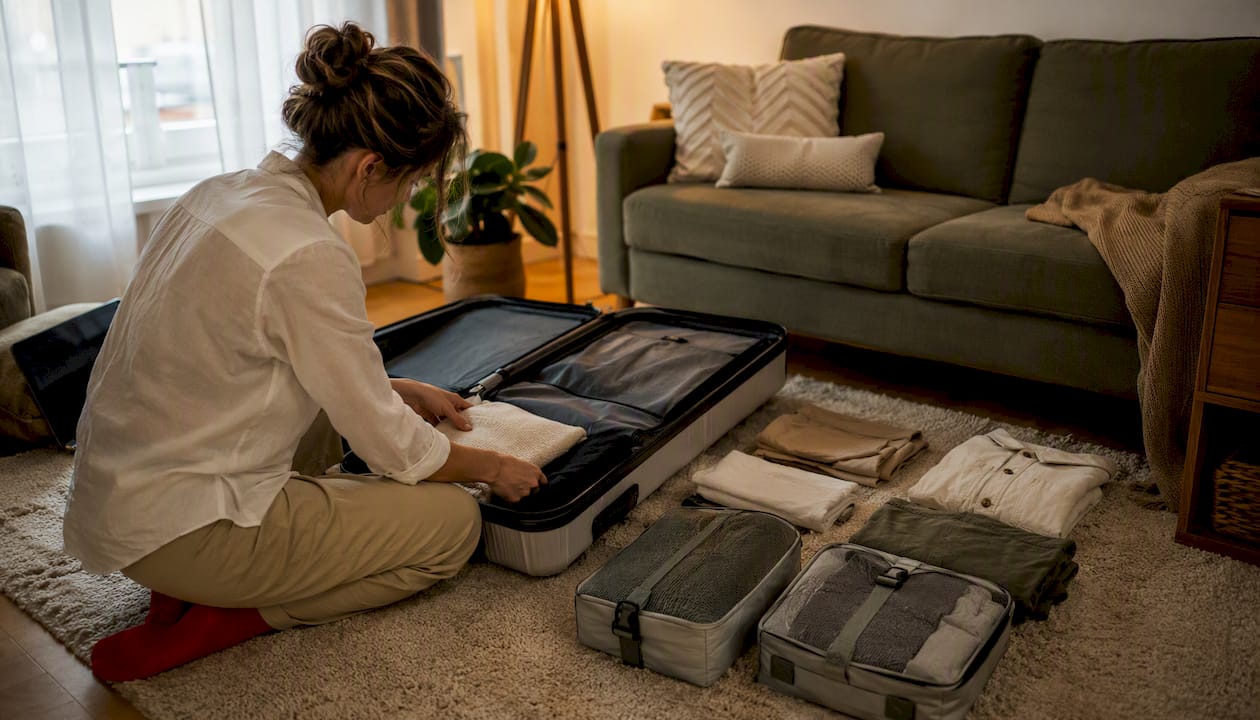
Overpacking is not about having a full bag. It means packing substantially more items or weight than your trip’s actual activities, duration, climate, and access to stores genuinely require. The key word is substantially. One extra shirt is insurance. Packing many extra shirts for a short trip is overpacking.
A few reliable signs you have crossed the line:
- You packed more shoes than typically needed for the length of your trip.
- You returned home with a significant portion of your clothing unworn.
- You struggled to stay under your airline’s weight limit.
- You added items with the phrase “just in case” more than twice.
The contrast becomes clear with two quick examples. A weekend city trip to Chicago in spring calls for two or three outfit combinations, one versatile pair of shoes, and a light layer. A seven-day beach trip to Florida adds swimwear and sandals but still does not require seven separate outfits — quick-dry fabrics and one laundry cycle cut that number in half. The moment your bag contains items for a version of the trip that probably will not happen, you are overpacking.
Why your brain keeps telling you to pack more
Overpacking is rarely a planning failure. Psychologists describe it as an anxiety-management strategy — a way to feel prepared and in control when travel introduces uncertainty. Once you recognize the mental pattern driving it, you can choose the right countermeasure instead of just trying harder to pack less.
The most common psychological drivers:
- Intolerance of uncertainty: Packing for every scenario feels like eliminating risk. It is not, but the brain treats it that way.
- Catastrophizing: One past trip where you forgot something becomes a vivid memory that overrides the dozens of trips where you had everything you needed.
- Availability heuristic: Memorable mishaps (a cold snap, a spilled drink) loom larger than base rates, so you pack for rare events as if they were likely.
- Aspirational packing: You pack for a version of yourself who will work out every morning, attend a formal dinner, and hike a mountain — even when the itinerary shows none of that.
The practical takeaway: identify your driver and match it with a system. If you catastrophize, keep a digital log of what you actually used on past trips — real data beats vivid memory every time. If you pack aspirationally, write your actual daily itinerary first and pack only for those specific activities.
The real costs of overpacking: money, mobility, time, health, and the environment
Overpacking creates identifiable costs across five buckets. None of them are trivial, and most are avoidable.
| Harm Category | What It Costs You |
|---|---|
| Money | Checked-bag fees ($35–$70 per bag), overweight charges, pricier transport choices when you cannot manage stairs or public transit |
| Mobility | Slower walking pace, inability to use escalators, stairs, or buses; restricted agility in crowded spaces |
| Time | Longer check-in lines, extended TSA screening, extra baggage-claim waits, slower hotel check-in when you are hauling multiple bags |
| Health & Safety | Musculoskeletal strain from heavy lifting, increased fall and injury risk on hikes, reduced agility in emergencies |
| Environment | Heavier aircraft and vehicles burn more fuel per passenger; excess weight compounds across millions of trips |
On the money side, the fees add up fast. A round trip with one checked bag can cost a substantial amount before you have bought a single meal. Add an overweight charge for a bag above 50 lbs and that number climbs quickly. Travelers who stay carry-on only avoid all of it.
The health risk is underreported. Carrying too much weight on hikes increases the risk of exhaustion, slowed decision-making, and falls. The same principle applies in airports and cities — a heavy rolling bag on cobblestones or a packed backpack on a long walking day creates real physical strain. Heavy luggage injuries are documented in emergency room data, and the strain is cumulative across a multi-day trip.
Screening slowdown: Dense, disorganized carry-ons are reported to be up to 10 times more likely to be pulled for manual secondary screening because X-ray operators cannot read the contents clearly. That costs you time and can force you to discard items on the spot.
The environmental angle is less dramatic but real. Heavier bags mean heavier planes and cars, which burn more fuel. Across a year of travel, the cumulative impact of consistently lighter packing is meaningful — especially on short-haul flights where fuel burn per mile is highest.
How to stop overpacking: a step-by-step system that actually works
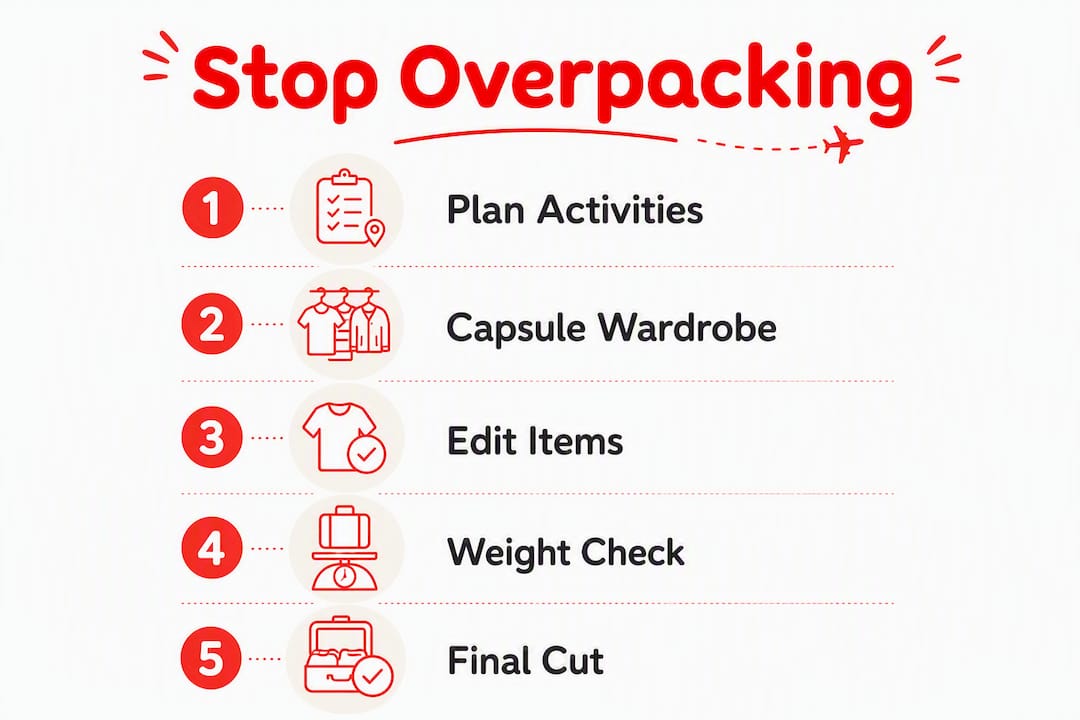
The core principle: plan by activities and outfits, not by “what if” scenarios. Roughly 40% of travelers return home with unworn clothes — proof that most “just in case” items never get touched. A repeatable system fixes this permanently.
Step 1: Define your trip activities first.
Write down what you will actually do each day. Check whether your destination has laundry facilities, pharmacies, and stores. If you can buy or wash it there, you do not need to pack it.
Step 2: Build a capsule wardrobe around those activities.
Choose a neutral color palette so every piece mixes with every other. Three bottoms and five tops in complementary colors create more outfit combinations than ten random items. For versatile outfit building, think in terms of layers and multipurpose pieces rather than single-use items.
Step 3: Apply an editing rule.
The 5-4-3-2-1 rule is a reliable framework. The 20% empty-space rule is equally useful — if your bag is stuffed to the zipper, you have packed too much. Leave room for a purchase, a souvenir, or a wet swimsuit.
Step 4: Do a weight and volume test.
Lift the bag. If you cannot comfortably carry it for ten minutes, it is too heavy. Weigh it with a digital scale before leaving home.
Step 5: Re-edit the night before.
Remove three items. You will almost certainly not miss them.
Quick packing templates by trip length
3-day trip: 3 tops, 2 bottoms, 1 versatile shoe, 1 light layer, minimal toiletries in a quart bag. Total: fits a personal item or small carry-on.
5-day trip: 4 tops, 3 bottoms, 2 shoes (one casual, one active or dressy), 1 layer, travel-size toiletries, one laundry pod for a mid-trip wash. Total: carry-on size.
7-day trip: 5 tops, 3 bottoms, 2 shoes, 1 layer, full toiletries kit, laundry plan for day 4. Total: carry-on plus personal item, no checked bag needed.
For family travel or special equipment: Camera gear, formal wear, and medical supplies are legitimate reasons to add weight. Ship non-essential items ahead via USPS or FedEx, use modular gear that serves multiple purposes, and carry critical items (medication, chargers, camera bodies) in your personal item rather than checked luggage.
Tools and micro-habits that make lighter packing stick
Small choices compound into big reductions. The right tools remove friction; the right habits prevent backsliding.
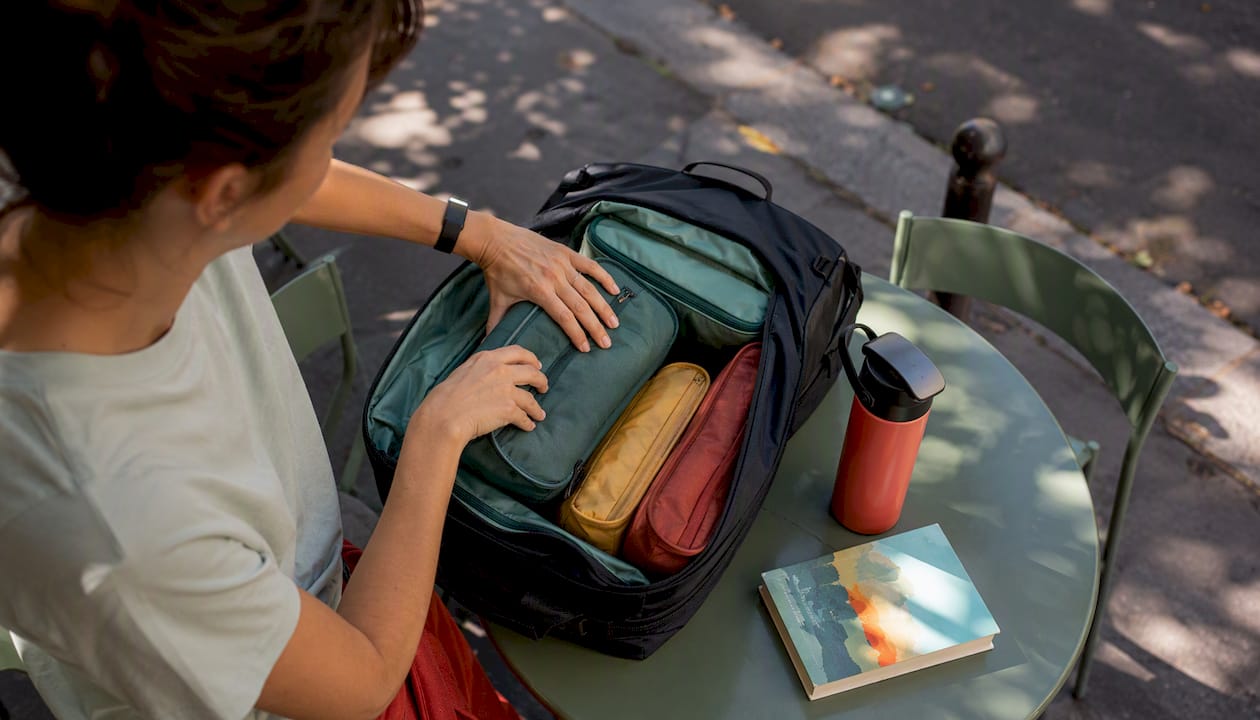
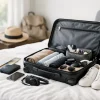
Packing cubes are the single most useful organizational tool. They compress clothing slightly, keep categories separated, and make repacking at each hotel fast. They do not reduce weight, but they make the contents of your bag visible and honest — you can see exactly how much you have packed.
A portable digital luggage scale ($10–$15 at most travel retailers) eliminates the guesswork. Weigh your bag at home, not at the check-in counter.
Travel laundry soap sheets (brands like Scrubba or Sea to Summit make compact options) let you wash clothes in a sink. One small packet replaces two or three days of extra clothing.
A portable clothesline weighs almost nothing and dries clothes overnight in any hotel room.
On compression bags: they reduce volume but can increase weight density, which means carry-on travelers can accidentally exceed weight limits because compressed items pack more mass into smaller visual space. Use them for checked bags where volume is the constraint, not for carry-ons where weight is the limit.
Weight placement matters too. Place heavy items centrally in your suitcase, not at the bottom. Central placement keeps the bag balanced, prevents tipping, and reduces the strain on your wrist and shoulder when you lift it. In a backpack, heavy items go closest to your back and high in the pack.
Pro Tip: After every trip, open a notes app and record exactly which items you used and which you did not. Three trips of honest data will transform how you pack — real records beat vivid memories of that one time you needed an umbrella.
When packing extra actually makes sense
Overpacking is a problem in most situations, but there are legitimate exceptions. The rule: extra weight is justified when you cannot replace the item locally, it is critical for your safety or income, and no compact alternative exists.
Reasonable cases for packing more:
- Medical supplies: Prescription medications, specialized equipment, or allergy treatments that are not available at your destination.
- Professional equipment: Camera systems, audio gear, or tools required for paid work that cannot be rented locally.
- Remote or wilderness travel: Locations with no resupply options within a day’s travel genuinely require more self-sufficiency.
- Extreme climate travel: Cold-weather destinations where layering systems are bulky by necessity.
When you must accept extra weight, mitigate the downsides:
- Ship non-essential items ahead via a postal or courier service.
- Use ergonomic luggage with quality wheels and padded straps to reduce physical strain.
- Carry the heaviest critical items in your personal item or on your person during transit.
- Consider travel insurance that covers lost or delayed checked bags when you have no choice but to check expensive gear.
What research and expert reporting say about overpacking’s hidden costs
The cognitive costs of overpacking are as real as the physical ones. Overpacking creates mental overhead that depletes cognitive resources and keeps travelers in a low-level state of vigilance — managing, tracking, and worrying about their belongings rather than engaging with the destination. That mental load is invisible but cumulative across a multi-day trip.
The TSA screening data point is striking. Dense, disorganized carry-ons are reported to be up to 10 times more likely to be pulled for manual secondary screening — a direct time cost that most travelers never connect to their packing choices. A bag that is organized and not overstuffed reads more clearly on an X-ray and moves through the checkpoint more smoothly.
On the physical side, hiking and field safety reporting consistently links heavier packs to higher injury rates, faster exhaustion, and degraded decision-making. A traveler slowed by a 40-lb bag on a cobblestone street faces the same basic physics as a hiker slowed by an overloaded pack on a trail — reduced agility, higher fall risk, and faster fatigue. For active travel, lighter packing is a safety decision, not just a comfort preference.
A concrete scenario: a traveler with a dense, overstuffed carry-on gets flagged at a TSA checkpoint. The bag is pulled for manual inspection, a prohibited item (a forgotten full-size shampoo bottle buried under compressed clothing) is found, and the traveler misses their boarding window. The same trip with an organized, lightly packed carry-on clears the checkpoint in under two minutes. The difference is not luck — it is preparation.
For a deeper look at how to build a minimalist packing system that prevents these situations from the start, the full guide covers templates, gear picks, and the mindset shift that makes lighter packing feel natural rather than restrictive.
Key Takeaways
Overpacking is a solvable problem rooted in anxiety and habit, and fixing it with a repeatable system saves you money, time, physical strain, and mental energy on every trip.
| Point | Details |
|---|---|
| Psychology drives overpacking | Anxiety and the need for control, not poor planning, cause most overpacking — identify your trigger to fix it. |
| Five harm buckets | Overpacking costs you money, mobility, time, physical health, and contributes to environmental impact. |
| Use a packing rule | The 5-4-3-2-1 rule and the 20% empty-space rule are two reliable frameworks that force honest editing. |
| Track what you actually use | A digital packing log of used vs. unused items from past trips is the most effective long-term fix. |
| Exceptions exist | Medical, professional, and remote travel needs can justify extra weight — mitigate with shipping ahead and ergonomic gear. |
The lighter-bag mindset: a note from our team
Our team at Lizard’s Lunch uses outfit planning, a 20% empty-space rule, and a digital packing log on every trip. The log took about five minutes to start — just a note in a phone app listing what got used and what came home untouched. After three trips, the patterns were obvious: the “just in case” jacket never came out, the third pair of shoes stayed in the bag, and the backup charger cable was redundant. That data made the next pack dramatically lighter.
Two moments stand out. On a trip to Rome, traveling with a carry-on only meant taking the stairs at a metro station without a second thought — no elevator hunt, no waiting, no wrestling a heavy bag up narrow steps. On a domestic flight, skipping the checked bag saved $70 in fees and 25 minutes at baggage claim. Neither outcome required sacrifice; both required a system applied the night before departure.
Packing lighter is a skill, not a personality type. It gets easier with every trip, especially once you have real data showing that the items you agonized over leaving behind were never needed. Start small: pack your next trip, weigh the bag, remove three items, and see what happens. The bag will be fine. The trip will be better.
Sources worth reading
- An Expert Look at the Reasons Why Travelers Overpack — AFAR’s psychology-focused piece with expert quotes on anxiety and control as the root causes of overpacking.
- How to Not Overpack (Wirecutter) — Practical guidance on compression tradeoffs, weight placement, and ergonomic packing from a trusted product-review source.
- Overpacking Suitcase TSA Mistake (The Kitchn) — Reports the screening risk from dense carry-ons and the time cost of secondary inspection.
- Packing Tips (USA Today) — Travel columnist advice on the 20% empty-space rule and minimalist strategies from mainstream travel journalism.















Leave a Comment
Your email address will not be published. Required fields are marked with *